
Land fund problems, complicated procedures
The actual implementation of social housing in the North Central provinces shows that the land fund for social housing is not yet synchronous, many localities are still sluggish in preparing resources.
Responding to the media, Ms. Pham Thi Mien - Deputy Director of the Vietnam Real Estate Market Research and Evaluation Institute (VARS IRE) - pointed out that the lack of priority for land allocation has caused supply to always "Change" demand, especially in localities with rapid urbanization and localities merging provinces.
In Hue City, the locality has approved the investment policy and implemented 13 social housing projects. However, according to the assessment, businesses have not yet prioritized investing in social housing due to low profits, unattractive incentives, many and complicated procedures.
Mr. Hoang Hai Minh - Vice Chairman of Hue City People's Committee - admitted that social housing projects in the area have not yet received strong attention from investors. The main reason is that support policies and incentives in general have not created enough attraction for businesses to divest.
To resolve this issue, Hue City has issued a resolution regulating the mechanism to support social housing projects. The city plans to support 30% of technical infrastructure costs, up to a maximum of VND 7 billion/project, to stimulate and share investment costs with businesses.
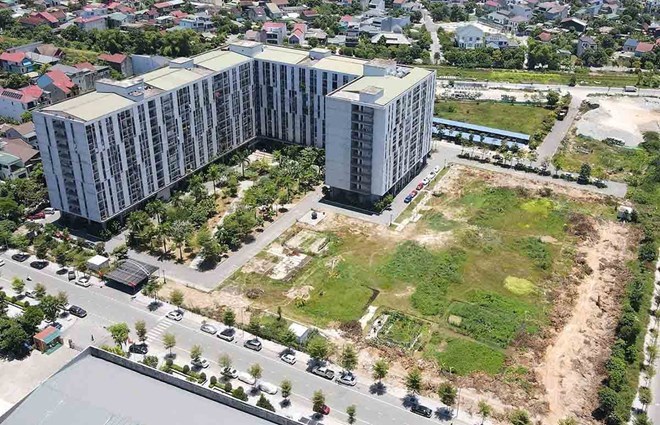
In Ha Tinh, despite being assigned a target of developing 3,700 social housing units in the 2021 - 2030 period and having arranged land funds, many projects have not been able to start construction due to prolonged procedures.
According to the People's Committee of Ha Tinh province, the biggest problems at present include: Difficulties in determining investment policies and construction licensing; Prolonged site clearance; Lack of methods to determine selling prices for transition projects; Unagreed arrangement of land funds for building workers' accommodation in industrial parks.
Talking to Lao Dong, an investor implementing a social housing project in Thanh Hoa said that businesses are not interested in social housing because of low profits and high risks, while loan procedures and determining home buyers are too complicated. This is the reason why many businesses "sell" social housing and prioritize commercial projects.
Credit is hard to access
In an analysis published in the Journal of Economics and Forecasting of the Ministry of Planning and Investment, Dr. Le Dang Minh (Saigon University of Technology) pointed out that the barriers to developing social housing are that many localities have not proactively arranged clean land funds according to the regulation of 20% of land in commercial projects. The approval procedure takes 1-2 years, making businesses hesitant;
Although there is a preferential credit package, loan conditions are still complicated, interest rates are still high compared to the ability of low-income people. Enterprises developing social housing often only achieve 8% - 10% profit, much lower than commercial real estate;
The approval mechanism is still overlapping, the procedures for proving income and housing are complicated. This makes it difficult for many people with real needs to access, while some cases may benefit from the "procedural relationship".
The above scientific conclusions are also true in the North Central region. In Ha Tinh, although the province aims to start construction of 488 more units in 2025, investment procedures, approval, and site clearance are still "working problems", leading to slow progress.
In addition, compared to the income of people in the North Central region, the price of social housing apartments, although lower than commercial housing, is still higher than income.
In Thanh Hoa City (old), a social housing apartment with an area of 5565m2 costing 800 million - 1.1 billion VND is a high level compared to the income of the majority of workers and laborers.
Some social housing projects with good locations and construction quality, although the starting price is lower than that of commercial banks, when a secondary market is formed (buy and resell), the price is increased, and low-income people have almost no access.
Meanwhile, projects with softer prices are located far from the center, with weak infrastructure and inconvenient transportation, making people afraid of living longer.
This reality leads to a situation where the same locality as Thanh Hoa has a vibrant transaction project, but many other projects are in disrepair, investors are worried about not being able to sell.
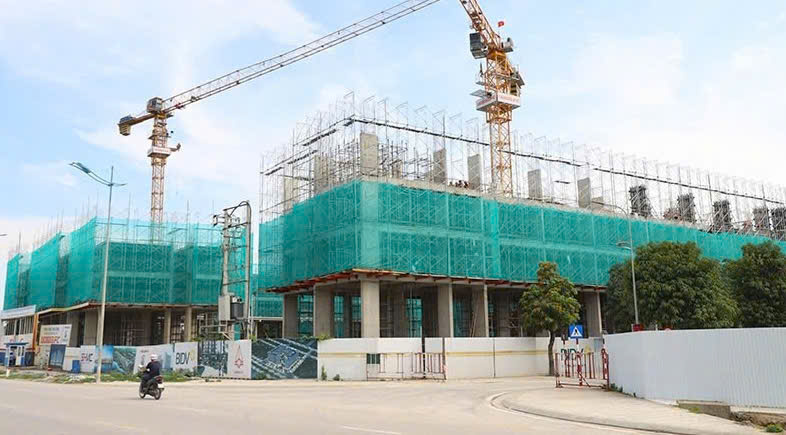
How to get social housing to those in need? Experts, managers and businesses all agree that it is necessary to synchronously deploy solutions: Clear land fund planning - prioritizing social housing from the beginning. Obligate urban projects, residential areas, and industrial parks to reserve at least 20% of their land fund for social housing. Publicly announce the location and area of social housing land to avoid the situation of "packaged planning".
Attractive enough incentive policies for investors such as exemption of land use fees, support for site clearance, and sharing of infrastructure costs. Simplify preferential credit packages; lend long-term to businesses with stable interest rates.
Shorten procedures, make legal transparency, and implement the "one-stop, one-stop" mechanism from policy approval to construction licensing.
In Thanh Hoa, the regular meetings between the investor - Department of Construction - provincial leaders have helped speed up progress and promptly remove obstacles.
Thanh Hoa is also a locality that has publicized the list of social housing buyers on the website of the Department of Construction and the Provincial People's Committee has issued regulations prohibiting sale at a higher price, diplomatic quotas, and strictly handling violations.
Putting social housing in conjunction with industrial park infrastructure and social institutions is the only way to attract buyers. Building social housing is for low-income people to have a house, not just to finish building it... just leave it there.
The reality in the North Central region shows that: any locality that is proactive, determined, and accompanies businesses will have a smooth implementation of social housing projects. On the contrary, in places where it is "difficult to do", working half the time, low-income people still have to wait.


