
Recommendations stemming from production practice
At the conference summarizing 15 years of implementing Resolution 6B/NQ-BCH and Directive 03/CT-TLĐLĐ on female labor work organized by the Da Nang City Labor Federation recently, the grassroots Trade Union of 29/3 Textile and Garment Joint Stock Company had a noteworthy presentation on the implementation of policies for female workers according to the current Labor Code.
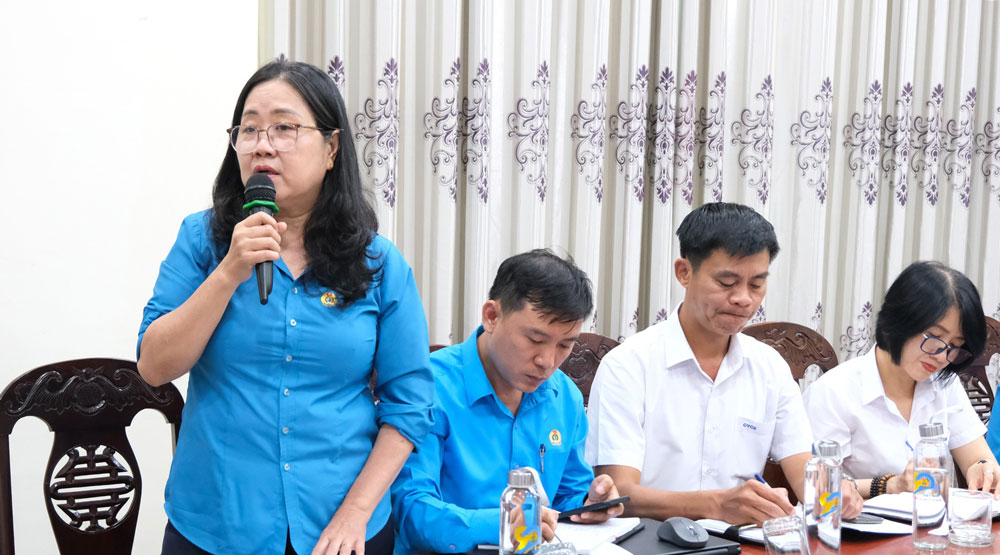
According to Ms. Le Thi Hai Chau - Chairwoman of the Trade Union of 29/3 Textile and Garment Joint Stock Company, female workers currently play a very important role in the textile, garment, footwear, electronics and service industries. In the textile and garment industry alone, female workers account for a large proportion, directly contributing to the productivity and sustainable development of enterprises.
In recent years, many policies related to female workers have been implemented such as maternity leave, prenatal check-up leave, support for raising young children, leave during menstruation, periodic health check-ups or labor safety policies.
At 29/3 Textile and Garment Joint Stock Company, the enterprise has implemented many care regimes for female workers such as signing stable labor contracts, paying full insurance, supporting lunch, professional bonuses, supporting raising young children, periodic health checks, arranging separate parking areas for pregnant female workers, reducing working hours for people raising children under 12 months old...
However, from practical implementation, grassroots trade unions believe that there are still many regulations that need to be studied and adjusted to better suit the current context.
One of the proposed contents is to stipulate a 30-minute/day break during menstruation. According to the presentation, the retirement age of female workers is gradually increasing according to a roadmap, while many women over 47 years old have entered pre-menopause or menopause, so they no longer need to use this regime.
From there, businesses propose that functional agencies study a more flexible mechanism, which may allow converting this leave time to health care forms suitable for each age group and the actual condition of female workers.
In addition, the grassroots trade union also proposed to expand the maternity leave regime. According to reports, throughout pregnancy, female workers today have to undergo many examinations, ultrasounds, and important tests to monitor the health of the mother and fetus, especially for workers working in high-pressure environments such as textiles and garments.
Therefore, the unit proposes to study increasing the prenatal check-up rest time to a maximum of 10 days throughout the entire pregnancy instead of a limit of 5 times as currently regulated.
Need more flexible and synchronous policies
Another content also mentioned is the adjustment of some objectives in Resolution 06b/NQ-TLĐ to suit the current population context.
According to Ms. Chau, previously the resolution set the goal of "each family only having 1 or 2 children". However, the current population policy has shifted to maintaining a reasonable birth rate and adapting to population aging. Many localities are currently encouraging having enough 2 children.
In addition to policies specifically for female workers, the issue of periodic health check-ups and health check-ups for the whole population is also of concern to businesses.
Representatives of the grassroots Trade Union of 29/3 Textile and Garment Joint Stock Company said that if there is no data linkage mechanism between health check-ups for the whole population and periodic health check-ups at enterprises, it is very easy to develop overlapping check-ups, increase administrative procedures, increase costs and put pressure on both businesses and employees.
According to Ms. Le Thi Hai Chau, female workers today really need substantive, flexible care policies suitable for each age group and specific working conditions. When policies are suitable for reality, workers will feel secure in sticking with businesses, and businesses will also be more convenient in organizing production.
From practical recommendations at the grassroots level, it can be seen that, along with the promulgation of policies, regular review and update to suit changes in working life is very necessary.
Because only when policies are close to reality, female workers will be truly listened to, protected and supported more effectively in the modern working environment.


