
The problem of lacking a place for students to practice AI
Many universities in Vietnam have implemented AI training at many levels. Some schools go further by establishing departments, institutes or AI centers. However, AI training in practice still faces a long-standing "bottleneck": the practical implementation and practice environment.
In most of the curriculum, students make projects with sample data, experimental models or simulated problems. Meanwhile, for an AI model to come into life, many factors are needed that the lecturer cannot easily meet: strong computing infrastructure, real data, implementation process and guidance from a team of experts with experience in developing AI in the market.
For example, 1 NVIDIA AI GPU has a unit price of up to 75,000 USD, while each standard lab room will need at least 4-5 GPUs, equivalent to billions of VND. With the available resources of schools, this is an "unfeasible" number. These factors show that having a first AI research space, solving AI practice problems for students is very necessary.
Schools cannot solve it alone
According to Resolution 57 of the Politburo on breakthroughs in science and technology, innovation and national digital transformation, Vietnam aims to be in the group of 3 leading countries in the field of AI research and development. Resolution 57 also sets out a strategic solution to mobilize social resources to solve the above-mentioned difficult problem: 3-house Cooperation Model (State - School - Enterprise).
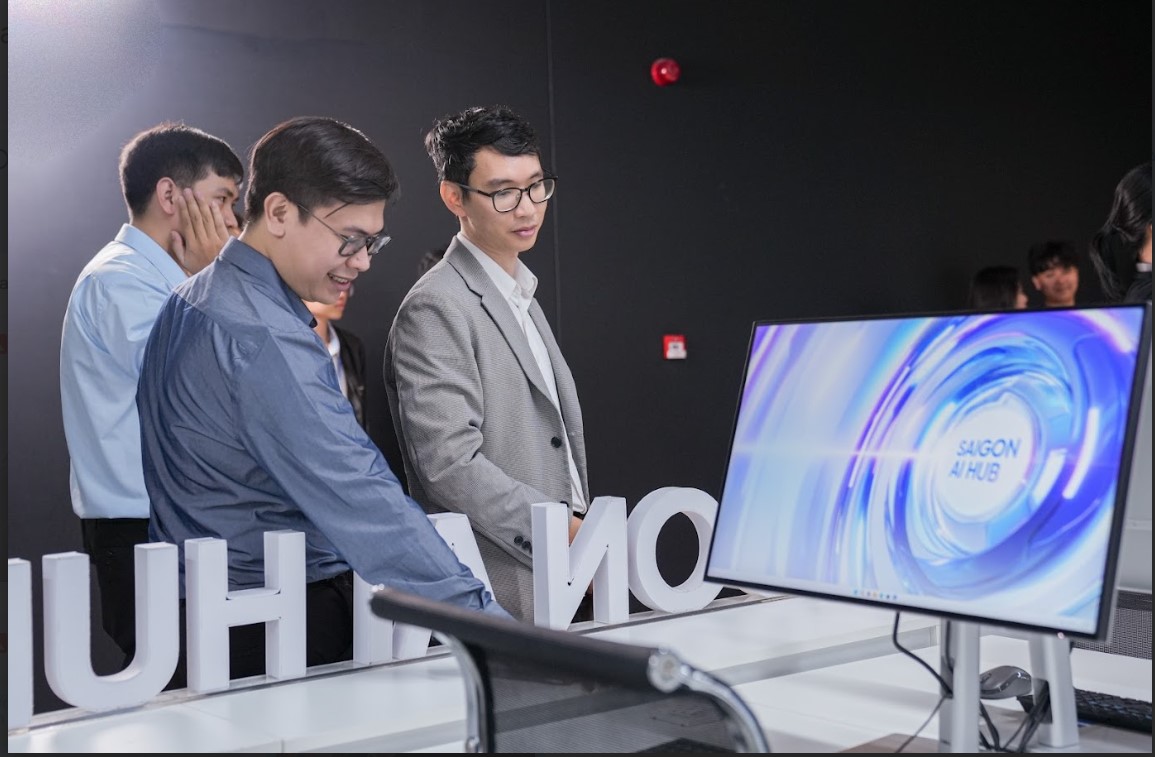
One of the most recent evidences for the effectiveness of this strategic model is Saigon AI Hub (SAIH), the first open space for AI research for students, lecturers, and young researchers in Ho Chi Minh City. Launched at the end of November at VNG campus and the result of cooperation between VNG Technology Group and Ho Chi Minh City National University, SAIH does not operate as a regular lab.
This place provides an R&D environment close to the enterprise: specialized computing infrastructure for AI, working space for the research team and the opportunity to directly connect with the team of engineers implementing commercialized AI projects in the market.
Associate Professor, Dr. Tran Minh Triet, Vice Principal of the University of Natural Sciences, representative of the SAIH Executive Board shared: The establishment of SAIH helps build a community where scientists and technology experts in businesses and in schools can truly cooperate, develop ideas together and bring solutions closer to reality.
We hope that in the coming time, we will further promote scientific publications at prestigious conferences, build experimental versions (POCs) that can be applied in life, and develop effective solutions to contribute to solving problems of society.
According to the first phase of the operation plan, Saigon AI Hub aims to attract about 30 young research groups to work directly on the computing infrastructure. The groups are encouraged to solve problems related to socio-economic reality, prioritizing the fields of health, education, transportation and public services.


