
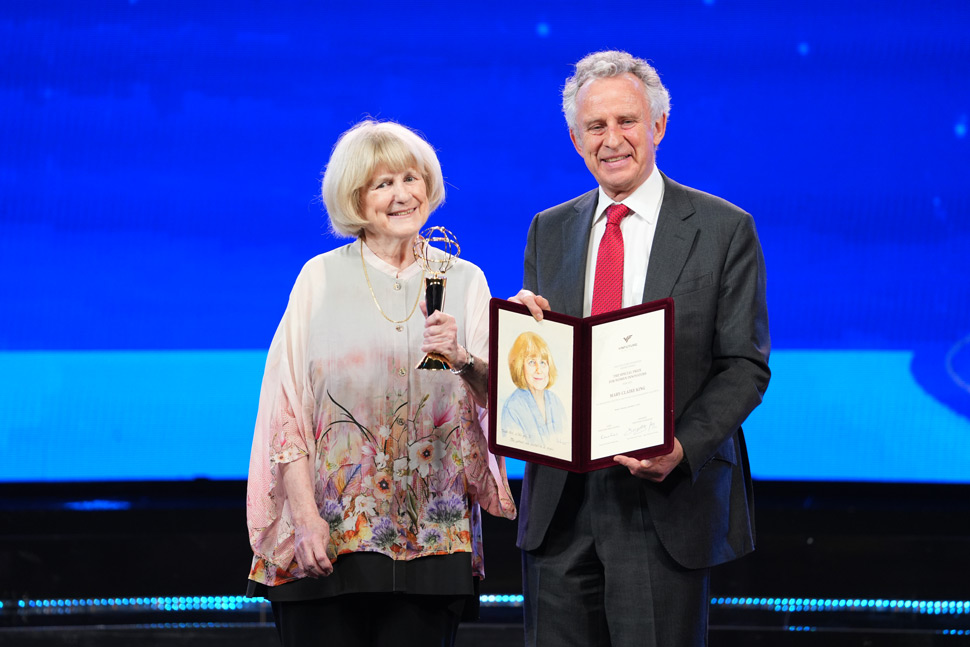
Professor Mary-Claire King is a geneticist at the University of Washington, Seattle, USA. She was born and raised in Chicago, received her Bachelor's degree in Mathematics from Carleton College, her PhD in Genetics from the University of California, Berkeley, and completed her post-doctoral research program at the University of California, San Francisco.
She was a professor at the University of California, Berkeley from 1976 to 1995 and has taught at the University of Washington since 1995 until now. Professor King has been a member of many councils and research committees of the US National Institutes of Health (NIH). She has also been a consultant to the Argentina Commission for the rights of Persons and conducted DNA testing for the United Nations International Criminal Courts. She was president of the American genetics Association and a member of the National Academy of Sciences (NAS).
In addition to NAS, Professor King is a member of the American Academy of Arts and Sciences, the National Academy of Medicine, the American philosophical Association, and a foreign member of the French Academy of Sciences. The prestigious awards she received include: Gruber Foundation Genetic Award, Dan David Award ( Israel), Shaw Award (Hong Kong), Lasker Award for Medical Research, and the US National Science Medal.
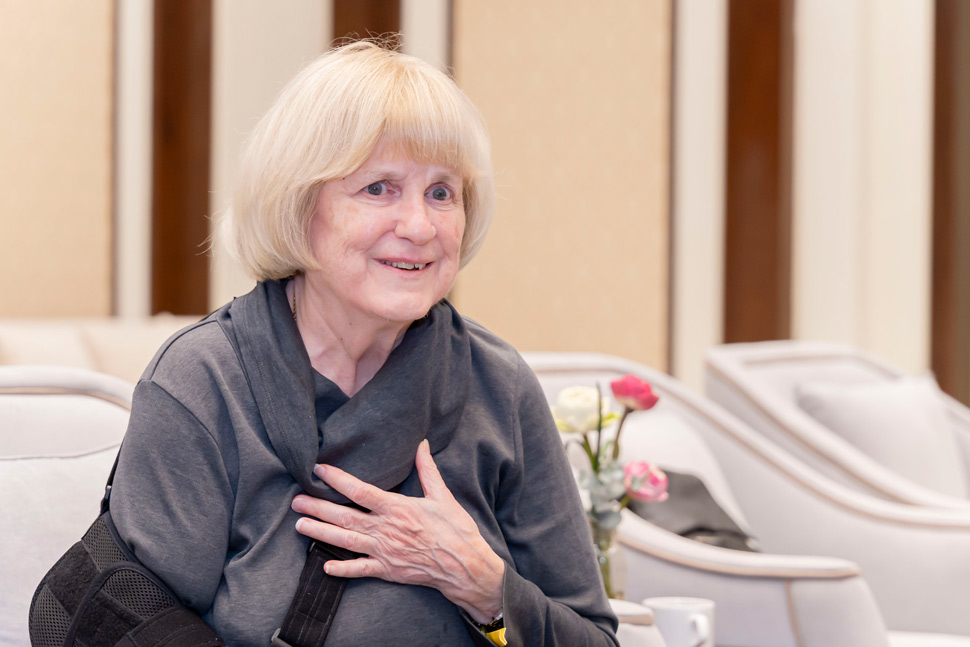
In this conversation, Professor Mary 8:00 King - the discoverer of the BRCA1 gene related to the risk of breast cancer and ovarian cancer - shared about research work, views on AI and special experiences in Vietnam.
Regarding motivation to do science, Professor King shared: I believe that the scientific motivation is often driven by three factors: curiosity, the importance of the problem, and connection with those affected by that problem. She said that all three of these factors are always present in her and her colleagues' thinking.
Recalling her first time coming to Vietnam in 2017, she said the image is still intact to this day. At the National Children's Hospital, she saw parents bringing their children in a very serious condition or with birth defects. She said: "Young doctors and department heads are extremely focused, serious and dedicated in finding out the problems of pediatric patients".
The group of nearly 20 people looked up clinicalcripts, tests and related information in both languages. Young doctors lean forward, closely monitoring every detail. I have never been to a place in the world with such a strong and complete dedication to patients, the Professor expressed.
At first, she had to take DNA samples from the child and parents to the US for testing. Now, according to her, "Vietnam has completely mastered gene decoding technology". Professor King also said he wanted to accompany the research on breast cancer and ovarian cancer in Vietnam.
Maybe a big priority is expanding screening programs and ensuring that when women are diagnosed with breast cancer or ovarian cancer, they get genetic testing, she said. Cases with BRCA1 or BRCA2 pathogens can be prescribed PARP inhibitors - the treatment method that she finds very effective.
Technically, Professor King said that Vietnam has very good gene Decoding ability and excellent clinical skills. However, genetic data interpretation still requires collective efforts, because the amount of information increases too quickly and this is a challenge in every country.
Talking about the women's award, she shared: "I was very surprised to receive an award dedicated to women, but it was a happy surprise". She said the award sends an important message about the increasingly strong participation of women in science.
She sent a message: "Let's go to science, young girls! Let's pursue and answer big questions with us."


