Election time and location
On the election day decided and announced by competent authorities, voting will start from 7 am and be carried out continuously until 7 pm on the same day.
Depending on the local situation, the Election Team may decide to start voting earlier but not before 5 am or end later but not past 9 pm on the same day.
In case voters have not yet completed voting near the end of voting according to regulations, the Election Team is responsible for notifying voters still in the polling area about the preparation for the end of the voting time and requesting voters to urgently complete the voting.
Voting must be carried out continuously. In case of unexpected events disrupting voting, the Election Team must immediately seal ballot boxes and documents directly related to the election, promptly report to the Election Commission, and at the same time take necessary measures to continue voting.
In case the voting time according to regulations has not expired but 100% of people in the voter list at the polling area have participated in voting, the Election Team is also not allowed to declare the end of the voting session and conduct ballot counting before 7 pm on the same day.
Therefore, in principle, the Election Teams and members of the Election Teams can mobilize and propagate to voters to actively participate in voting and exercise their voting rights, but must not urge or force voters to vote early to end the voting early.
Regarding polling locations, in each neighborhood, there are listings and wide announcements to voters about polling locations. Voters can also look up polling locations on the VNeID application according to the instructions here.
Election voting method
Each voter has the right to cast 1 ballot to elect National Assembly deputies and cast 1 ballot to elect People's Council deputies corresponding to each level of People's Council that they are allowed to participate in the election. Voters must vote on their own, not to ask others to vote on their behalf.
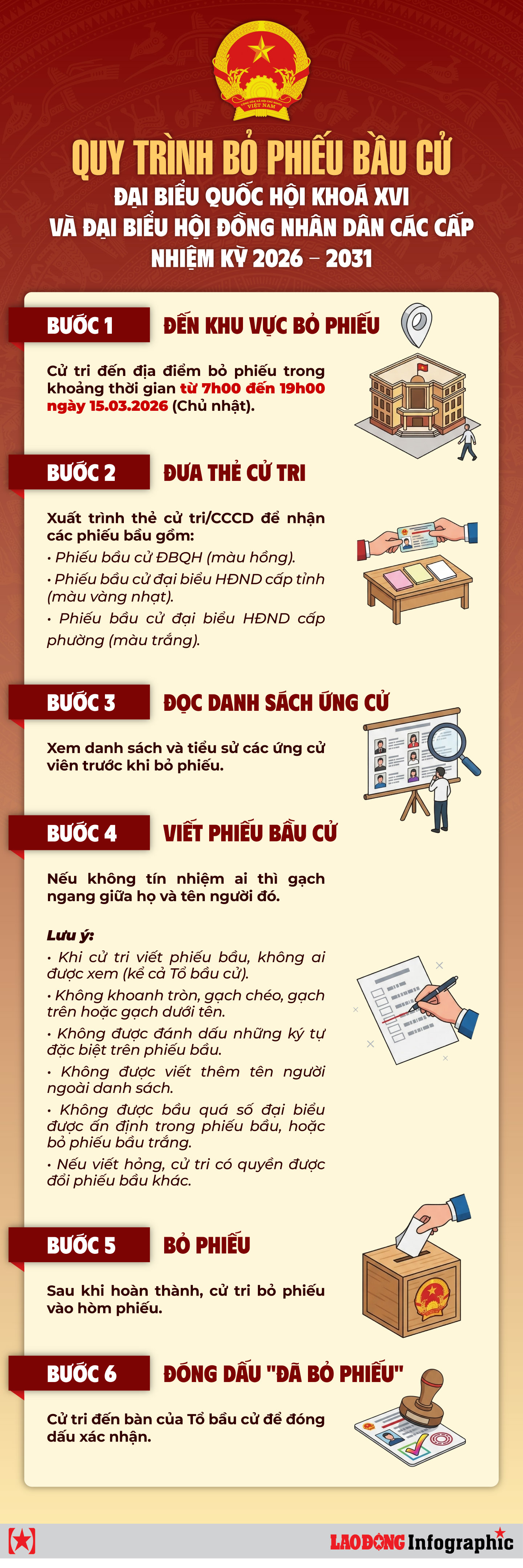
The first step is that voters will come to the polling station from 7 am to 7 pm on Sunday, March 15, 2026 to participate in the election.
Step 2, voters go to the candidate biography list posted in the polling area to learn information about candidates and read the voting room regulations. Next, voters move inside to follow the election team's instructions on the voting process. Then, at the ballot distribution table, voters present their voter cards to receive ballots.
To the most important step in the six-step process, voters need to fill out the ballot correctly and fully. When no candidate is trusted, voters cross the line between both the candidate's name and full name. In the process of writing the ballot, voters need to pay attention to some of the following regulations:
When voters write ballots, no one is allowed to see them, including members of the election team. Do not circle, cross, underline, or overline the name of the candidate's last name. Do not mark special characters on the ballot. Do not write or write names from outside the candidate list on the ballot. Do not vote more than the number of delegates specified in the ballot or cast a blank ballot. If writing incorrectly, voters have the right to change to another ballot.
If voters cannot write the ballot, they can ask others to write for them, but they must vote on their own.
After completing the writing of the ballot, voters must personally vote into the ballot box. Finally, voters move to the election team's desk to stamp "voted" on the voter card.
After completing all 6 steps according to the above procedure, voters completed their voting activities.
How do citizens traveling and working abroad vote?
Vietnamese citizens who are living, traveling or working abroad still have the right to vote, but only exercise this right when they are present directly in Vietnam on election day.
Current law has regulations to ensure citizens' voting rights in cases where voters may not be present at their permanent residence on election day due to business trips, travel or staying in other localities.
According to the Law on Election of National Assembly Deputies and People's Council Deputies 2015 (amended and supplemented in 2025), voters who are named in the list at their permanent residence but have to leave their locality on election day may request the commune-level People's Committee where the voter list is made to issue a voting certificate.
Thus, with this document, voters can participate in voting in another voting area in accordance with the provisions of law.
After voters exercise their right to vote, the election team at the polling station will collect the certificate to ensure that each voter only votes once.
According to the guidance of the National Election Council, voters who are temporarily residing in another locality for a long time (working, studying or staying) if they have registered for legal temporary residence can be added to the list of voters at the temporary residence, thereby participating in voting in the polling area near the place of residence.
Also according to the provisions of the Law on Election of National Assembly Deputies and People's Council Deputies 2015, in some special cases, the election team can also use auxiliary ballot boxes to bring to places where voters cannot directly go to the polling station, such as hospitals, nursing homes or special areas.
As for Vietnamese citizens living, traveling or working abroad, they still have the right to vote. However, the exercise of this right is only carried out when citizens are directly present in Vietnam on election day.
Currently, the Law on Election of National Assembly Deputies and People's Council Deputies only stipulates that citizens' voting rights are exercised on the territory of Vietnam, but there are no regulations on the implementation of elections when they are still abroad. Therefore, citizens who are abroad do not exercise their voting rights. Current law does not have regulations on the form of remote voting for citizens who are abroad.
Specifically, Clause 4, Article 29 (principles of making voter lists) of the Law on Election of National Assembly Deputies and People's Council Deputies 2015 clearly states: Vietnamese citizens returning to Vietnam abroad in the period from after the voter list has been posted to 24 hours before the voting start, they must come to the commune-level People's Committee to present a passport with Vietnamese nationality to be listed in the voter list.
After that, citizens receive voter cards to elect National Assembly deputies and People's Council deputies at the provincial and commune levels (if present at the registered permanent residence) or elect National Assembly deputies and People's Council deputies at the provincial level (if present at the registered temporary residence).