Energy is the "blood vessel" of the economy
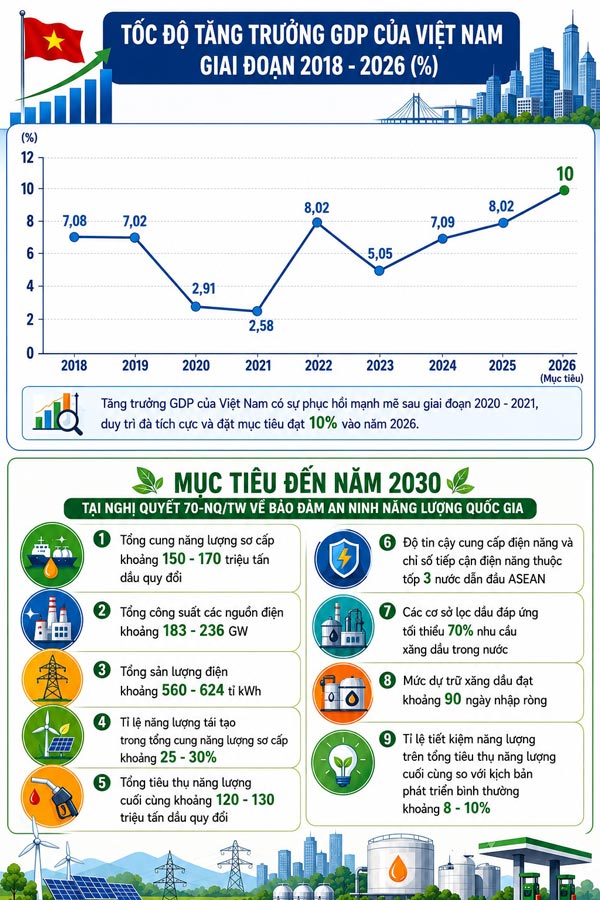
To achieve double-digit growth and become a high-income country by 2045, Vietnam needs abundant, green and stable energy sources.
According to Dr. Dao Duy Anh - Deputy Director of the Department of Innovation, Green Transformation and Industrial Promotion (Ministry of Industry and Trade), with the goal of double-digit economic growth in the coming period, strong development of new energy sources to improve self-reliance to always stabilize energy supply for economic development is a decisive factor.
If in the past we talked a lot about energy security in the sense of ensuring sufficient supply, now it is necessary to expand it to the concept of new generation energy security. It is not only about sufficient energy, but also that energy must be greener, cleaner, and renewable. The country's energy potential must be better resistant to geopolitical fluctuations, must diversify supply sources, not depend on one source of raw materials, fuel or certain markets. In the overall energy transition process, the deployment of E10 biofuel from June 1st is a solution to the transition process, a specific and practical step towards green transformation in fuel use" - Dr. Dao Duy Anh emphasized.
Analyzing the opportunities from energy transition, Assoc. Prof. Dr. Nguyen Thuong Lang - Institute of International Trade and Economics (National Economics University) said that in the context of export markets increasingly tightening emission standards and sustainable development, the use of clean energy will help businesses expand opportunities to access international markets, reduce risks from carbon taxes and green technical barriers.
Energy transition also opens up new growth space for the economy by promoting investment in renewable energy, biofuels and energy-saving technologies. These are not only industries that create new energy supply but also form an industrial, service and technology ecosystem with high added value, creating more jobs, attracting investment capital and improving the productivity of the economy" - Assoc. Prof. Dr. Nguyen Thuong Lang emphasized.
Energy transition needs impetus from institutions
Although the orientation is clear, energy transition in Vietnam is still facing many bottlenecks in capital, infrastructure and market mechanisms, slowing down the progress of clean energy projects.
Talking to Lao Dong Newspaper, Dr. Nguyen Quoc Viet - economic expert, lecturer at the University of Economics (Vietnam National University, Hanoi) - emphasized that the difficulties that make businesses slow to participate in energy transition are not due to the shortage of natural resources or the limitations of technical solutions, but due to bottlenecks in green financial institutions, the lack of substantial economic incentive mechanisms and policy risks in electricity purchase and sale contracts.
Vietnam needs to build a stable policy framework to encourage investment in clean energy, low-emission technology and new business models based on green economy and circular economy. Policies on green growth and renewable energy should focus on developing strategic energy infrastructure according to international standards, testing institutions (sandboxes) and support conditions for businesses to participate in green value chains" - Dr. Nguyen Quoc Viet said.
In the coming time, Dr. Nguyen Quoc Viet believes that Vietnam needs to design a fair carbon pricing roadmap. At the same time, promote institutional reform and green financial policies, combining fiscal tools: The implementation and promulgation of specific institutions in the field of capital and credit associated with the "green classification" list is extremely urgent for banks to confidently disburse.
For renewable energy, it is necessary to drastically implement the direct electricity purchase and sale mechanism (DPPA) to meet the demand for clean energy of large manufacturing enterprises, especially foreign investors. At the same time, it is necessary to simplify administrative procedures, reform the electricity market bidding process towards a one-stop shop, unify investor selection criteria in localities, based on technical capacity, finance and clear environmental safety requirements" - Dr. Nguyen Quoc Viet said.