
In the latest exhibition "The sky is the same everywhere" suddenly the image of people "disappears" from paintings, as if they could not step into the natural world in front of them, or they have gone very deep, immersed in it for a long time.
1. The series of paintings includes more than 10 works of various sizes, painted in oil paint, with two main colors: green and yellow. The green paintings, which are landscapes, have been painted by artist Dinh Thao Phong for decades. The yellow layer covering the top is by Dinh Thi Tham Poong (sister of artist Dinh Thao Phong), the work started at the beginning of the year.
The two artists paint a painting together, in a continuous form - something rarely seen in the practice of painting - which emphasizes the independent activities of individual artists. The end of Dinh Thao Phong's pen is the opportunity for Dinh Thi Tham Poong to start. Finally, when Tham Poong stopped writing, viewers returned to ask themselves: Is the starting point the "real end" of the painting?
Because the golden features that attract the fibers like waterfall on the green background are very fragile, and the beautiful, prominent, and round treetops in front of the trees are created by each leaf like the leaves of the yellow mustard flowers. Waterfall, tree, rock, horse - are more eye-catching, easier to see, and have less solid structures.
Although the overall shape of the waterfall, trees, rocks, and horses - according to Tham Poong's intention is not messy, but very neat, clear, and recognizable immediately. Pay attention to the yellow leaf trees with a little more attention, they grow in a strange " scene": Usually starting from the middle of the trunk, near the tops, not from the roots.
The scenery that Thao Phong and Tham Poong bring is a combined scene, "clinging together", but we do not see them in harmony or supporting each other. Standing together in the sky, not excluding each other, but it felt like they were strangers to each other. The strangeness of plants and trees, of animals and plants, of nature and nature - without the need for human hands.
2. The absence of humans in the paintings may have been Tham Poong's intention. That nature still exists without humans, as it has existed. The absence of human images, giving viewers another opportunity to stand in front of the scenery and face it.
The painting allows viewers to stand and observe or explore, or find a hypothetical way to step into space. In paintings with large panels, there is almost always a distance from the eyes of the person in front of it. The distance is like an obstacle - blocked by waterfall, by tree canopy, by book prices - not necessarily by the overwhelming wild, vast space.
Only the painting of the ancient tree leaning at Ngoc Chien and Son La by Dinh Thao Phong, Tham Poong, was left original, without adding patterns. A tree with a lost story about the abiding place of a tiger has yellow wings that the Thais pass on to each other. The tree closest to the eye, most approachable in the painting, was actually submerged under the lake. Without sparkling yellow, there is no way to stop fake viewers from entering, but perhaps only the painter who painted and those who have been attached to the real scenery of the story of the deity know that they cannot step forward. If the artist only paints the truth of the present that is happening, and the viewer only looks at the painting as if it exists before their eyes, then perhaps we will find it difficult to recognize the connection when Tham Poong adds to the remaining paintings of waterfall and trees.
In her mind, perhaps nothing is intact over time, including the primitive or the finely-packed. She kept a little poem on the painting for the imagination, comforting that art can at least soothe the eyes when we have just touched it.
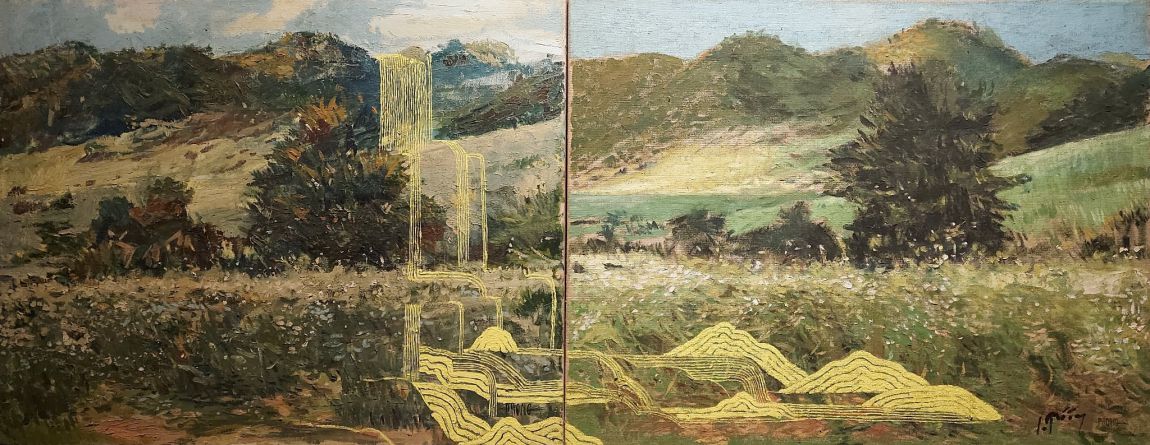
3. The harsh side, as Linh Lan associated in this practical article by Tham Poong: "Phong's scenery (sky, mountains, forests, old places) is no longer a stationary, passive object... but has become an independent existence, has been and is still existing, continuously projecting the look back to the artist...". The absence of human images in the series of paintings, similarly, also gives viewers the experience of standing in front of it: Not that we are looking at the space in front of us, but on the contrary, the space in front of us is looking at us.
When viewers change roles, we realize that we no longer have the right to judge or impos an endogenous view of it - not only the space in the painting but also the scenery outside it - where nature is truly present in the sky, on the ground, around us.
That a wide-open eye everywhere, from the sky, mountains, forests, rivers... is scrutinizing us, following us, seeing what we do to nature itself. Do we deserve to live together and admire the beauty of nature forever if we keep harming them?
If we look back, we understand that the sky is the same everywhere to know how to live carefully and cherish more what we have.
Painter Dinh Thi Tham Poong was born in 1970, in Lai Chau.
Graduated from the Faculty of Sculpture, Hanoi University of Fine Arts (currently Vietnam University of Fine Arts) in 1993.
The exhibition "The sky is the same everywhere" will open from November 8 to December 7, 2025, at Manzi Exhibition Space, No. 2, Hang Bun Alley, Ba Dinh, Hanoi.


