
The Tay Con Linh desert is majestically located in the border area of Ha Giang (Tuyen Quang province). Although there is the word Tay in the name, because the mountain runs towards the Northeast, it is known as the roof of the Northeast. The place name Tay Con Linh sounds very exciting, because it has entered adventure literature, detective stories, and forest roads of writers like Hoang Ly, Lan Khai...
Tay Con Linh always seems mysterious because it is surrounded by countless superstitious legends of the mountain tops that protect the border, as well as the layer of fog that always covers the real front, only revealing in a few short sat-n-t-t-t-ils, then disappearing into vanity. It is true that under a great reputation, mediocrity cannot be achieved.
Only adventurers who dare to go all the way to the top of Tay Con Linh have the opportunity to see the countless treasures hidden under their cloud, fog, and thick water and steam scarves. These are the ancient Shan Tuyet tea trees and the green moss-covered houses or in the magical literature, along with the forests that have been around for thousands of years.
Also because of the clouds, this place is still hidden. The altitude of 2,431 meters above sea level of Tay Con Linh has created a very humid climate with abundant water resources, completely opposite to the absolutely dry cold area at the beginning of Dong Van Geopark, just a few dozen kilometers away.
Between the clouds and the wind, there must be a fairy tale. But in Tay Con Linh, people have not seen fairies but only live like fairies. Xa Phin village (Thanh Thuy commune, Tuyen Quang) is the scenic spot that I accidentally got lost in during a "backpacking trip around Tay Con Linh" with visits to Ha Giang land.
Although it is only located at an altitude of 1,000 meters, Xa Phin village enjoys the scenery of eating wind, drinking fog, and traveling in the clouds almost all year round. From the asphalt road connecting Ha Giang ward and Thanh Thuy border gate, the more than 10km road to Xa Phin only faces up, not down or passing by.
Along the way, white clouds appeared when they appeared to follow the tourists with the sound of streams and waterfalls coming from a corner of the forest. It is necessary to go through a few waterfalls with one's eyes to reach Xa Phin, the place where the Dao ethnic people have lived for hundreds of generations.

The Dao people, from their personal perspective, are probably the harmony of the H'Mong and the Tay people in their view of choosing land to settle down and make a living. If the H'Mong people prioritized choosing land for houses in high, rugged places, with few human footprints and majestic mountain scenery, the Tay people preferred low, flat, convenient places to travel, in rice fields and near water sources.
However, the Dao people are neutral in these two residential options, especially in the Dao community in Xa Phin village. This place is not near the top of the mountain but is also 1,000m from the road, with mountains in front and forests behind, but is surrounded by streams and waterfalls to create suspension lakes and dams in the air.
The Dao people in Xa Phin live by planting forests, growing rice on terraced fields, raising cold-water fish with high value and a specialty of this region is suddenly fish. However, the high humidity also helps the Dao people have another strength, which is the profession of making tea, growing tea and exploiting tea from the ancient tea roots of Shan Tuyet, the most rare type of tea.
The Shan Tuyet tea trees here have large trunks, covered with green moss with large, steep canopy appearing in the clouds. They are nurtured by fog at an altitude of more than 2,000m, so their refreshing, wild and fragrant flavor is very special. The scene of Dao girls windily climbing ancient tea trees to pick tea is truly absolutely cinema.
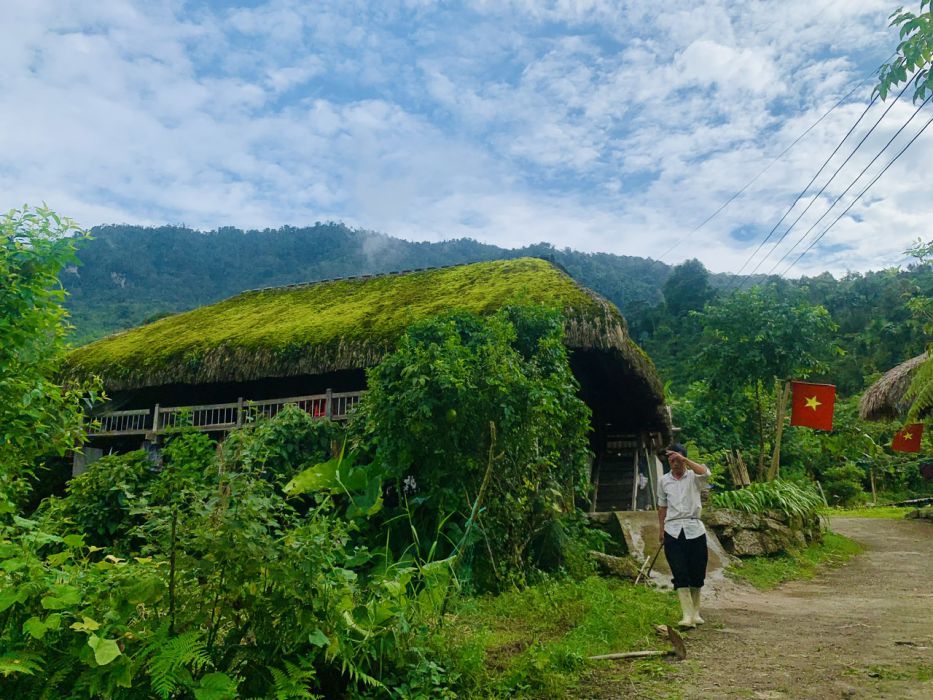
But the high humidity of this terrain also accidentally creates a treasure for Xa Phin. The Dao people here live in stilt houses with roofs covered with palm leaves. The newly built tamarind trees were brown, but after a few years, they turned turned turned blue like the fabric of Dao girl.
That green is the layer of moss that naturally grows on the palm roof. The high humidity in this area causes moss to thrive, clinging to the roof and gradually covering it, creating a magical blue armor, extremely unique, that cannot be found anywhere else.
Indeed, when I first saw these moss-roofed houses, I could not help but think of the houses of the hobbit people in Saga Theord of the Rings by author J.R.R Tolkien. It has a mysterious beauty but instead reflects the healthy coexistence between humans and nature.
Xa Phin moss roofs have a very diverse beauty, depending on weather conditions and the time of year. In September or October, moss roofs are truly a fairy tale place when they are floating on golden terraced fields, decorated with white clouds.
They often sink in a giant white towel but then suddenly appear as illusion, blue under the golden sunlight, showing off all the most charming beauty. That is also the time when people go to see the moss roof most because it is convenient for moving.
Or at this time, Xa Phin village has the beauty of a village in the Nordic forest preparing to welcome Christmas. The three-leaf pine trees, the end of the pine pine trees, and the sandalwood have been scattered with fragrant aroma, the colder it gets, the stronger it gets. The moss roofs are now turned dark green, covered with fog, so thick and soft like snow.
But in just a few months, when Spring comes, the moss roofs change to a new green coat to show off their beauty next to the peach blossoms that have just turned pink. Think of sitting under that green moss roof to enjoy a glass of wine or tea, and immersing yourself in the dense space of clouds and smoke. Not too much to miss!


