Green living from solar panels on the roof
In recent years, the roof of Ms. Tran Thi Hoa's house (Dong Trieu, Quang Ninh) is no longer just a place to shelter from the sun and rain, but gradually has become a "mini power plant" serving daily life for the whole family. Initially, Ms. Hoa only installed a small solar panel to light up the yard and gate. Seeing the system operating stably, saving electricity, especially effective in the hot season, she decided to invest in expanding capacity.
From lighting services, the rooftop solar power system gradually meets additional equipment such as water heaters and basic household appliances. "Previously, my house's monthly electricity bill was usually more than 1.5 million VND, especially in the summer when demand increased. Since installing solar power, electricity bills have decreased to just over 800,000 VND/month. The initial investment is not small, but if calculated in the long term, "the more you use, the more beneficial it is", because the lifespan of the panels can be extended for many years, while monthly electricity bills have decreased significantly," Ms. Hoa shared.
At Mr. Ngo Van Thuy's family (Liem Tuyen, Ninh Binh), they have also started using solar power for about two months now. Mr. Thuy said that previously the family's electricity bill was quite high due to the need to use electricity for lighting for the residential area, kitchen, yard and barn.
Initially, his family only tried to buy 2 sets of solar lights for about 600,000 VND to check the effectiveness of use. After a period of practical experience, seeing that it was economical and convenient, he continued to install more. Up to now, the family is using 4 solar light bulbs in many areas of the house, kitchen, yard and barn.
According to Mr. Thuy, previously his family's monthly electricity bill fluctuated around 600,000 VND. After using a solar lighting system, electricity costs decreased to less than 300,000 VND/month, helping to save about 200,000 - 300,000 VND/month.
Renewable energy becomes a competitive "lever" for businesses
Energy transition is no longer a macro story of the Government or large corporations, but has become a problem associated with daily life, from light bulbs, pumps to production lines. For people, solar power helps reduce the pressure of living costs and be more proactive about electricity sources, while for businesses, this is becoming an important solution to optimize operating costs, reduce carbon emissions and improve competitiveness in the context of increasingly strong green transformation requirements.
From civil houses to factories and operating offices in industrial parks, renewable energy is gradually becoming a part of the sustainable development model. If for people, solar power helps reduce the pressure of living costs and be more proactive about electricity sources, then for businesses, this is becoming an important solution to optimize operating costs, reduce carbon emissions and improve competitiveness in the context of increasingly strong green transformation requirements.
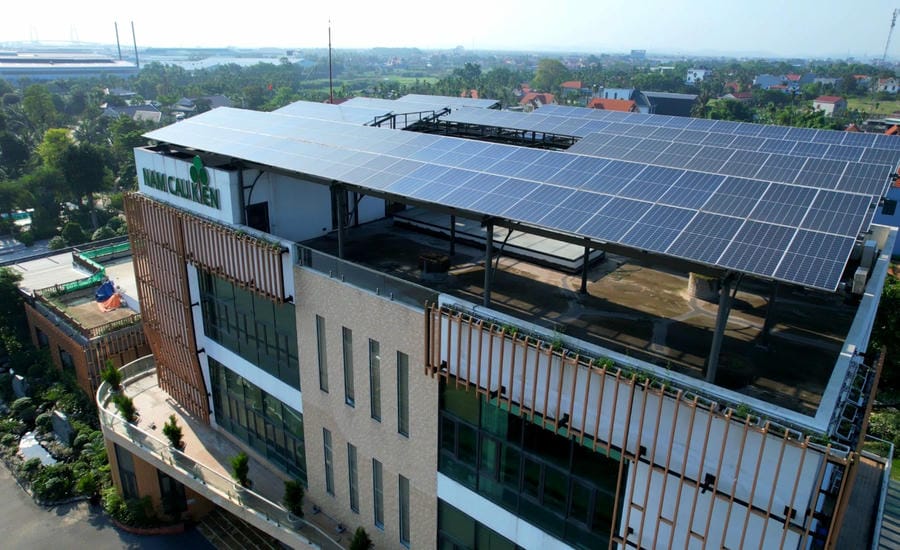
Talking to Lao Dong Newspaper, Mr. Pham Hong Diep - Chairman of the Board of Directors of Shinec Joint Stock Company, investor of Nam Cau Kien Industrial Park, said that in the journey towards the ecological industrial park model and the goal of net zero emissions, the enterprise is particularly focused on solutions to use renewable energy and improve electricity efficiency. One of the early solutions implemented in Nam Cau Kien is the rooftop solar power system at the operating office area. According to Mr. Diep, the effectiveness is very clear when electricity costs decrease sharply after a short time of putting it into operation.
Previously, when rooftop solar power was not used, the operating office area alone had to spend more than 50 million VND per month on electricity. After deploying this system, the cost has decreased to only about 5 million VND/month," Mr. Diep said.
Not only helping businesses significantly reduce operating costs, the rooftop solar power model also contributes to reducing carbon emissions and improving energy efficiency in the entire industrial park. According to Shinec's leaders, this is an inevitable direction in the context that green standards, emission standards and requirements for sustainable development are increasingly becoming mandatory conditions in the global supply chain. However, in order to expand the model on a scale of the entire industrial park, businesses are still waiting for mechanisms, policies and legal corridors to be completed in a more synchronous, clear and stable direction.
Mr. Diep said that currently many businesses are still concerned about the mechanism of connection, electricity purchase and sale, electricity storage as well as the harmony of interests between parties participating in the electricity market. These are bottlenecks that need to be removed soon to encourage businesses to boldly invest in renewable energy. "If the mechanisms are completed in a more favorable and transparent direction, we can completely deploy a synchronous rooftop solar power system throughout the industrial park," Mr. Diep emphasized.
According to him, when this model is expanded, Nam Cau Kien will not only significantly reduce carbon emissions but also have the opportunity to form a new circular economy model right in the industrial park. This will be an important foundation for businesses to move closer to the Net Zero goal, while improving competitiveness in the green transition trend that is taking place strongly globally.
For people, solar power helps reduce the pressure of living costs and is more proactive in power sources, while for businesses, this is becoming an important solution to optimize operating costs, reduce carbon emissions and improve competitiveness in the context of increasingly strong green transformation requirements.