Sun launches X1.1 flare, radio incident spreads
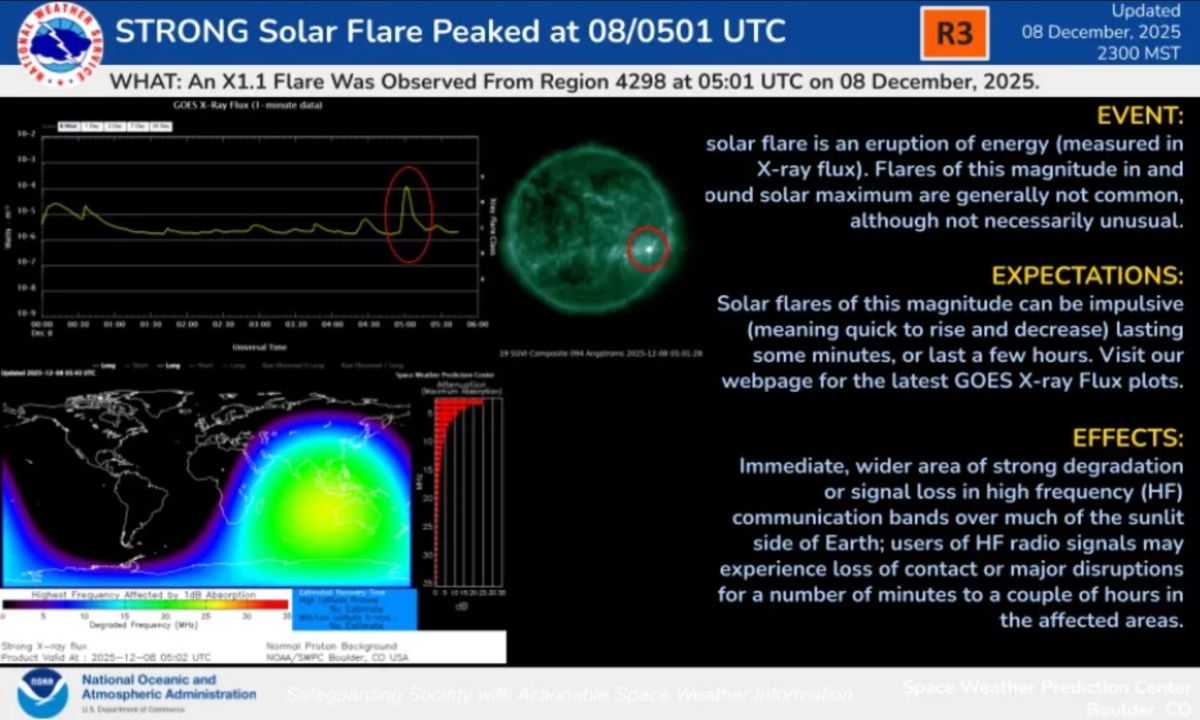
In the early morning of December 8 (Vietnam time), the Sun suddenly released an X1.1 outbreak - the strongest level on the flare scale - causing disruption and disrupting high- frequency radio communication on the bright half of the Earth.
Australia and part of Southeast Asia were the most affected areas, with many areas having lost HF contact for many minutes.
According to data from supervisory agencies, the flare peaked at 5:11 GMT on December 8 (12:10 Vietnam time), originating from the black spot AR4298 moving towards the western edge of the Sun. The area will disappear from view over the next few days, reducing the risk of other strong flare affecting the Earth directly.
Along with the X1.1 ray, a block of bul bul bulge material (CME) was also blown into space. Initial images show that this CME is not directly targets the Earth, significantly limiting the risk of serious magnetic disturbances.
However, the Sun is in its peak activity week. Many CMEs that emerged from previous flare cases were forecast to impact the Earth around December 9.
The National Oceanic and Atmospheric Administration (NOAA) and the British Meteorological Agency have issued a G2-G3 typhoon warning, which could cause the aurora to appear at high to medium latitude and affect the positioning and communication system.
What is solar flare?
Solar flare - or solar flare - is a phenomenon of sudden release of energy accumulated from magnetics, creating a huge radiation field.
Flare is classified by intensity, in which X-class is the strongest; M-class is about 10 times weaker than X; C, B, A-class: gradually weakens, in which A-class has almost no impact on the Earth.
The December 8 outbreak had an intensity of X1.1, is among the strong event groups and is likely to clearly affect the Earth's electricity layer.
Why is the radio signal lost?
When the radiation from the flare reaches the Earth, it immediately ionizes the upper atmosphere. Under normal conditions, high- frequency radio waves propagate thanks to the reflection through thin layers of the atmospheric ionization layer. But in strong flares, the low and thick layers of the atmosphere's ionized phase are suddenly ionized, causing radio waves to continuously collide with the particles and deplete energy.
As a result, the signal is weakening, distorted or completely gone - as recorded in Australia and parts of Southeast Asia on the night of December 8.
Risk of earthquake storms in the next few days
Although CME with flare X1.1 did not make a direct impact on Earth, the previous CME chain is still approaching. According to experts, the Earth may experience many mild to moderate magnetic waves in the next 48 hours.
This opens up opportunities for observing auroras at some mid-latitude regions, and requires the aviation, telecommunications and space meteorological agencies to closely monitor and warn.
For human health, storms can cause headaches; dizziness; fatigue and sleepiness; mood swings; reduced concentration; weakness and irritability; worsen chronic diseases.