
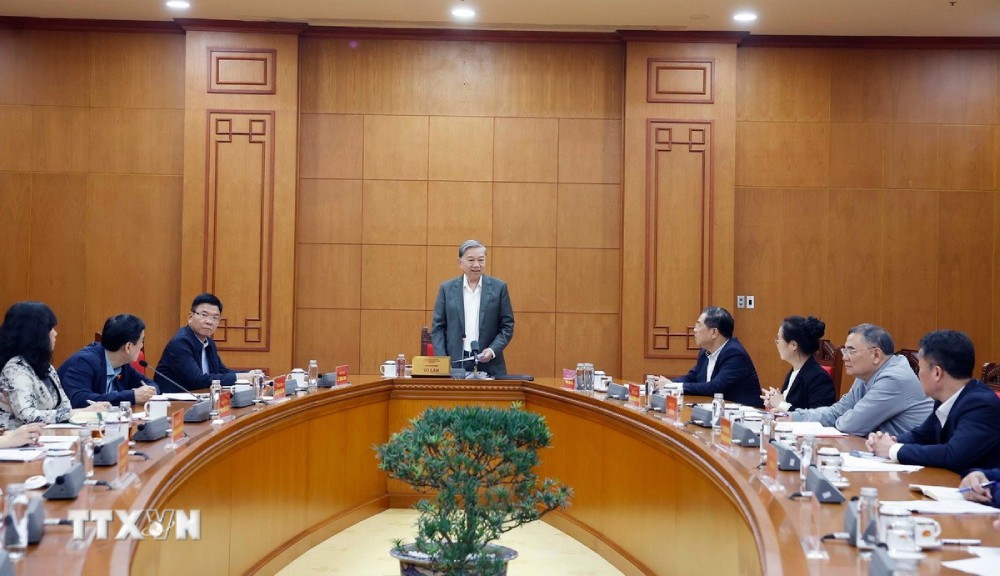
The Central Party Office has just issued Conclusion Notice No. 444-TB/VPTW of General Secretary To Lam at the working session on December 3, 2025 with representatives of the Government Party Committee and central departments, ministries and branches on the implementation of the Party's guidelines and policies and the State's laws for people with disabilities.
According to the announcement, at the conclusion of the working session, General Secretary To Lam stated that people with disabilities are an inseparable part of the ethnic community, with the right to guaranteed living, studying, working and participating in social activities like all citizens.
Caring for people with disabilities with the spirit of "leaving no one behind" is not only the responsibility and morality of the entire political system, but also a measure of civilized society, a requirement for sustainable national development, demonstrating the humanity and superiority of the socialist regime and the commitment of the Party and State in ensuring human rights for all citizens.
The General Secretary requested Party committees, Party organizations, authorities, and unions at all levels to focus on implementing well a number of tasks and solutions.
In which, there are synchronous solutions to reduce the number of newly disabled people. This is a core, fundamental issue and has strategic significance; instead of focusing on handling the consequences, proactive disability prevention from the root helps reduce the burden on families, society and the social security system; at the same time, improving population quality, human resource quality and the quality of rice strains.
Develop and perfect policies and laws for people with disabilities to shift from "health care - care" to "social - integration" approach, aiming to eliminate prejudice, reduce inequality, expand opportunities and empower people with disabilities.
In addition to health support policies, rehabilitation or health insurance, it is necessary to focus on building appropriate integrated education and vocational training policies, preferential mechanisms in recruitment, access to transport infrastructure, public works, digital transformation for people with disabilities to use online public services and supporting technology tools; support livelihoods, housing and legal aid, ensure a minimum living standard for people with disabilities. Encourage the private sector, social organizations and the community to participate in activities to support people with disabilities, from job creation to creativity and consumption of friendly products and services.
The Conclusion also clearly states the content of continuing to research strong solutions so that all children with disabilities are detected early, can go to school, study and integrate. There are solutions to build a system of integrated education support centers; develop learning materials for blind and deaf children; train teachers, as an effective support basis for children with disabilities.
Research and supplement practical solutions to expand job opportunities and livelihoods for people with disabilities. Build adaptive vocational training models, support employment in the community, encourage businesses and cooperatives to employ workers with disabilities, and increase the rate of people with disabilities to have stable jobs.
Implementing fundamental solutions on infrastructure - transportation - public works - online public services that are more friendly and accessible to people with disabilities. There is a feasible roadmap, considering access to infrastructure for people with disabilities as a mandatory responsibility, not just an encouragement; all works and services in the future must take into account the needs of people with disabilities right from the design stage.
The Conclusion also clearly states the application of assistive technology and digital transformation to improve the quality of life for people with disabilities. In which, technology is considered one of the breakthroughs for people with disabilities to integrate better, it is necessary to continue to expand, standardize, integrate platforms, create an "ecosystem" of assisted technology, warning devices, sign language processing software, control devices for people with disabilities.
Continue to study solutions to prevent, detect and handle violence, abandonment, and discrimination against people with disabilities; need a friendly reporting mechanism, timely support at the grassroots level; focus on disabled women and children - the most vulnerable groups.
Strengthen communication and raise social awareness, spread the spirit of respect, sharing, and accompanying people with disabilities. Implementing simplification of administrative procedures, removing barriers that make it difficult for people with disabilities to access their legitimate rights.


