
On December 2, the National Assembly discussed in the hall the draft Resolution of the National Assembly on a number of breakthrough mechanisms and policies for the work of protecting, caring for and improving people's health.
National Assembly Delegate (NAD) Nguyen Tam Hung (NA Delegation of Ho Chi Minh City) said "very much in agreement" with the policy of hospital fees exemption according to the roadmap until 2030 and increasing health insurance (HI) benefits for vulnerable groups.
However, it is recommended to consider adding criteria to determine the group of subjects eligible for increased benefits according to the level of health risk and high risk of disease instead of only relying on social - administrative criteria.
Because in reality, people at high risk such as chronic diseases, genetic diseases, early metabolic disorders... always need large and long-term treatment costs.
Expanding the standard approach in the direction of priority according to health risks will guide policies in practice, ensure fairness in health care and contribute to reducing the burden of social diseases in the long term delegate Hung emphasized.
According to the delegate, the regulation of salary classification for doctors from level 2 and 100% preferential allowances for specific fields is a good policy. However, it is recommended to consider adding professional responsibility allowances for each job position, not just for the major.
The reason is that at the grassroots health sector and at resuscitation and anti-poison units, work pressure, on-duty intensity and occupational risks are very high, but if responsibility allowances are not regulated, it will be difficult to ensure the retention and creation of sustainable vocational motivation. This is a decisive factor for the strategy of developing medical human resources - the biggest challenge today.
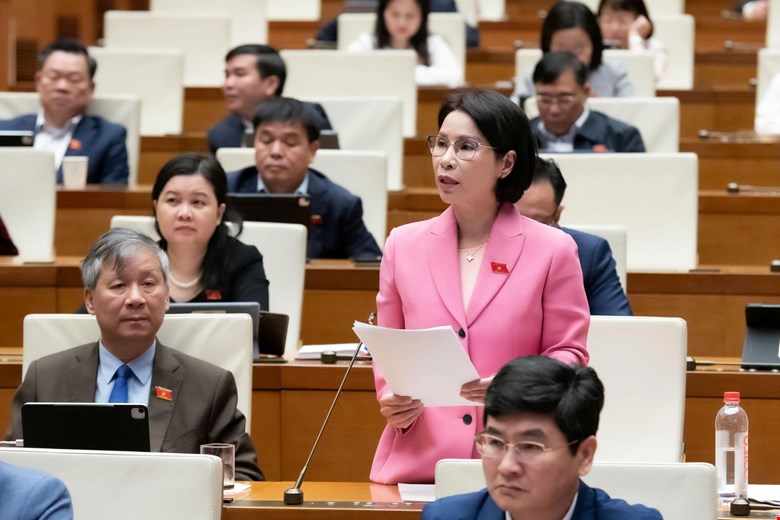
Also related to the regime, policies, and salaries for health workers, delegate Tran Thi Nhi Ha (National Assembly delegation of Hanoi) said that the policies stated in the draft are not really groundbreaking to attract and retain qualified doctors.
In reality, there is a serious shortage of doctors in the grassroots health sector, but the policies we are applying such as sending young doctors to the grassroots or seconding them for 2 to 3 years, only temporarily.
"The psychology of doctors when transferred according to a short-term model is often unstable, making it difficult for them to focus on long-term attachment. Without a stronger and more sustainable mechanism on income, working conditions and career development roadmap, it will be difficult for the grassroots health sector to have a team of human resources with sufficient quantity and strong quality as expected" - delegate Ha stated.
From the above issues, this delegate proposed to add 2 solutions.
First, for doctors from the non-state sector attracted to work in grassroots health care, they need to be calculated for seniority and have a salary level equivalent to that of doctors working in the state sector;
Doctors are considered for special recruitment to civil servants at health stations (not having to take an entrance exam) if they already have a certificate or practice license.
Second, regarding preferential allowances, it is proposed to apply a rate of 100% to doctors directly working at commune health stations and preventive health facilities; for other medical professional positions, at least 70% is applied.


