
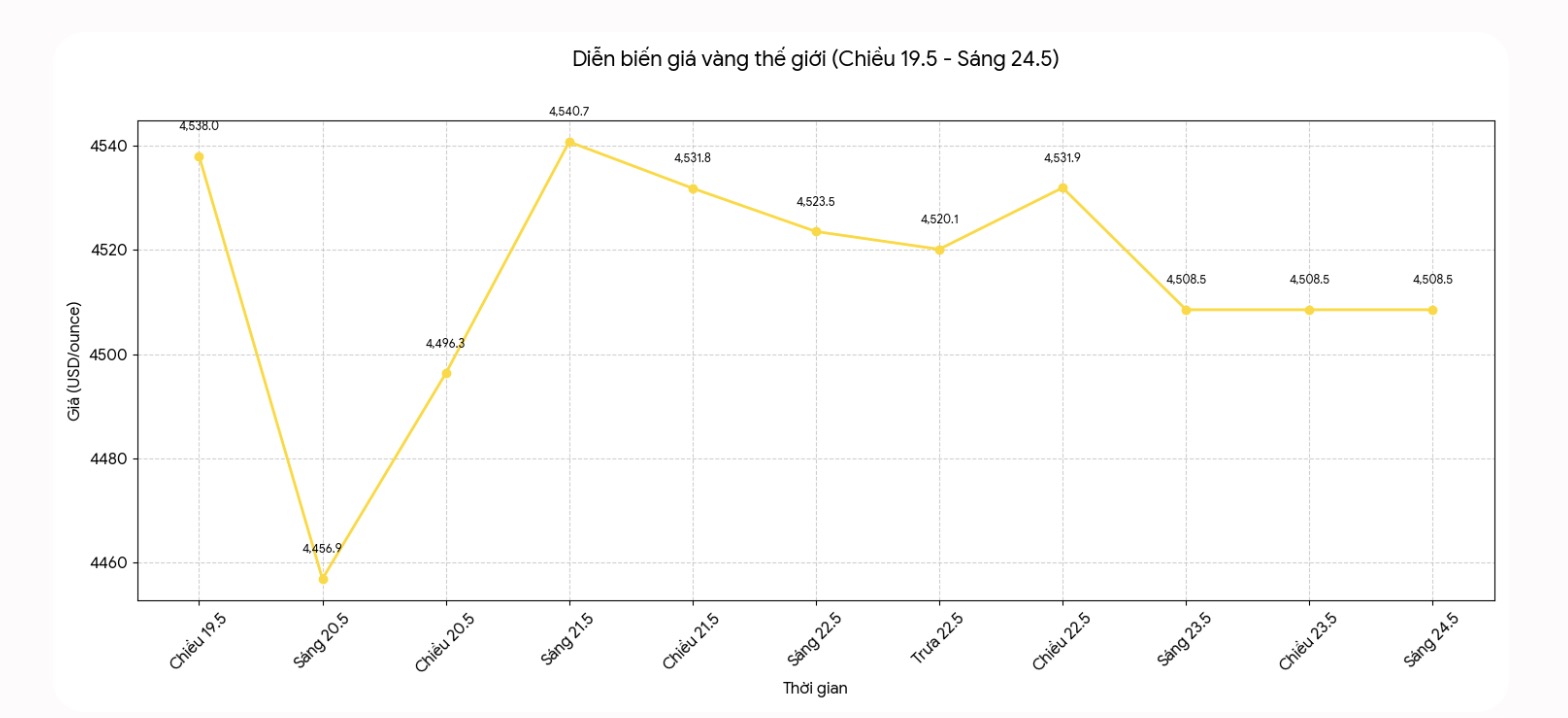
Mr. Marc Chandler - Managing Director of Bannockburn Global Forex - said that gold has repeatedly lost the important support zone of 4,500 USD/ounce but is currently mainly fluctuating and accumulating above this threshold.
According to Mr. Chandler, the market has not yet shown strong enough signals to confirm a return to the upward trend. To reverse the upward trend, gold needs to surpass the 4,600 USD/ounce zone.
He also noted that although the bond market has recovered, gold buyers have not yet been able to regain control. In that context, gold prices are at risk of continuing to fall to the 200-day moving average around 4,370 USD/ounce.
Mr. Chandler warned that the longer the conflict in the Middle East lasts, the greater the risk of countries like Turkey and some Gulf countries continuing to sell gold reserves, thereby putting more pressure on the precious metals market.
Sharing the same opinion, Mr. Rich Checkan - Chairman and CEO of Asset Strategies International - said that the ceasefire between the US and Iran is increasingly fragile.
According to him, the nuclear issue continues to be a bottleneck that escalates tensions as both sides maintain a tough stance. However, this development has not supported gold since the conflict broke out.
Mr. Checkan also emphasized that inflationary pressure is returning after the US producer price index (PPI) and consumer price index (CPI) increased sharply last week, in which the PPI reached its highest level in many years.
The possibility of interest rate cuts has been removed from the agenda for quite a long time. Now, the market is starting to consider the possibility of raising interest rates again," he said, adding that a high interest rate environment often puts pressure on gold prices.
Meanwhile, Mr. Kevin Grady - Chairman of Phoenix Futures and Options - said that liquidity in the gold market is currently very low, mainly due to position conversion from June contracts to August.
According to Mr. Grady, the current trading volume does not reflect new speculative cash flow participating in the market, but is mostly just technical transactions.
He believes that investors are in a state of waiting because no one wants to hold a large position in the context of geopolitical risks that can cause the market to fluctuate strongly at any time.
If the market falls sharply to the 4,100 USD/ounce zone and then is sold off deeper, investors will not want to be stuck" - he said.
Although assessing that the risks of increase and decrease are currently relatively balanced, Mr. Grady believes that the gold market is still lacking momentum to form a clear upward trend in the short term.
Mr. John Weyer - Director of Trade Protection at Walsh Trading - also said that gold is still heavily dependent on developments in the Middle East.
According to Mr. Weyer, the longer the conflict lasts, the clearer the negative impact on the economy, contrary to the initial assessment of the administration of US President Donald Trump that the impact will only be temporary.
He said that the sharp drop in the Michigan University consumer confidence survey is a signal that high energy prices have begun to spread to the supply chain and directly affect consumers.
The upward momentum of the US stock market also makes many investment funds have no strong reason to shift capital to gold or other safe-haven assets.
Mr. Weyer predicts that gold prices next week are likely to continue to fluctuate around the 4,500 USD/ounce mark, in the range of 4,470 - 4,560 USD/ounce and there has not been a major breakthrough in any direction.


