
Kitco reported that the People's Bank of China (PBoC) increased its gold reserves by nearly 10 tons last month, marking the 19th consecutive month of buying this precious metal, according to the latest data from the Chinese government.
The State Foreign Exchange Administration of China (SAFE) on Sunday announced that the country's official gold reserves increased by 320,000 ounces, equivalent to 9.95 tons in May, to a total of 74.96 million ounces, equivalent to 2,331.52 tons.
China's total foreign exchange reserves increased to 3,442.2 billion USD at the end of May, an increase of 31.7 billion USD, equivalent to 0.93% compared to April. This is the highest foreign exchange reserve level of China since November 2015. The country's foreign exchange reserves also maintained above the threshold of 3,300 billion USD for 10 consecutive months.
SAFE believes that the increase in foreign exchange reserves comes from many factors, including a stronger USD Index and rising global asset prices. The agency also said that the stable growth momentum of the Chinese economy has supported the stability of foreign exchange reserves.
Experts believe that China's increased foreign exchange reserves are closely related to the country's export results.
According to the latest data from the General Department of Customs of China, China's total foreign trade turnover in the first 4 months of 2026 increased to 2,390 billion USD, an increase of 14.9% compared to the same period last year. Of which, exports increased by 11.3% to 1,370 billion USD, and imports increased by 20% to 1,010 billion USD.
Meanwhile, China's domestic gold market has shown clear signs of cooling down in recent weeks.
In the context of increasing market instability, gold ETFs recorded a downward trend in total managed assets, with many funds witnessing significant net withdrawal of capital" - Gelonghui Finance's report stated - "As of June 3, 14 gold ETFs recorded total net withdrawal of capital exceeding 10 billion yuan, equivalent to 1.48 billion USD in the past month".
The investment outlook that was once widely accepted as'buying when gold prices fall' is beginning to show differentiation in the current volatile market context," the report added.
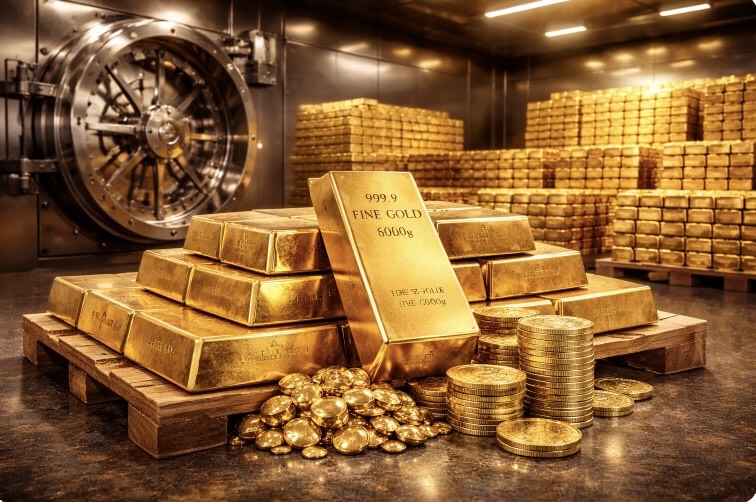
Chinese gold stocks listed in Hong Kong (China) also fell sharply in a development considered "abnormal".
The group of gold stocks listed in Hong Kong (China) simultaneously decreased, including China National Gold International Resources and Jihai Gold down 3.6%; Zijin Mining down 3.5%; Shandong Gold and Zhaojin Mining down nearly 3%; Zijin Gold International down 2.4%; while Chifeng Gold, Lingbao Gold, China Silver Group, Zhufeng Gold and Tongguan Gold also decreased" - the report stated.
China's physical gold market has also cooled down significantly compared to the vibrant demand at the beginning of the year, when domestic and international gold prices continuously set new record highs almost daily.
The latest data from the Shanghai Gold Exchange (SGE) shows that the amount of gold withdrawn from the exchange in May only reached 63.5 tons. This is the lowest level since February 2020, when the first COVID-19 wave broke out, and only about half of the level recorded in March this year.
Industry experts told Gelonghui Finance that "although gold price fluctuations in the short term may continue, the core foundation supporting the strategic allocated value of gold remains intact in the medium and long term.


