
In the just-reported national security strategy, the US under President Donald Trump for the first time affirmed that energy is the new axis of power.
The White House has conveyed a straightforward message: The US will no longer wear the global mission coat, but will switch to the language of resources, production and the geoeconomy.
Washington stressed that energy will become a key tool for US foreign affairs, and they want to play the role of conductor in the world market, not just a player.
The strategic focus is the ambition to restore US energy advantage. This includes three major pillars:
First, expand production. Washington wants to increase oil, gas, uranium and coal production - not only domestically but also as a surplus to supply its allies and dominate half of the global market. Cheap energy sources are considered the driving force for re- industrialization and technological breakthroughs.
Second, boost exports as a security tool. The US believes that expanding exports helps tighten relations with allies and limit the influence of opponents.
Europe has become a priority market as Washington has asked the EU to leave unreliable suppliers and reject green policies that it believes have harmed Europe. The document affirms: "We reject the destructive ideology of climate change and Net Zero".
Third, dominate supply chains and strategic assets. The US aims to prevent opponents from controlling large energy projects. This explains why US investors are suddenly interested in projects like Nord Stream, TurkStream or Arctic LNG-2, not only to make a profit but also to gain control.
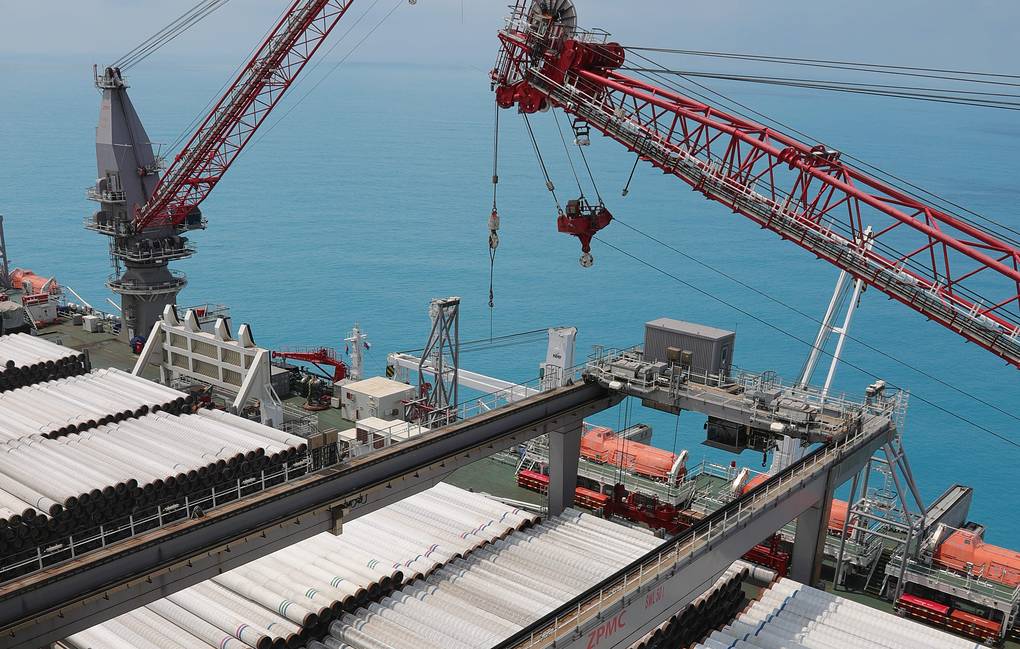
In addition to gas, Washington has launched an investment package, infrastructure and logistics support to penetrate deeper into the Asian supply chain, reducing the region's dependence on its main rival, China. In the Western Hemisphere, Washington said it would strongly counterattack the economic impact of Beijing.
For Russia, there are not many strategic documents written, but the message is clear: the US wants to end the Ukrainian conflict and find a state of strategic stability, but not let Russia - an energy power - return to the European market without getting control.
After 2022, Russia will shift its huge energy flow to Asia. But the US, like in Africa and Latin America, is also jostling these markets.
Igor Yushkov, an expert from the Russian National Energy Security Fund (FNEB), said the US has long wanted to clear its market path.
Previously, Washington strongly opposed Russian projects such as Nord Stream or South Stream, even sending special representatives to Caspi energy projects to promote alternative sources for the EU. But now, he said, the US is only promoting its own projects.
Maxim Shaposhnikov, an advisor at the Industrial Code Fund, said that the US strategy shows that Washington wants to turn Russian businesses into resource suppliers for the US trade system - similar to the early post-Soviet period, when the US supported mining and LNG technology in exchange for influence.
As for the Middle East, Washington is reshaping relations in the region, but still wants to prevent a hostile power from dominating oil and gas here.


