
Proposal to soon issue standards for parking and charging areas for electric vehicles in the basement
At the seminar "Hanoi bans gasoline motorbikes by the hour: What calculations for infrastructure and livelihoods?" organized by Dan Tri Newspaper on December 9, Mr. Dao Viet Long - Deputy Director of Hanoi Department of Construction informed about the direction to handle the situation of some apartment buildings refusing to receive electric motorbikes.
According to Mr. Long, in parallel with the support policy, Hanoi has identified developing charging station infrastructure as a key factor in the conversion process. After two surveys, the Department of Construction has identified 110 potential locations to install public charging stations from Ring Road 3 and above. Most of the locations meet technical conditions. However, the biggest difficulty at present is that central ministries and branches have not fully issued national standards on charging stations
The Department of Construction has reported to the City People's Committee a pilot plan for installation at licensed parking lots and some suitable locations to proactively prepare infrastructure. According to Mr. Long, not all Ring Road 3 areas have charging stations but only deploy them at 110 suitable locations, ensuring feasibility and resource saving.
The technology of quickly replacing batteries for two-wheeled electric vehicles is also considered a supplementary solution to shorten charging time and ensure fire safety.
The draft resolution also clearly stipulates the ratio of charging stations in parking lots and public works. At least 15% of parking spaces at existing parking lots in the Ring Road 3 area must have charging stations before 2030. For newly built works, this rate must reach at least 30%. Charging stations are required to operate according to a shared model, not serving exclusively to any car company to ensure fairness and limit space waste.
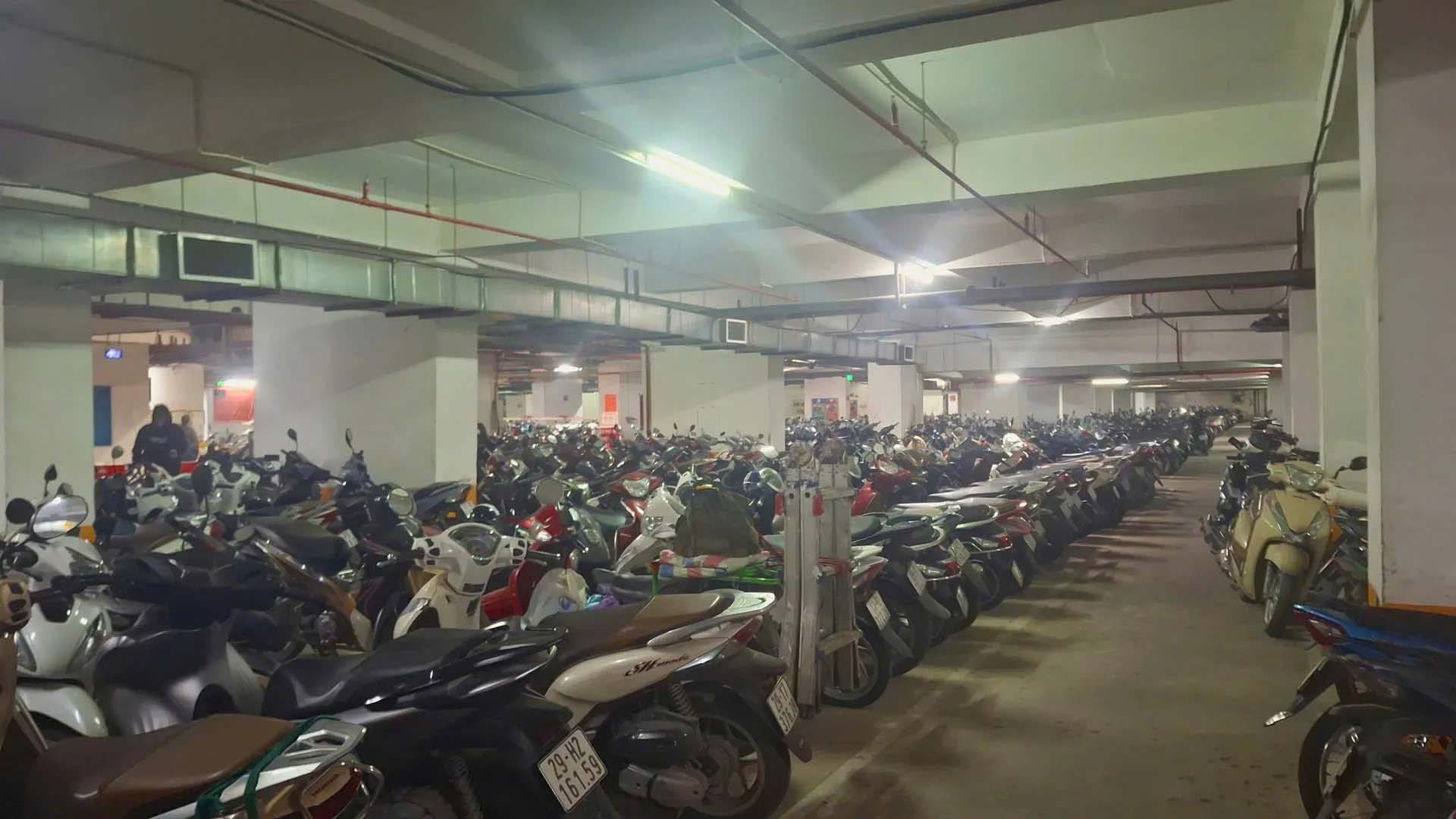
Regarding the situation of some apartment buildings refusing to accept or banning electric vehicle charging in basements, Mr. Long said that according to the 2023 Housing Law, handling is under the authority of the People's Committees of communes and wards.
In the immediate future, local authorities need to coordinate with the apartment management board to review and arrange separate electric vehicle parking areas, ensuring fire safety, and at the same time consider surrounding land funds to add parking lots and charging stations.
In the long term, departments and branches will coordinate to guide localities in handling disputes and recommend that ministries and branches soon issue standards for parking and charging areas for electric vehicles in the basement.
In the field of public transport, Hanoi has identified large-volume transport as a "backbone" in its strategy of reducing private vehicles. The city is developing a plan to put mini electric buses into operation on small streets in the old quarter and the old quarter. With urban railway, the goal is to complete important items of the Nhon - Hanoi Railway Station, Nam Thang Long - Tran Hung Dao and Van Cao - Hoa Lac lines, aiming for a network of more than 600 km in the future
In addition, Hanoi is promoting the public bicycle model. From December 2025, the system has had 600 electric bicycles and 1,000 motorbikes at 130 locations, expected to increase by 5,000 vehicles before July 2026 and reach 10,000 vehicles by the end of the year
Mr. Dao Viet Long affirmed that the green transformation process is a big step, with a wide impact, but all decisions of Hanoi put people and businesses at the center.
The city will continue to improve policies in the direction of listening, sharing and openness, towards the ultimate goal of a safer, sustainable, and better quality living environment for the whole community.
Is the roadmap for converting to green vehicles too fast?
When asked whether the roadmap for converting green vehicles is too fast or causing pressure on businesses and people, Mr. Long said that first of all, the city will not implement it in a dispersed manner, but clearly identify the group of vehicles that need to have a roadmap for conversion in advance as well as policies to support conversion for this group, ensuring that it is suitable for practical conditions and the ability to respond of businesses and people.
The first group is motorbikes and mopeds operating in the transport business, including vehicles using transportation connection applications, 20% before January 1, 2027, 50% before January 1, 2028, and 100% completed before January 1, 2030.
The second group is taxis and cars carrying up to 8 people for transportation business activities, including vehicles using technology platforms.
According to the draft, the two most important milestones for this group include: (1) From July 1, 2026, 100% of new replacement and investment vehicles are clean energy vehicles, (2) 50% before January 1, 2028 and (3) 100% completed before January 1, 2030.
These conversion rates are proposed on the basis of working and receiving comments from units, not one-sided forced.
Thus, businesses, both transportation business units and transportation connection software providers, will have the entire 2026-2030 period to proactively plan the conversion, without being subject to pressure to change simultaneously.
"I would like to clarify: We have put the group of transportation businesses in the conversion roadmap sooner, there is a reason. This is a group of vehicles with a very high frequency of operation - running continuously in urban areas, traveling long distances every day, so the amount of emissions to the environment is also much higher than conventional personal vehicles.
Early conversion to this group of vehicles means that we have significantly reduced emissions, noise and air pollution in the inner city area," said Mr. Long.


