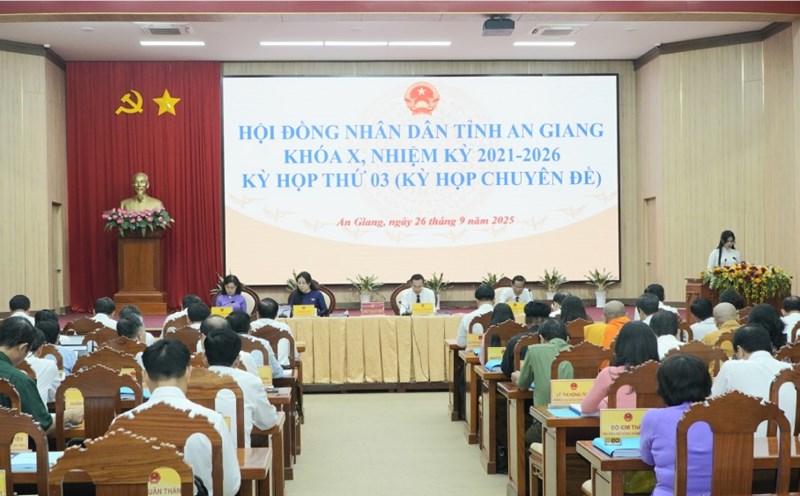
On December 9, the People's Council of An Giang province held its 6th session (special session) to review and decide on a number of contents under the authority of the Provincial People's Council.
In his opening speech, Standing Deputy Secretary of the Provincial Party Committee, Chairman of the An Giang Provincial People's Council Nguyen Thanh Nhan emphasized that this is a session of special significance, entering 2026 - the first year of implementing the 5-year financial - budget plan, the second year of implementing the new administrative unit model after the arrangement.
In 2026, new and urgent requirements are set out such as: restructuring the financial - budgetary system in line with the two-level government model and meeting new governance requirements; ensuring spending efficiency in the context of resources having to meet more goals...
According to the orientation of the 5-year financial plan 2026-2030, An Giang province aims to strive for an economic growth rate of 11% or more, the scale of GRDP at current prices reaching nearly 2.4 million billion VND in the whole period; the total state budget revenue is expected to be more than 162 trillion VND.
According to Mr. Nguyen Thanh Nhan, to make a breakthrough and become a fairly developed province by 2030 in the spirit of the Resolution of the First Provincial Party Congress, An Giang province must synchronously combine many solutions, from perfecting institutions, improving governance quality and operating capacity to ensuring resources and organizing effective implementation.
At the session, the People's Council delegates voted to approve 4 resolutions. Specifically: Regulating principles, criteria and norms for regular state budget allocation in 2026 in An Giang province; Regulations on decentralization of revenue sources, expenditure tasks and the percentage (%) for revenue division between the provincial budget and the commune budget in 2026 in An Giang province; State budget revenue estimate in the area and local budget revenue and expenditure estimate in 2026; Local budget allocation in 2026.
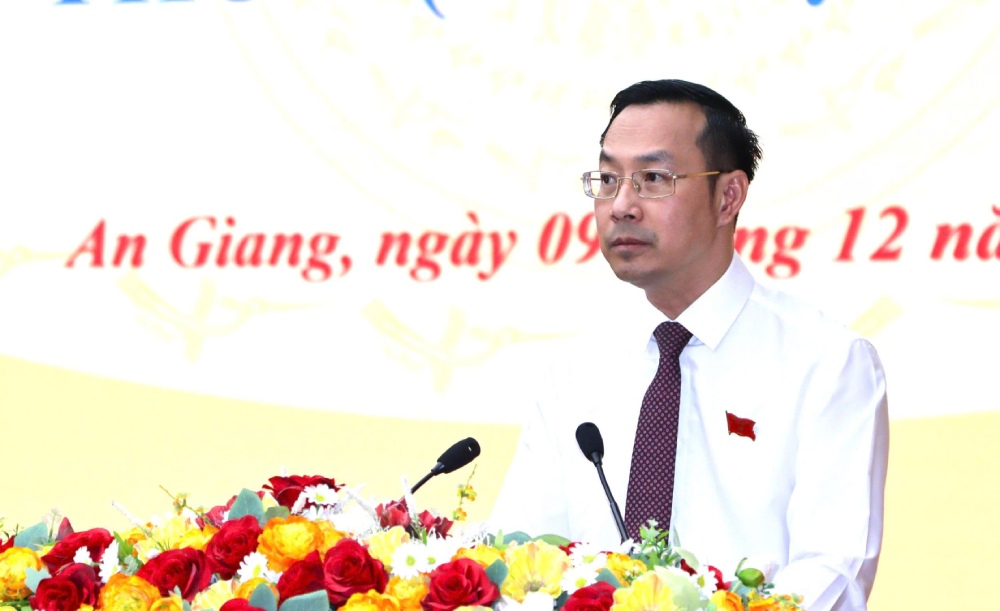
The 4 resolutions submitted at today's session are one of the factors of special significance - creating a legal basis, shaping the province's financial and budgetary framework in 2026 and being the foundation for the entire period of 2026 - 2030, Mr. Nguyen Thanh Nhan emphasized.
The session focused on solving 3 key issues: Resolution on decentralization of revenue sources, expenditure tasks and regular expenditure norms in the direction of strengthening decentralization, expanding proactiveness for localities, but at the same time also assigning the responsibility of balancing revenue and expenditure, improving discipline and order and enhancing financial autonomy of commune-level authorities in the two-level government model.
The Resolution on the allocation of estimates and budget allocation for 2026 shows a relatively comprehensive financial picture: Total state budget revenue is over 32 trillion VND; total local budget expenditure is over 59 trillion VND, the surplus is 87.2 billion VND within the permitted limit. In particular, the development investment spending structure is over VND15 trillion to focus resources on infrastructure and fields to create growth momentum; prioritize increased spending on science, technology and innovation; Education spending alone is over VND13 trillion - accounting for a large proportion of regular spending, demonstrating the province's determination to improve the quality of human resources, a decisive factor for development.
The report on the 5-year financial plan for 2026 - 2030 not only provides orientation but also shows the province's efforts in managing public debt safely and sustainably. The total maximum loan amount for the entire period is about 26 trillion VND; the outstanding loan at the end of the term is expected to be only 6.24% compared to the total local budget revenue - much lower than the ceiling according to regulations, ensuring no burden on the budget and for future generations.