
On June 9, information from the People's Committee of Lao Cai province said that the Provincial People's Council has issued Resolution No. 04/2026/NQ-HĐND stipulating the level of regular maintenance contracts for roads managed by the locality in the province.
The Resolution applies to agencies, units, organizations and individuals related to regular maintenance activities of the local road system.
According to regulations, the contracted expenditure level is determined according to each type of road. In which, highways are applied a level of 140 million VND/km/year; national highways 50 million VND/km/year; provincial roads 35 million VND/km/year.
Other roads managed by the provincial level, internal roads in industrial parks and economic zones are also applied at a rate of 35 million VND/km/year. Urban roads are contracted at 20 million VND/km/year; commune roads 15 million VND/km/year and village roads 5 million VND/km/year.
For the bridge system, the contracted expenditure level is regulated according to the length and type of road. Bridges on national highways, provincial roads and roads managed by provincial levels with a length of up to 300m are subject to a rate of 420,000 VND/m of length/year; bridges over 300m are subject to a rate of 550,000 VND/m of length/year.
For bridges on urban roads, commune roads and village roads, the contracted spending level is 190,000 VND/m of length/year.
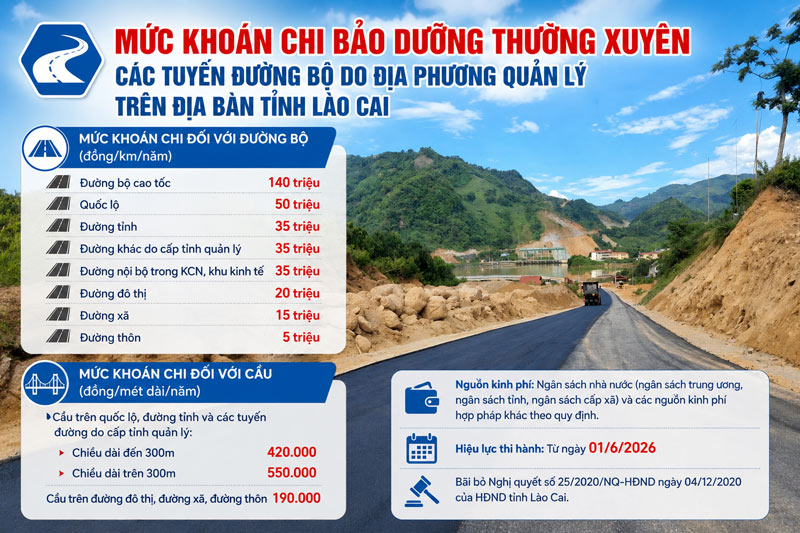
The funding source for implementation includes the central budget, provincial budget, commune-level budget and other legal funding sources as prescribed.
The Resolution takes effect from June 1, 2026, and at the same time abolishes Resolution No. 25/2020/NQ-HĐND of the Lao Cai Provincial People's Council on the level of contract for regular maintenance of bridges and roads managed by the locality.
According to Lao Cai Provincial People's Committee, the promulgation of new regulations aims to ensure a unified legal basis in the management and use of maintenance funds for road traffic infrastructure; improve the efficiency of project exploitation, extend the lifespan of infrastructure and ensure traffic safety in the area.


