
Difficulties and obstacles in energy transition and renewable energy development in Vietnam
In recent years, energy transition has become an inevitable trend globally to respond to climate change, ensure energy security and implement commitments to reduce greenhouse gas emissions.
According to the International Energy Agency (IEA), renewable energy currently accounts for nearly 30% of global electricity production and continues to be the fastest growing source of electricity for many consecutive years. In Vietnam, with advantages in solar, wind, hydropower and biomass potential, our country has experienced a period of strong renewable energy development from 2019 to 2021. However, the transition process is facing many systemic bottlenecks, directly affecting the implementation of the adjusted Power Plan VIII, ensuring national energy security and attracting investment.
It is noteworthy that the current difficulties are no longer simply finding investors or choosing technology. The biggest challenge has shifted to a new stage: how to operate safely, stably and economically an electricity system with an increasingly high proportion of renewable energy. This is a problem that most energy transitioning countries are facing and Vietnam is no exception.
1. Unsynchronized and seriously overloaded power grid infrastructure
This is one of the biggest challenges today. Vietnam's power grid system is designed mainly for traditional centralized power sources, so it is not ready to receive distributed and highly volatile renewable energy sources.
By the end of 2025, the total power source capacity nationwide will reach about 87,600 - 95,000 MW, of which renewable energy (excluding large hydropower) accounts for 27-28%, equivalent to more than 24,000 MW. Many central and southern provinces such as Ninh Thuan and Binh Thuan often have to cut renewable energy production from 20-30%, even up to 50-60% during certain hours or when the weather changes suddenly. Typically, in 2020, about 364 GWh of solar power was cut; this situation continues to this day. This creates a paradox that Vietnam has clean electricity but cannot transmit it all to the system, causing waste of resources and reducing investor confidence.
The progress of building a new power grid is still slow due to difficulties in site clearance and capital. Although Power Plan VIII adjusted the investment requirement of more than 18 billion USD for transmission infrastructure, the actual implementation still has a large gap.
2. Policy mechanisms are unstable and lack synchronization
The initial success of the preferential electricity purchase price mechanism with the FIT price mechanism contributed to the explosion of solar and wind power. In just 3 years, Vietnam's solar power capacity has increased from nearly 0 to over 16 GW. However, this too rapid development also revealed many inadequacies, accordingly, the power system has not been prepared in terms of grid and dispatch, so many projects have to reduce capacity despite completing investment. After the FIT mechanism ended, many transitional projects continued to face difficulties in determining electricity selling prices. The transition to bidding and new electricity purchase and sale contracts has created legal loopholes. Many projects are therefore in a state of suspension or slow progress. Administrative procedures between ministries and sectors are still cumbersome, increasing costs and preparation time for investors.
Power Plan VIII adjusted in April 2025 has raised the renewable energy target (solar power reaches 46,000-73,000 MW, onshore wind power reaches 26,000-38,000 MW by 2030). However, implementation in practice is still slow due to the lack of specific guidance and synchronous coordination between national planning and local planning.
3. Challenges in investment capital and finance
Financial challenges are fundamental issues that determine the success of the energy transition process. According to the adjusted Power Plan VIII, the total investment capital demand for power sources and grids in the 2026–2030 period is estimated at 136–150 billion USD. On average, the electricity industry needs to mobilize from 27–30 billion USD each year, equivalent to about 6–7% of Vietnam's current GDP. This capital source must be invested in the development of renewable energy sources such as wind and solar, and at the same time, it is necessary to invest in 500 kV and 220 kV power grids, LNG centers, energy storage systems, energy-intensive hydropower, regulation systems and smart grids, and offshore wind power infrastructure.
Meanwhile, the Commitment to Equitable Transition Energy Partnership with 15.5 billion USD is progressing slowly, only a small part has been disbursed. High domestic lending interest rates, exchange rate risks and production cuts make many projects less attractive. Foreign investors often require electricity purchase and sale contracts to ensure sufficient conditions to easily mobilize capital from international financial institutions. In addition, the trend of reducing funding for fossil fuels from international financial institutions is creating great pressure on coal and natural gas power projects.
4. The disruption of renewable resources, the challenge of balancing regulation and flexible resource demand
This is the most profound technical difficulty. By the end of 2025, the total installed capacity of Vietnam's power system will reach about 87,600 MW, of which solar and wind power alone will be 18,000 MW and 6000 MW account for nearly 28% of the total installed capacity of the entire system. However, solar and wind power depend on weather conditions, so the output varies sharply by time and season, so only 2-16% of the electricity output in 2025 can be mobilized and has caused frequent power cuts.
As the proportion of renewable energy increases, the power system faces major difficulties in maintaining real-time supply-demand balance, stabilizing frequency and voltage. The national power system must always meet the basic principle that: At all times, the power generation capacity must be equal to the load capacity plus losses on the grid. If the power source is lower than the consumption demand, the system frequency will decrease. Conversely, if the power source exceeds the demand, the frequency will increase. When the frequency exceeds the permissible limit, the power system may become unstable or widespread incidents occur.
For coal or gas-fired power plants, power generation capacity adjustments can be made according to dispatching requirements. However, solar and wind power do not have this capability. When the sun sets, we do not have solar power. When there is no wind, we do not have wind power and renewable energy not only generates electricity but also creates fluctuations for the power system. This fluctuation is the biggest technical challenge of energy transition.
This fluctuation requires solid energy sources such as coal thermal power and gas thermal power to improve flexibility, meaning it must increase/decrease capacity at a faster and deeper rate, be ready to stop operating units more times, have larger capacity reserves, and that in return is a reduction in the lifespan and efficiency of fuel-based thermal power units, the increased use of expensive fuels such as LNG and diesel, and that is why electricity prices have to increase. This is a double challenge: it is necessary to both accept higher costs to ensure security and system flexibility, and carefully consider social factors when adjusting electricity prices.
Currently, large-scale energy storage is still limited, and forecasting and regulation tools are not yet advanced enough. We still lack many energy-intensive hydropower plants and generally do not have storage centers using batteries. The situation becomes even more complicated when we have to gradually reduce the role of coal-fired power – a stable but less flexible baseline power source.
According to the adjusted Power Plan VIII, coal-fired power will be kept at about 31,055 MW by 2030, then not newly developed and aiming to sharply reduce to nearly 0 MW by 2050. To compensate, it is necessary to strongly develop lower and more flexible sources of emissions such as gas-fired power, internal combustion engines, battery storage systems and green hydrogen. The plan sets a target for domestic gas-fired power to reach 10,861-14,930 MW and liquefied gas-fired power to about 22,524 MW by 2030.
5. Transportation electrification – An inevitable trend of the 21st century
If in the period 2010–2020, the focus of energy transition was the development of renewable power sources such as solar and wind power, then in the period 2025–2050, the electrification of energy consumption sectors will eventually become the main driving force of global energy transition. An important challenge is emerging is the electrification of transportation.
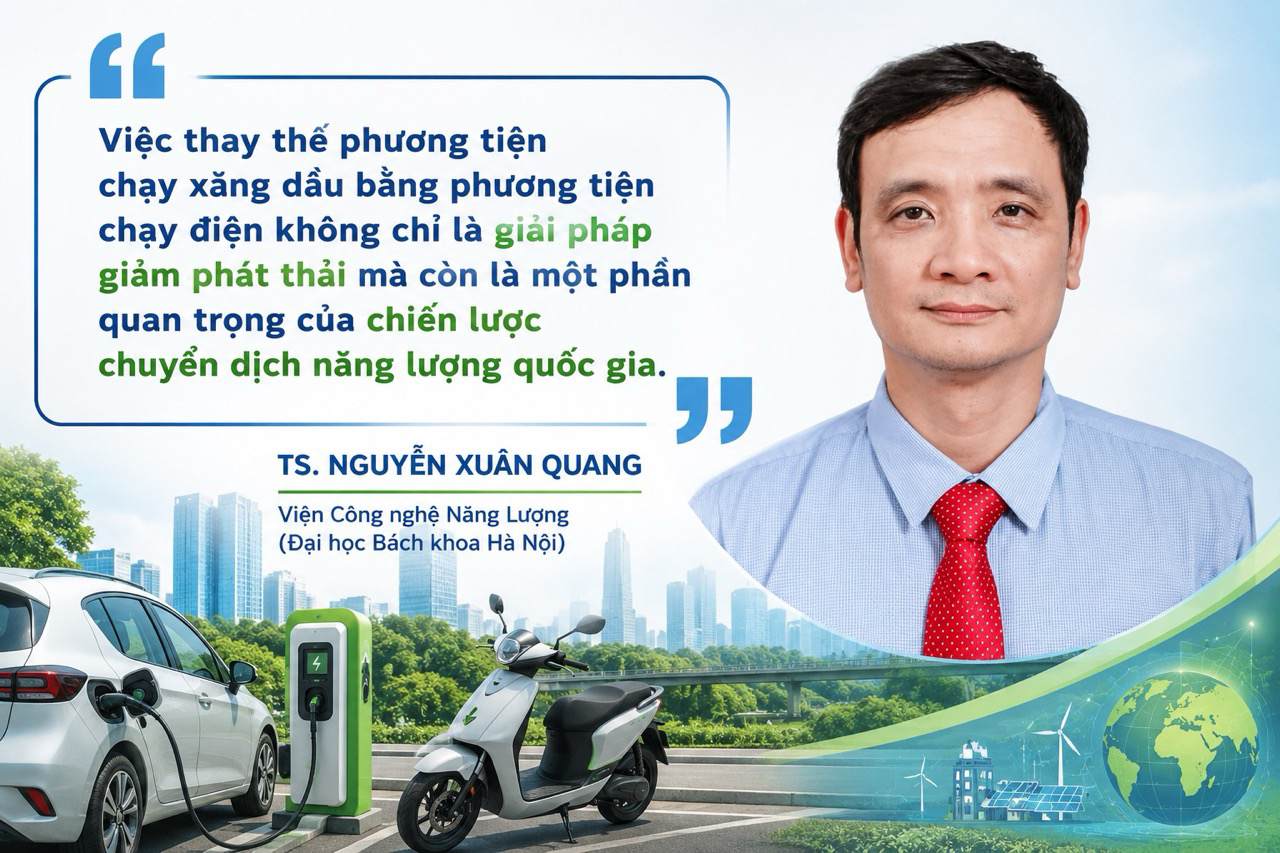
In Vietnam, transport consumes about 20–25% of the total final energy of the economy and is one of the fastest growing greenhouse gas emissions sources. Therefore, replacing gasoline and oil vehicles with electric vehicles is not only a solution to reduce emissions but also an important part of the national energy transition strategy. However, this replacement will significantly increase national electricity demand. According to recent studies, by 2030, the additional electricity demand for electric vehicles is estimated at about 3.1–5.6 billion kWh/year, equivalent to 0.7–1.1% of total commercial electricity demand. Although this increase is still limited before 2030, from 2035 onwards, especially by 2050, electricity demand for electrified transportation may account for 22–28% of total electricity demand, depending on the development scenario.
This not only requires the addition of new sources of electricity (prioritizing regeneration) but also requires strong investment in smart grid infrastructure, storage systems and charging stations, in order to avoid local overload during peak hours of battery charging, and at the same time, there must be more flexible electricity price policies to avoid encouraging battery charging during peak hours to avoid pressure to invest in a solid new source of electricity.
One of the most important impacts of electric vehicles does not lie in total electricity consumption but in the change in the load chart. Currently, Vietnam's electricity load usually peaks in the evening and if millions of electric vehicles are recharged after working hours, the electrical system may face a new form of load of a very large scale. Therefore, energy shift in the future is not only a problem of building more power sources but also a problem of smart load management. A very interesting aspect is that electric vehicles not only create new loads but can also support solving the difficulties of renewable energy. One of the technologies assessed to be able to fundamentally change the electrical system in the future is Vehicle-to-Grid (V2G). Vehicle-to-Grid (V2G) technology allows electricity flow to be transmitted in both directions, the power grid supplying electricity to the vehicle and when needed, the vehicle can recharge the grid when needed. Then each electric vehicle will become a mobile energy storage system. However, this requires the system to have a very flexible electricity price policy to be able to mobilize this uninvested storage battery source.
6. Inappropriate electricity price mechanism and lack of market momentum
One of the most sensitive issues of Vietnam's electricity industry today is electricity prices. For many years, electricity prices have always been considered from the perspective of supporting production and controlling inflation. EVN once recorded a cumulative loss of about 38,680 billion VND at the end of 2024 after the state had many policies to maintain electricity prices in the context of many fluctuations in fuel prices in the world.
This figure shows that the electricity price problem cannot only be viewed from the perspective of curbing inflation, but also from the perspective of energy security and the financial capacity of the electricity system. The energy transition process requires huge investment capital. Meanwhile, Vietnam's average retail electricity price is still much lower than many countries in the region. If electricity prices do not fully reflect the investment and operation costs of the system, the ability to attract private investment in the energy sector will face many difficulties.
The current average retail electricity price is about 2,204 VND/kWh (excluding value-added tax). The five-tier price schedule is still strictly controlled and does not fully reflect system costs, environmental costs as well as the flexible value of renewable energy.
Another important limitation is the application of unified electricity prices nationwide. With a long territory, renewable sources are mainly concentrated in the Central and Southern regions, while major consumption centers are located in the North and urban areas in the South, the general price mechanism does not accurately reflect long-distance transmission costs, power losses (about 6-8%) and the level of grid congestion. This leads to cross-subsidy between regions, lack of price signals to encourage effective investment and increases the situation of local production cuts.
Prices in new electricity purchase and sale contracts are often lower than the previous period, causing the capital recovery time to be prolonged. Large enterprises also participate less in direct electricity purchases. The fixed price mechanism, with little fluctuation over time and location, is becoming a barrier to the transition process.
7. Other challenges: Human resources, supply chains, social impacts, energy saving and economic restructuring.
Human resources are an extremely important factor in the development process. The energy transition process is fundamentally changing the way the power system operates. In the future, the electricity industry will not only need thermal or hydropower engineers as before, but also: Energy storage experts, electricity market experts, artificial intelligence experts in system regulation, renewable energy forecasting experts, network security experts for smart grids, offshore wind power project developers.
According to many international studies, the energy transition process will create millions of new jobs but also strongly change the labor structure in the energy industry. Vietnam needs to prepare high-quality human resources early to avoid over-reliance on foreign experts in new technology fields.
In addition, using energy economically and efficiently along with economic restructuring also plays a key role. Energy saving is considered the "cheapest and cleanest energy source". If we implement thrift solutions well (according to the National VNEEP Program), we can significantly reduce the demand for new energy, thereby reducing the pressure of investing in electricity sources and creating more time for renewable energy development.
Regarding economic structure, the choice of production and business industries has a great impact on energy shift. High-energy industries such as cement, steel, metallurgy, chemicals... consume a lot of electricity and fuel, emit large emissions but have low added value. Conversely, high-tech, high-value industries such as semiconductor chip manufacturing, electronics, information technology, smart devices... consume less energy per unit of GDP.
Continuing to strongly expand heavy industries will rapidly increase energy demand, put great pressure on the power system and make it difficult to achieve the Net Zero target. Therefore, shifting the economic structure towards reducing the proportion of energy-intensive industries, strongly increasing high-tech industry and high-quality services is a long-term strategic solution, helping Vietnam both achieve sustainable economic growth and implement more favorable energy transition.
CONCLUSIONS AND RECOMMENDATIONS
Energy transition in Vietnam is at an important stage.
The above difficulties are real, but can be completely overcome if there is high political determination and synchronous coordination between stakeholders.
Some key recommendations may be proposed as follows:
Accelerate investment in power grid infrastructure and energy storage systems in the form of public-private partnerships.
Completing the Electricity Law towards marketization, shortening administrative procedures.
Promote a substantively equitable Transition Energy Partnership, accompanied by a risk guarantee mechanism for production cutbacks.
Prioritize the development of gas-fired thermal power and flexible sources as a transitional bridge.
Reform the electricity price mechanism towards the market, apply two-component prices, prices by location and by usage time frame, and at the same time have appropriate support policies for remote and isolated areas.
Increase the use of energy economically and efficiently; promote economic restructuring towards high technology and added value.
Synchronous planning between the electricity and transportation sectors to respond to increased electricity demand from electrified vehicles.
Strengthen human resource training and implement fair transformation.
With its rich potential and favorable geographical location, Vietnam can completely become the renewable energy center of Southeast Asia. Energy transition is not only an environmental responsibility but also an important opportunity for sustainable economic development and ensuring long-term energy security for the country.
Let's act together for a clean and prosperous energy future.



