Nguyen Sang (1923-1988) is one of the painters who made many typical contributions to modern Vietnamese painting.
Graduating from Gia Dinh Fine Arts Secondary School and Indochina College of Fine Arts, course 14 (1940 - 1945), he is known as the person who made a significant revolution in the field of oil paint, especially lacquer. He is also known as one of the "four talents" of 20th-century Vietnamese painting, "Nghiem - Lien - Sang - Phai".
With a sophisticated artistic eye along with visual thinking and a heart always directed towards the nation, Nguyen Sang has left behind many works of profound artistic and historical value. Among them, "Admission to the Party in Dien Bien Phu" and "Youth of the Bronze Citadel" are two outstanding works of his recognized as National Treasures.
Work Admission to the Party in Dien Bien Phu
According to heritage records - documents of the Department of Cultural Heritage, the work was created in 1963 - depicting a short but solemn admission ceremony in the bunker amidst fierce warfare with 3 groups of main/secondary characters. This is one of the most typical works of painter Nguyen Sang.
The painting depicts the central character group of three soldiers, including one soldier with a bandage on his head and a gun in his hand. This group of three people is closely linked to the other two soldiers on the right side of the painting with a determined handshake.
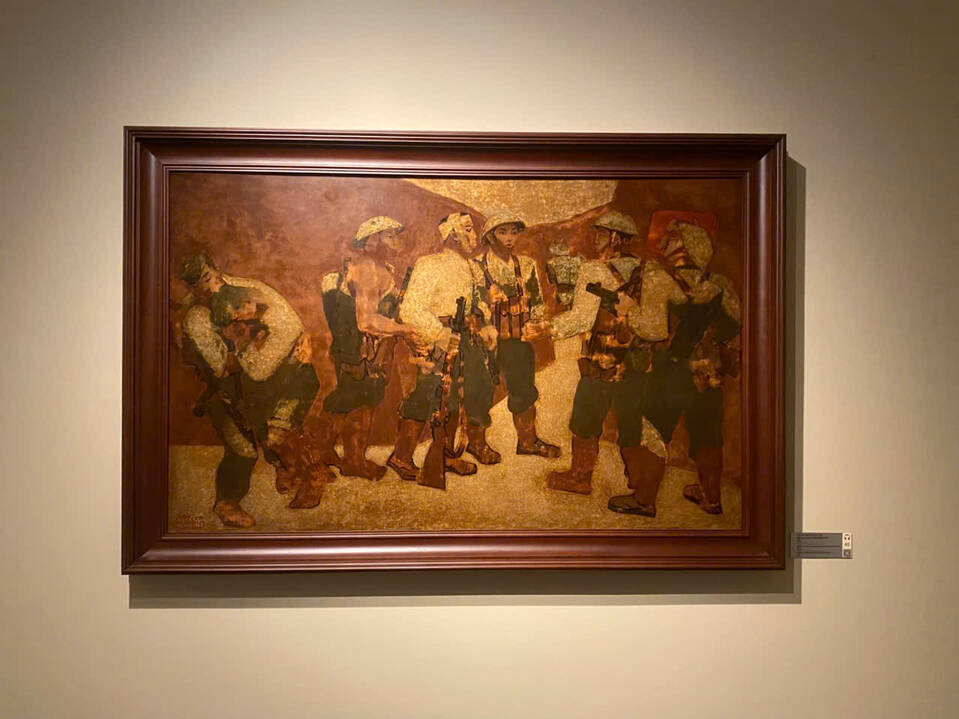
The entire Party admission ceremony takes place in the trench space. The left corner is a soldier supporting an injured comrade, showing the fragile boundary between life and death. But behind the scenes is another soldier rushing to battle as if that loss is the motivation and further emphasizes the urgent context of the war.
The work is the inheritance of the shaping style of Western art with solid realistic techniques, imbued with Vietnamese spirit and colors. It not only reflects the profound content value but is also a fundamental proof of the diverse expressive ability of Vietnamese lacquer art in addition to the decorative style in traditional fine arts.
The work is an "original and unique" artifact and is highly appreciated by many historical, cultural, and fine arts researchers with full values.
Work Thanh Nien Thanh Dong
According to documents from the Department of Fine Arts, Photography and Exhibition (Ministry of Culture, Sports and Tourism), facing the scene of a divided country, although unable to return to his homeland from the 1940s, Nguyen Sang still always yearned for his homeland. The boiling struggle movements of Saigon students in the 60s strongly moved him and became a source of inspiration for him to create the work Thanh Nien Thanh Dong from 1967 to 1978.
The work depicts the struggle and protests of Saigon students in the 1960s during the anti-American war. The painting shows the steadfast and indomitable will of the intellectual class in protesting the presence of US soldiers in Vietnam.
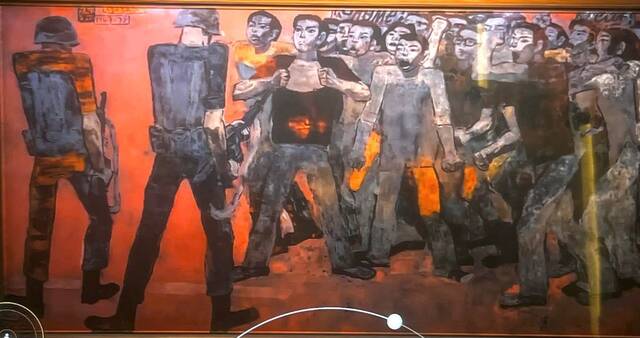
The characters are arranged in two lines: on one side are two tall American soldiers, wearing helmets, wrapped in bullet bags around their backs, wearing high-heeled shoes standing with their backs facing the viewers with guns in their hands pointed at the fighters; opposite is a large group of young men and women forming a solid block like a city wall.
The most prominent character is the young man - standing facing the American soldier, his face as sharp, resolute with hateful eyes, his hands are like flapping his chest, his legs spread wide in a steady, balanced, ready posture and as if challenging the tall American soldier, the rest of the group have a resolute attitude with their hands tightly held.
The two works "Admission to the Party in Dien Bien Phu" and "Thanh nien thanh dong" in general and Nguyen Sang's other works in particular not only affirmed his position in the history of modern Vietnamese fine arts. Those are also timeless artistic imprints, living forever in the hearts of audiences and art lovers.