Kieu Anh shared that in Que Lam there are many sidewalk eateries like in Vietnam, so the feeling of traveling abroad is still quite familiar.
Her group of 3 friends ordered a skewer tray with a price of 135 Yuan (about 553,500 VND with a exchange rate of 4,100 VND/Yuan).
The grill tray includes many familiar small strings. The squid beard is grilled just right, the beard part is curved and retains its crispness. The gizzards and pork belly are thinly sliced, grilled on a charcoal stove to drain excess fat so they are not greasy to eat. Besides, there are also beef strings, grilled balls and a few skewers of vegetables.
What makes the difference for Chinese grilled dishes lies in the marinating seasoning. The seller sprigs dried chili powder and peppercorns directly onto the meat skewers while grilling. Biting the first piece, a mild numbness appears right at the tip of the tongue, then the spiciness spreads throughout the oral cavity.
In Vietnam today, there is no shortage of skewer restaurants with standard Chinese flavor, but when directly eating locally, Kieu Anh still feels much more excited.
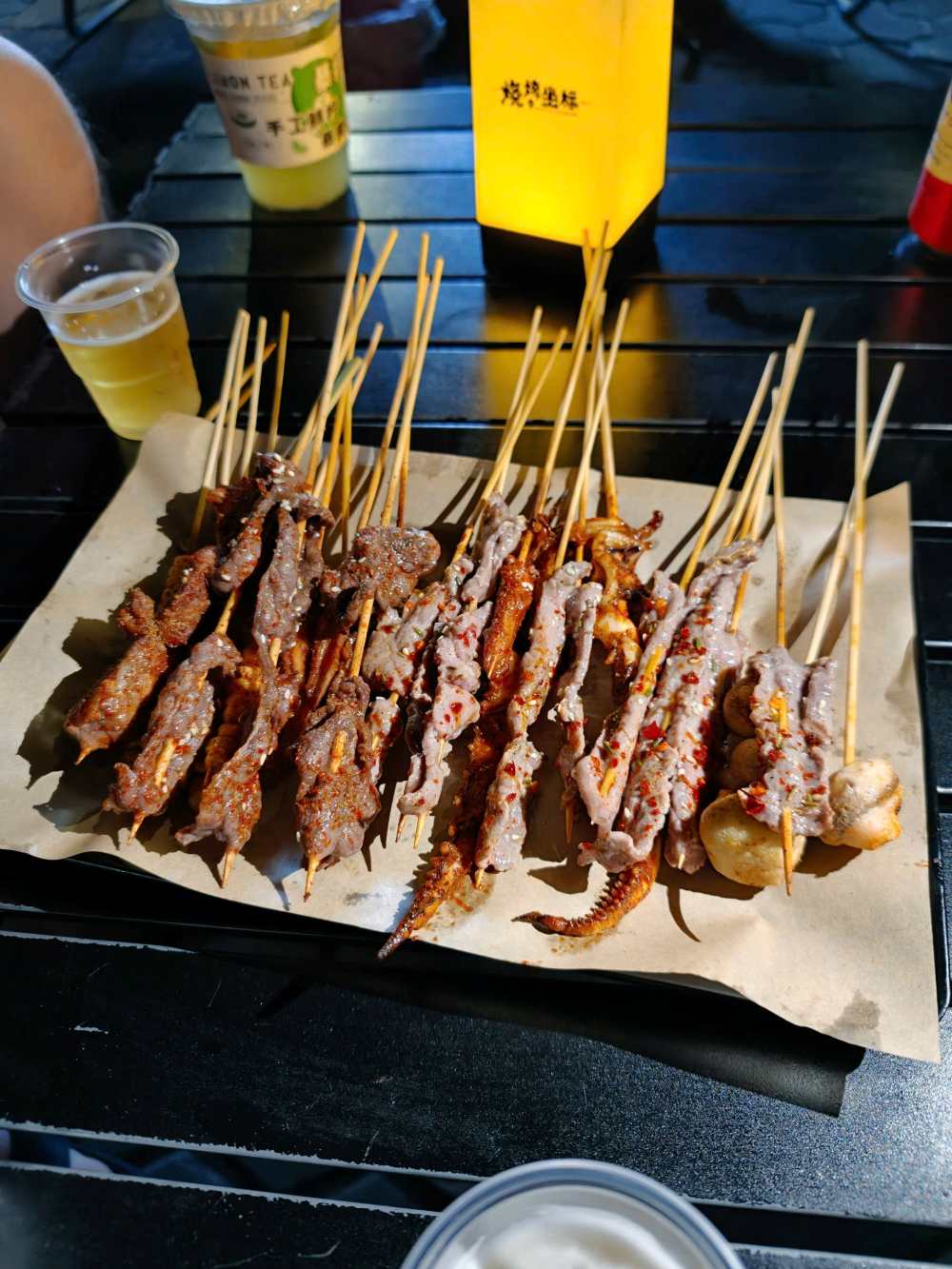
To balance the stinging taste of spices, visitors can order a glass of hand-pound lemon tea and a glass of cold beer. Sipping hot grilled skewers while drinking a sip of cool water in the night air of Guilin is a very memorable experience.
Besides culinary experiences, this tour trip also helped Kieu Anh draw quite a lot of important practical experiences.
First of all, regulations on luggage when entering the country. Kieu Anh said that it is necessary to absolutely not carry luggage for anyone else except for her own belongings. When passing through the customs gate, each person in the group is required to carry their own luggage to ensure safety and compliance with procedures.
Regarding time, China is located in the GMT+8 time zone, 1 hour faster than Vietnam. For example, when in Vietnam it is 7 am, in China it is 8 am. As soon as you arrive, you should adjust your watch and phone according to local time for convenient monitoring and focusing on time according to the delegation's schedule.
For those who like to buy technology items, it is necessary to pay attention to tariff regulations when returning home. Electronic goods brought to Vietnam worth over 300 USD will have to pay tax according to state regulations, with a tax rate applied from 50% to 75% for the outstanding value.
The issue of communication and Internet is also a point that needs careful preparation. You should buy a Chinese travel sim to be able to directly access applications such as Facebook, Zalo or Messenger. If using a Vietnamese sim to connect to the international network, the fee will be around 3 USD/minute.
A special note is that in China, both answering phones and receiving messages from SIM cards are charged, when all the money in the SIM card is called, you can top up to continue using it.
When you need to call Vietnam via mobile sim, you press 0084.9... (for mobile numbers) or 0084.4... (for landline numbers), and to text, press +84.9... or +84.3....
In case you want to use a landline phone at the hotel to call home, you must contact the reception desk to deposit from 200 CNY or more, the actual fare is about 10 CNY/minute.
Finally, there is the tip culture for tour guides and drivers. This is a worthy reward for their labor and attentive service throughout the trip.
The general regulation is 5 USD/day for each passenger. Kieu Anh's experience is that the whole group should elect a group leader to collect all tips and represent them to give to tour guides and drivers on the last day of the tour.