
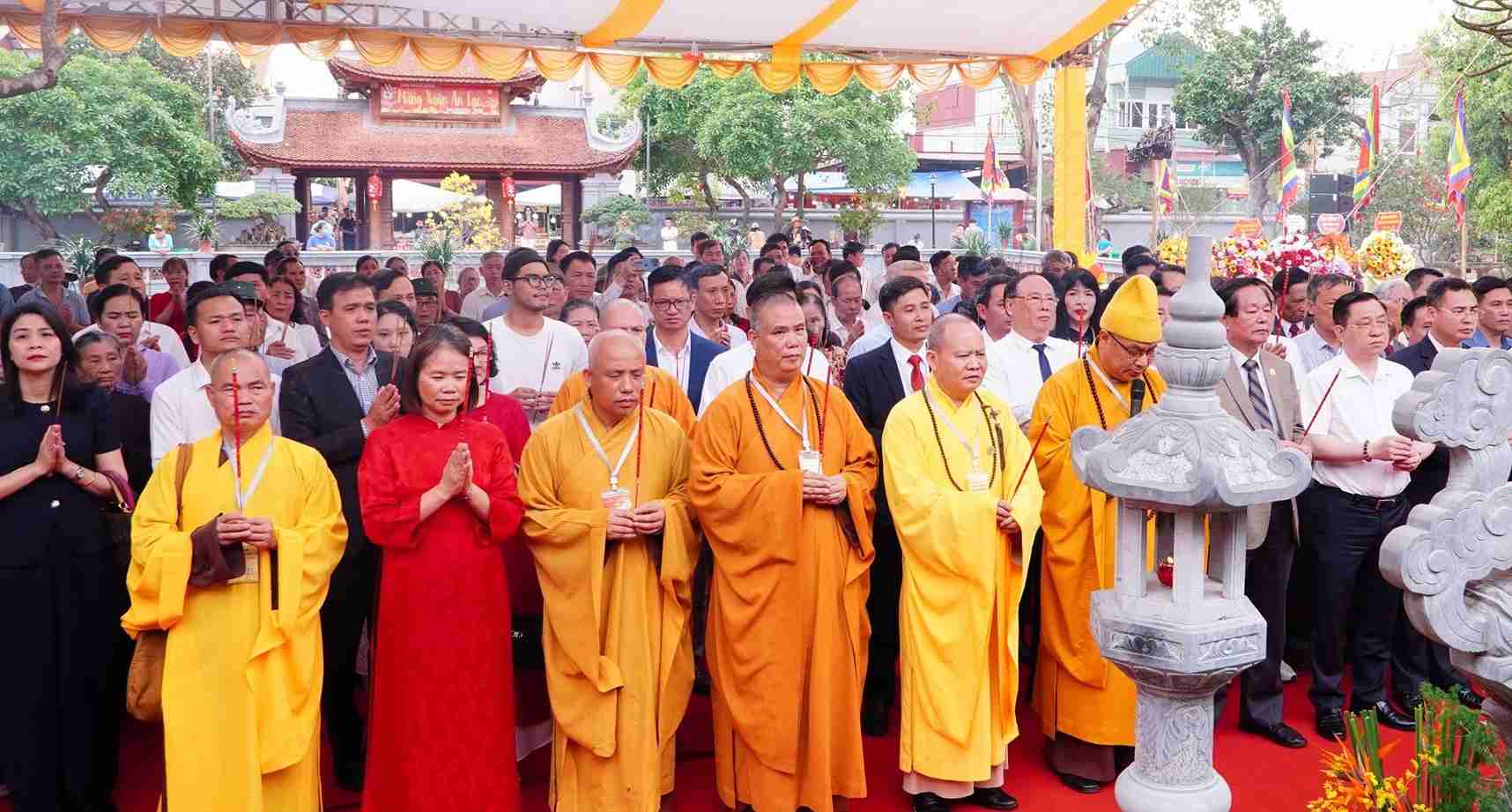
On April 1st, at the special national relic Giam Pagoda (Cam Giang commune, Hai Phong city), the Organizing Committee opened the traditional festival of Giam Pagoda in 2026, commemorating the 626th anniversary of the death of the Great Physician - Zen Master Tue Tinh (1400-2026).
Zen master Tue Tinh, real name Nguyen Ba Tinh, from Nghia Phu village (now Cam Vu commune). Orphaned from a young age, he was raised in a pagoda and early showed intelligence and eagerness to learn. Although he passed the Thai student exam under the Tran Du Tong dynasty, he did not choose the path of officialdom but became a monk, dedicating his whole life to researching medicine and treating patients.
With the viewpoint "Nam Duoc Tri Nam Nhan", Zen Master Tue Tinh has painstakingly collected and researched folk remedies, developing them into a system of medical theory and practice. He is the author of many valuable works such as "Nam Duoc Than Hieu", "Hong Nghia Giac Tu Y Thu", contributing to laying the foundation for our country's traditional medicine.
According to historical records, during his time working in his hometown, he built many pagodas as places to examine and treat diseases, teach medicine to monks and nuns, contributing to spreading the spirit of medical ethics in the community. These great contributions helped him to be honored by posterity as the "father of Southern medicine".
In 1384, Zen Master Tue Tinh was sent on a mission to China. Here, he cured the disease of the Empress of the Ming Dynasty and was awarded the title of Great Zen Master. However, he did not have the opportunity to return to his homeland. Before passing away in a foreign land, he left a touching line: "Whoever returns to the South, let me return".
More than two centuries later, Dr. Nguyen Danh Nho, when on a mission, visited the tomb, copied the stele and brought it back to the country. The stele was later erected at Bia Temple (Cam Van commune), becoming a relic associated with the life and wishes of the famous doctor.
The annual Giam Pagoda opening ceremony is not only an occasion to show gratitude for the merits of Zen Master Tue Tinh but also contributes to educating tradition, honoring medical ethics and promoting the cultural and historical heritage values of the locality.


