
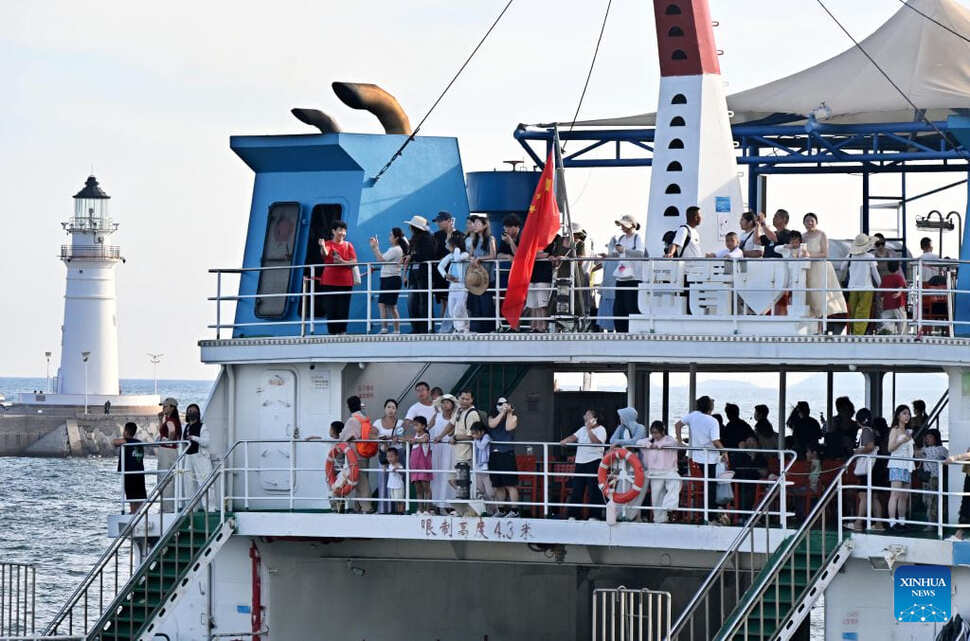
In order to diversify products and meet the needs of tourists' experiences, the Management Board of Qingdao Olympic Sea and Sailing Cultural Tourist Area - a famous landmark that was once the venue for sailing events at the 2008 Beijing Olympic Games - has promoted and exploited simultaneously many tourist boat routes connecting prominent destinations, stretching from Jiaozhou Bay to Zhaitang Island.
Real-world records from Xinhua news agency show that a large number of tourists have flocked to the sailing wharves to learn about the itinerary information and directly experience the cruise along the coast. Tourists can leisurely enjoy the modern coastal urban landscape, take souvenir photos and immerse themselves in the unique marine cultural space of Qingdao.
Efforts to elevate waterway tourism products in Qingdao take place in the context of China's tourism industry witnessing a strong boom thanks to the open visa policy.
Previously, on August 20, the China National Immigration Administration (NIA) officially added Vietnam and Kyrgyzstan to the 240-hour (10-day) transit visa exemption program, bringing the total number of countries benefiting from this policy to 57 countries.
The new regulation allows Vietnamese citizens to carry a common passport and have an international transit ticket to a third country to enter the country through 65 designated border gates and stay for a maximum of 10 days for sightseeing, work or family visits. In addition, citizens of these two countries are also subject to a 30-day visa exemption policy when entering Hainan province.
The continuous series of visa easing policies, from expanding unilateral visa exemptions to extending transit times, has created a large wave of interest in Chinese tourism.
According to NIA data, Chinese border management agencies handled a record 369 million entry and exits in the first half of this year (up 10.8% compared to the same period last year). Notably, the number of foreign visitors entering under visa exemption increased sharply by 30.6%, exceeding the 17.8 million mark and accounting for more than 3/4 of the total number of international visitors.
In the first half of this year, Vietnam was the 4th largest international tourist sending market of China, after South Korea, Russia and Malaysia. At border gates such as Ha Khau (Yunnan province), traffic volume has exceeded 4 million people with more than 20,000 tourist groups.
The combination of favorable visa policies and new and attractive sea tourism products in cities like Qingdao is expected to continue to be an important lever, opening up opportunities for international and Vietnamese tourists to access and explore more diverse destinations in the populous country.


