
From April 1, Quang Ninh and Hai Phong deployed a plan to transport passengers across the heritage area, connecting Ha Long Bay with Lan Ha Bay. This is a specific step to concretize the regulation on coordination of inland waterway vehicle management between the two localities, signed on March 26.
Accordingly, tourist boats on both sides will be allowed to transport tourists interlinked between the two bays, instead of having to transit as before. This opens up a new experience space, contributing to the formation of large-scale inter-regional tourism products.
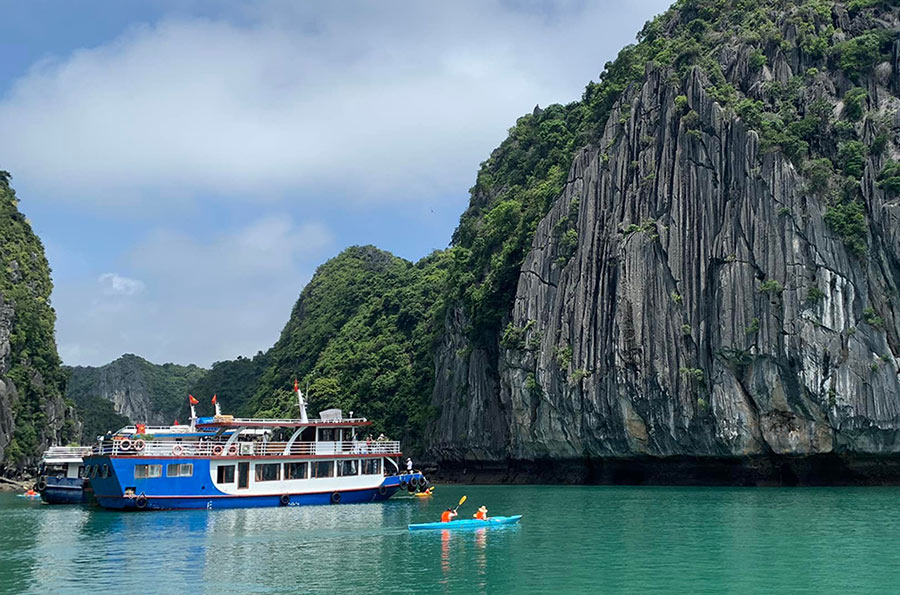
Along with the opening of the route, 4 routes connecting the two bays were also announced.
Specifically, the first route (Ha Long 3 - Lan Ha) takes tourists through Cua Van Floating Cultural Center, Tien Ong cave, Ba Ham lake... (Ha Long) to Tra Bau, Sang - Toi cave, Ba Trai Dao, Cai Beo fishing village (Lan Ha).
The second route connects points such as Thien Canh Son cave, Thay cave, Vung Vieng, Tung Ang eco-tourism area (Ha Long) with Tra Bau, Gia Luan, Sang - Toi cave (Lan Ha).
The third route (Ha Long 5 - Lan Ha) combines familiar tourist symbols such as Thien Cung cave, Dau Go cave, Trong Mai island (Ha Long) with Gia Luan area, Ba Trai Dao, Viet Hai estuary (Lan Ha).
The fourth route (Ha Long 6 - Lan Ha) passes through Chan Voi island, Ba Cua valley, Tung Lam island (Ha Long) and connects to Tra Bau, Sang cave - Toi cave, Ba Trai Dao (Lan Ha). Overnight accommodation ships will be anchored in areas under local management.
The connection of the two heritage areas is expected to create a boost for regional tourism. According to forecasts, when operating stably, Ha Long Bay may welcome an additional 5,000-6,000 visitors and dozens of accommodation ships from Lan Ha each day.
To ensure safe and sustainable operation, localities require unifying vehicle standards, strictly complying with regulations on technical safety and environmental protection. Ship coordination will be based on tonnage at sightseeing points, ports and anchorage areas; at the same time, functional forces strengthen inspection and supervision.
Previously, about 500,000 visitors each year had to travel by high-speed train to switch routes between the two bays, causing inconvenience and limiting the experience. The opening of this route is expected to remove prolonged bottlenecks and at the same time enhance the attractiveness of the heritage complex on the Vietnam tourism map.
According to the Ha Long Bay - Yen Tu World Heritage Management Board, after the regulation takes effect, it is expected that Ha Long Bay will welcome an additional 5,000 to 6,000 visitors per day and over 50 overnight cruise ships from Lan Ha Bay.


