
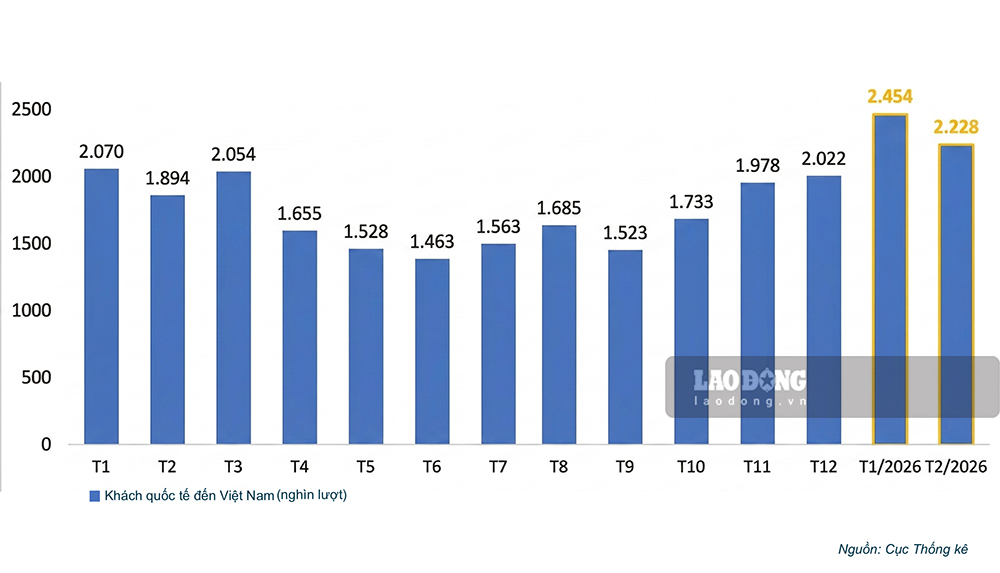
In general, in the first two months of 2026, Vietnam welcomed more than 4.68 million international visitors, an increase of 18.1% compared to the same period last year, according to a report by the Statistics Office.
Although down 9.2% compared to January 2026, the number of international visitors in February increased by 17.7% compared to the same period last year.
February 2026 is the third consecutive month Vietnam has welcomed more than 2 million visitors per month. Previously, Vietnam welcomed 2.45 million international visitors in January 2026 and 2.02 million visitors in December 2025.
South Korea rose to hold the position of the largest sending market in the first two months of the year, with about 971,000 visitors in the first two months of the year, an increase of about 10% compared to the same period in 2025.
The Chinese market ranked second with about 923,000 visitors. While the Japanese and Taiwanese (China) markets maintained stable growth momentum.
In particular, the Indian market recorded 158,000 visitors, an increase of more than 71% compared to the same period last year.
Major markets recorded very good growth such as the UK (up 17.1%), France (up 19.8%), Germany (up 17.5%).
In particular, Russia continues to be the largest market in Europe with 247,000 visitors (up 212.5%).
Meanwhile, many Southeast Asian markets recorded positive growth in the first two months of the year. Philippines (up 72%), Singapore (up 35%), Indonesia (up 27%) and Malaysia (up 16.5%) all grew by two digits compared to the same period. Cambodia continued its strong growth momentum compared to the same period last year (up 95.1%).
The Vietnam National Authority of Tourism assesses that the uniform growth from Northeast Asian, ASEAN, European and distant markets shows that Vietnam's international visitor structure is becoming more diverse and balanced.
This is an important foundation to help the tourism industry maintain growth momentum in 2026, while enhancing the competitiveness of Vietnam's destinations in the context of increasingly competitive global tourism.


