
This year, the 23rd day of the twelfth lunar month falls on Tuesday, February 10, 2026.
According to the book "Traditional Vietnamese Worship - Rituals and Ritual Practices" (World Publishing House), the offering tray for worshiping Ong Cong and Ong Tao has offerings depending on regional culture and customs and depending on the circumstances and conditions of each family.
Depending on the family's destiny, it can be real carp for release or paper carp (code paper) to burn and offer to the Kitchen Gods. Besides, there are indispensable offerings such as incense, lamps, candles, flowers, fruits, cakes, candies...
However, between the three regions of North - Central - South, each place has some differences in the time of worship and offerings.
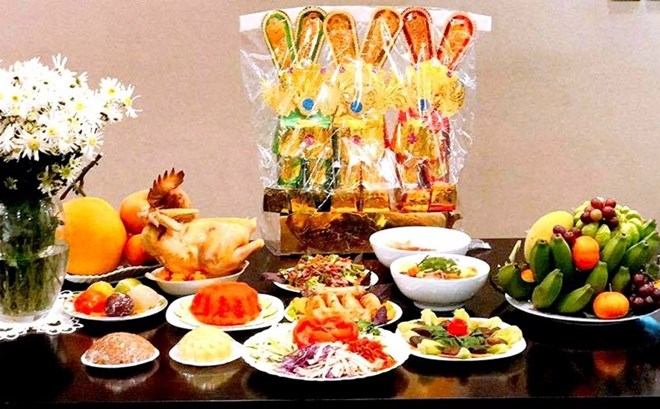
Offering trays for worshiping Ong Cong and Ong Tao in the North
In the North, people usually perform the Ong Cong Ong Tao worshiping ceremony from dawn on the 23rd, some places can start from the 20th, at the latest at 12 noon on the 23rd day of the twelfth lunar month.
The offering tray for worshiping Mr. Cong and Mr. Tao includes a full range of traditional dishes such as sticky rice, chicken, spring rolls, spring rolls, spring rolls, bamboo shoot soup... In particular, in the offering tray in many localities in the Northern region, there is also sticky rice and sweet soup, usually "che ba cot", cooked with sticky rice, sticky rice, brown sugar and ginger.
The carp offered here can be live carp, or paper carp (coffins), depending on each family. After burning incense and praying is completed, the homeowner will release live carp into ponds, lakes, and rivers near the house, avoiding dirty lakes and stagnant ponds.
Offerings for worshiping Ong Cong and Ong Tao in the Central region
In the Central region, the time to worship Ong Cong and Ong Tao is the night of the 22nd, dawn of the 23rd of the lunar calendar. Instead of worshiping carp like in the North, people here often worship a paper horse with a full set of saddle and reins.
Some regions such as Hue and Hoi An have the custom of worshiping earth statues of the Kitchen Gods. The set of earth statues is full of hard dust, fresh flowers, fruits, placing new and old statues next to each other. The offering tray is also similar to the North, but must have mackerel or tuna.
Offering trays for worshiping Ong Cong Ong Tao in the South
In the South, people usually perform ceremonies in the evening, from 8 pm to 11 pm. Southerners believe that at the end of the day, after the whole family finishes dinner, no longer cooking and using the kitchen, they are allowed to see off the Kitchen Gods to meet the Jade Emperor.
People will offer paper hats, shirts and boots. According to author Huynh Ngoc Trang in Special Discussion on Family God Worship, in the South, the custom of bringing Ong Tao is slightly different, instead of offering carp to bring Ong Tao, people use a set of paper "co bay ngua chay" (some places also called "co bay co bean"), meaning horses carry Ong Tao by road and then storks carry Ong Tao back to heaven.
Due to cultural intersection, the offering tray of Southern people is also similar to Northern people. In addition to Southern savory dishes, there is also 1 plate of keo theo leo candy (keo vung/me den) or in some places mainly only keo theo leo candy is offered.
Although there are some differences between the three regions, in general, the Kitchen Gods worship ceremony only needs a simple tray of rice, sticky rice, sweet soup, betel and areca, and fruits, without being too elaborate or expensive. People should avoid the wrong concept of spending millions of dong to buy many votive papers to burn with the belief that if they offer the tray high, they will be "forgiven" by the Kitchen Gods for their bad deeds and be granted many blessings.
To date, there are still no researchers or books to mention that worshiping Ong Cong and Ong Tao on the ancestral altar or under the kitchen is "standard". Usually, offering offerings and incense to worship Ong Cong and Ong Tao are performed on the ancestral altar or divine altar.
In the South, people often set up separate Kitchen Gods altar placed in the kitchen, near the cooking place, and they perform the Kitchen Gods worship ceremony right at this altar.


