
According to the Department of Agriculture and Environment of Can Tho City, with the advantage of 72km of coastline, 3 large river mouths and abundant water resources all year round, Can Tho identifies aquaculture as a spearhead economic sector, in which brackish water shrimp plays a key role, contributing greatly to agricultural growth.
In the period of 2015 - 2024, brackish water shrimp output increased by an average of 11.1%/year, from 90.854 tons to 232,872 tons, an increase of more than 2.5 times. In 2025, the city aims to maintain 96,500 hectares of aquaculture, of which 51,000 hectares are for shrimp farming, with an output of 705,958 tons, and 229,700 tons for shrimp alone.
Recently, many high-tech shrimp farming models such as 2 - 3 stage tarpaulin ponds, semi biofloc, automatic monitoring... have been replicated, helping the yield of white-leg shrimp to reach 20 - 30 tons/ha/crop. By the end of 2024, the area of tarpaulin shrimp farming reached 8,664 hectares, an increase of nearly 12% compared to the previous year, concentrated in Vinh Chau, My Xuyen, Tran De, Cu Lao Dung, Long Phu.
Enterprises invest in mechanizing the entire process, from pond renovation to harvesting; using automatic feeding floors, monitoring the environment using a modern monitoring system. The city has issued more than 7,500 breeding codes, helping to trace the origin, ensuring transparency, meeting the requirements of the export market.
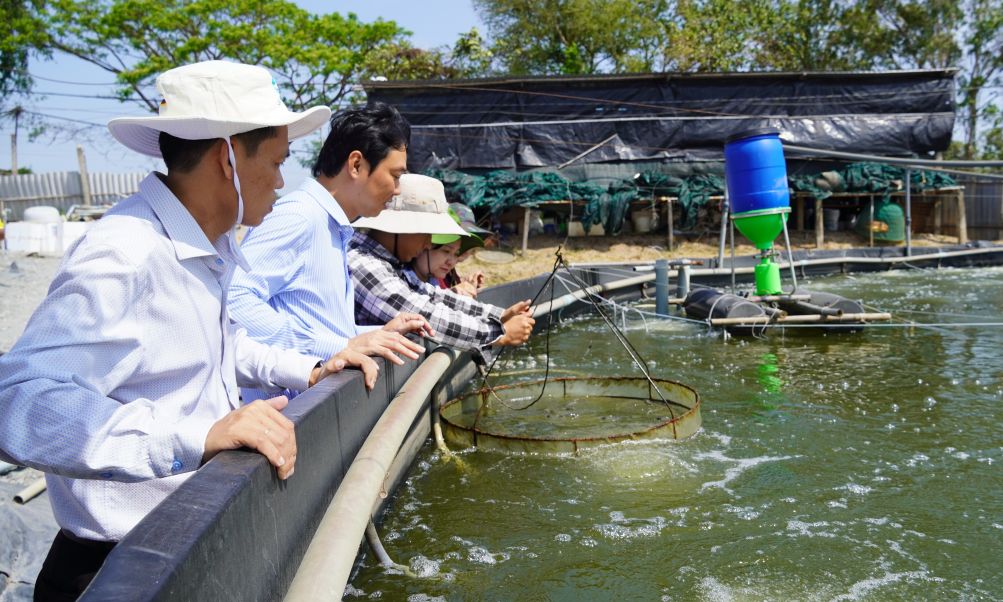
To maintain its position and meet market requirements in the context of climate change, the agricultural sector of Can Tho City continues to promote the application of high technology in brackish water shrimp farming, towards sustainable development and increasing product value.
At the same time, the functional sector has increased propaganda and instructed people to apply scientific - technical and high-tech advances in production to improve productivity, reduce costs and adapt to climate change.
The city also creates a favorable mechanism, encouraging businesses to invest in digital transformation, digitalize seafood production and processing processes; review and plan key farming areas and invest in synchronous infrastructure to serve the application of high technology.
In particular, promoting linkages between institutes, schools and enterprises in research, training, technology transfer, forming a chain of linkages from production to consumption, contributing to the development of a modern, effective and sustainable seafood industry.
Previously, Soc Trang province (old) implemented the Project on developing brackish water shrimp farming for the period 2023 - 2025, with a vision to 2030. According to the Project, the average growth rate of seafood production value in the period of 2021 - 2025 will reach 2.74%/year, striving to reach 5.1%/year by 2025.
By 2025, the area of brackish water shrimp farming will reach 57,000 hectares, including 1,500 hectares of super-intensive shrimp, 40,500 hectares of deep-pressure, semi-intensive shrimp and 15,000 hectares of improved rice and cross-ultural shrimp. The output of brackish water shrimp is expected to reach 233,800 tons, with an export turnover of at least 1 billion USD.
In the period up to 2030, 57,000 hectares of brackish water shrimp farming will continue to be stable, including 3,000 hectares of super-intensive shrimp, 44,000 hectares of intensive, semi-intensive shrimp and 10,000 hectares of improved rice and cross-ultural shrimp. The output is expected to reach 311,428 tons, with an average growth rate of 6.7%/year.
The total cost of the project is more than 29.4 billion VND, including 17.57 billion VND from the state budget and 11.83 billion VND from socialized capital (including counterpart capital from the people and bank loans).
