
In the space of the mountains and forests of western Nghe An, every idle time, laughter and talking are bustling on the vacant land. The folk game of to mang - shooting mang seeds by hand or foot to hit the target - has become a familiar activity, contributing to connecting the Thai community and preserving cultural identity, according to VNA.
One afternoon in early May, in Binh Chuan commune (Nghe An province), a vibrant atmosphere took place in the Muong Chon market area, at the beginning of Tong village. Hundreds of people gathered in many circles, watching the games. Brocade costumes stand out in the dirt yard creating a scene full of cultural colors.
In the middle of the field, the *mặng* seeds are arranged at the starting line; more than 10m away are small pieces of wood standing upright as the finish line. After the "coming to battle" command, players kneel or sit down, using their fingers to open the *mặng* seeds. Each shot hitting the finish line causes the piece of wood to vibrate and fall, followed by cheers and resounding cheers.
Ms. Kha Thi Nguyen - a resident of Binh Chuan commune - said that on holidays, people do not go to the fields, so they gather to play to mang, attracting many participants. Children stand around attentively watching, excitedly watching each beautiful shot.
Mr. Ha Vinh Uoc - Vice Chairman of Binh Chuan Commune People's Committee - said that to mang has existed for a long time, originating from production labor. In ancient Thai, "to" means shooting, throwing; "mang" is a type of round, flat seed, black-brown, about 3-5cm in diameter, smooth surface, suitable for beating or throwing with feet.
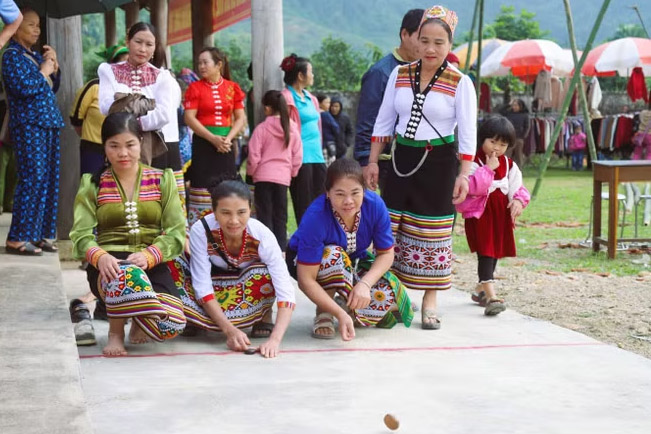
According to Ms. Lo Thi Luong, a resident of Na Co village, the game is suitable for all ages, regardless of gender. Just need mang seeds and an empty space to play. When dividing teams to compete, the atmosphere becomes more lively, creating a unique community activity.
Not only is it an entertainment game, to mang also appears in many events such as housewarming ceremonies, weddings, village worshiping ceremonies, new rice celebrations or great solidarity festivals. In Binh Chuan commune, the Thai people in Na Co, Xieng, Quan, Tong, Met, Que and Dinh villages still maintain this game regularly.
Tó mặng is attractive not only in the atmosphere but also in the rules of the game with 13 steps such as: ka đít, ka nặng, ka xông, mươi thìn, xùm, ka nay, pa lạt, phan tiền, xụt xịt, tòn èn, kép nê, ki hua and nhín. Each step corresponds to a pose, technique from simple to complex, requiring skill and accuracy.
Despite the development of modern entertainment types, it still retains its vitality thanks to its close connection with community life. In recent years, games have been included in cultural and festival activities to encourage people, especially the younger generation, to participate, contributing to preserving traditional values.
In the late afternoon, when the sunlight gradually fades behind the mountain peak, the playground is still bustling. The final rounds of shooting close in laughter, leaving an aftertaste of a cohesive cultural space - where small grains contribute to preserving the memories and identity of the Thai people through many generations.


