
This is an easy-to-grow plant, with good drought resistance, which not only helps farmers escape poverty but also opens up sustainable agricultural development in the Bay Nui region, An Giang province.
Greening dry hill soil
Previously, Ta Lot hamlet (Nui Cam commune) was severely short of water in the dry season, causing fruit tree planting to continuously fail, and farmers' lives were extremely difficult. Many households fell into the situation of planting and then cutting down, with precarious incomes.
In that context, farmers began to switch to bamboo. This plant does not require much water, has low investment costs and is suitable for the harsh conditions of the Seven Mountains region. Bamboo also has a fairly stable output, serving the needs of construction, fence making and handicraft weaving. The ease of nature of bamboo has replaced inefficient production models at the foot of the mountain.
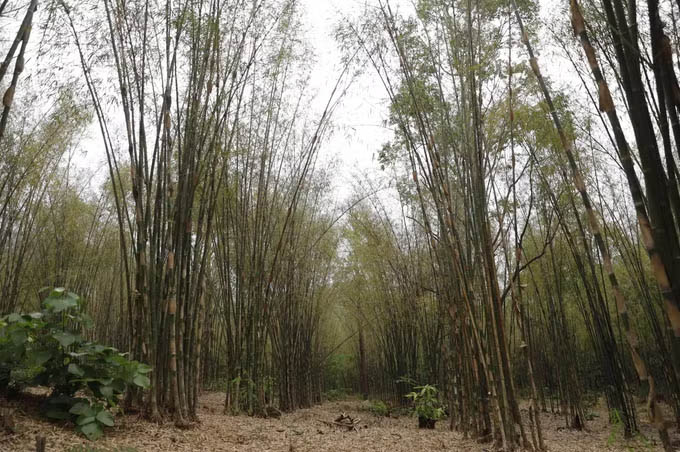
According to VNA, currently, the hillsides that were once abandoned have been covered in the green of bamboo. Mr. Dang Ngoc Binh (Ta Lot hamlet) said that after many years of failure with fruit trees, he switched to planting 3ha of bamboo. The trees grow well, have few pests and diseases, and bring in more than 150 million VND per year. Traders come to the place to buy to help his family feel secure in production.
Similarly, Mr. Huynh Van Tan (Ta Lot hamlet) shared that each hectare of bamboo brings a profit of about 70 million VND per year. "Changing crops helps ensure output, stable selling prices, and improved income. Farming now also requires learning to get better," Mr. Tan said, and hoped that functional sectors would continue to support technical training to stick with it for a long time.
Production linkage, expanding growing areas
From small-scale models, people in Ta Lot hamlet gradually formed a linked mindset. In 2024, the Nui Cam commune branch of professional farmers growing bamboo and four-season bamboo was born, marking a shift to a systematic organization. To date, the branch has 52 members, managing more than 80.5ha. Small groups share experiences, support farming techniques, pest and disease prevention, and agree on harvest schedules.
In addition, the Commune Farmers' Association and credit institutions have disbursed more than 1.6 billion VND of loan capital, helping many households expand their area. The formation of concentrated growing areas not only increases income but also contributes to limiting erosion, retaining soil moisture and improving ecology in climate change conditions.
Enhancing the value of bamboo
Although it brings clear efficiency, the output of bamboo trees in Ta Lot is still difficult. People mainly sell raw to traders, so the value is not high and it is easy to be overpriced. In addition, bamboo leaves fall a lot in the dry season, requiring people to strengthen forest fire prevention. The lack of processing facilities makes the potential of this tree species not fully exploited.
Faced with this reality, the local government is orienting to attract businesses to invest in deep processing. Mr. Ly Thanh Tung - Chairman of the Farmers' Association of Nui Cam commune - said that the locality is calling for investment in handicraft production facilities from bamboo sheaths right on the spot. Instead of selling raw, the commune aims for products such as household appliances, decorations, souvenirs to serve a large number of visitors to visit Nui Cam and export.
To improve sustainable value, the commune is researching the construction of the Nui Cam bamboo rattan brand, standardizing the process and forming a linkage chain from cultivation to consumption.
From the barren hillsides of yesteryear, bamboo trees are rising to bring stable livelihoods. If invested in the right direction, this type of tree can completely become a wealth-making tree, changing the economic face of the mountainous region of An Giang.


