
Located in Ba Dinh ward, Hanoi city, Hoe Nhai Pagoda also has the initial name Hong Phuc Tu, formerly belonging to Hoe Nhai ward of Thang Long capital.
According to historical records, this was once one of the largest pagodas in the capital, located near Dong Bo Dau wharf - where the Tran Dynasty army and people defeated the Mongol army in 1258.
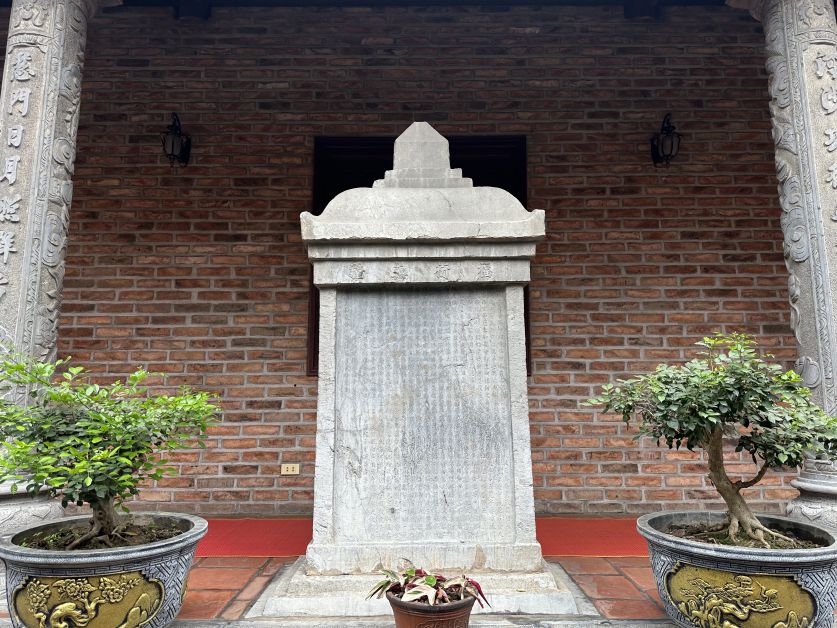
The stele "Phuc Dien Vo Cuong" erected in 1703 under King Le Hy Tong is still preserved at the pagoda, recording quite clearly the history and location of the ancient pagoda by the Red River.
The pagoda was built in the early 11th century during the Ly Dynasty but was damaged many times by war. In 1698, Mrs. Nguyen Thi Phan - nanny of King Le Hy Tong, Dharma name Tu Du - stood up to donate to restore the pagoda and invite Zen master Thong Giac Thuy Nguyet to be the abbot.
From here, Hoe Nhai Pagoda became an important center of Cao Dong Zen sect in Dai Viet. Zen master Thuy Nguyet was the person who brought this Zen sect from China to the country in the 17th century after a period of studying in Ho Chau. Among his disciples, Great Tue Quoc Su Chan Dung Tong Dien is the most prominent successor.
Not only associated with Buddhist history, Hoe Nhai Pagoda is also a place where the late Great Venerable Thich Duc Nhuan - First Patriarch of the Vietnam Buddhist Sangha - practiced and presided over until his death.
Currently, the pagoda has an area of about 3,000m2, built in the style of "nội công ngoại quốc". The main works are located on a unified axis, facing West. Tam quan is in the Nguyen Dynasty style, in front of the courtyard there are 3 towers commemorating monks and nuns who practiced at the pagoda.
Notably, the "An Quang" tower was erected in 1963 to commemorate Venerable Thich Quang Duc who self-immolated to protest the Ngo Dinh Diem government's crackdown on Buddhism in the South.
The main hall consists of 5 Bai Duong compartments connected to 3 Thuong Dien compartments in the shape of the letter "Cong". The items bear the strong architectural imprint of the Le - Mac period with a 2-story match roof, rustic brick walls and a system of round doors creating ventilation.
Hoe Nhai Pagoda currently preserves 28 stone steles, of which the oldest stele dates back to 1703. In addition, the pagoda owns 68 statues made of bronze, terracotta and lacquered and gold-plated wood, mostly in the style of 18th-century art.
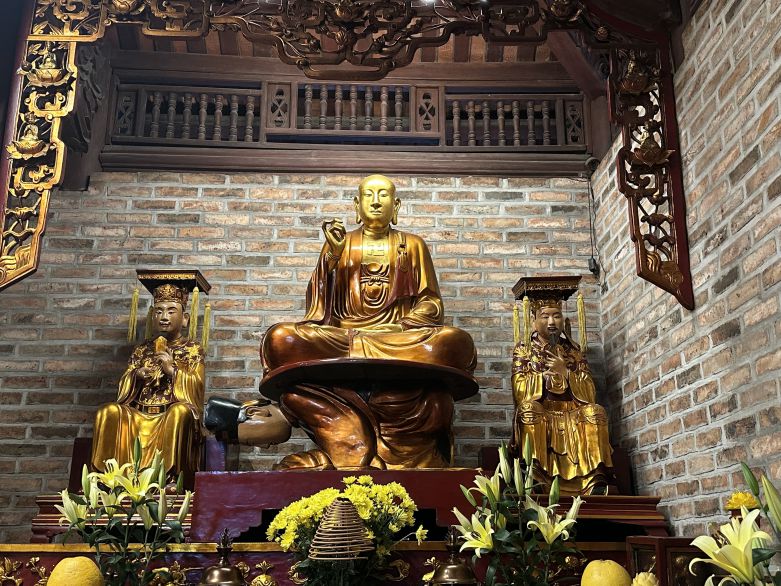
The most famous is the Sam Hoi statue over 3m high - considered unique in Vietnam. The statue consists of a figure kneeling and carrying Buddha on its back. Folk people once thought it was a statue of King Le Hy Tong, but many researchers believe that the work is related to the image of "Phan Vuong carrying Buddha" mentioned in the book "Nhan Thien Nhan Muc" stored at the pagoda.
In 2006, when UNESCO recognized Buddha's Birthday as a world religious festival, the Sam Hoi statue of Hoe Nhai Pagoda was also introduced as a unique mark of Vietnamese Buddhist culture.


