
Located in the land of Hung Yen, Keo Pagoda has the typical ancient appearance of Vietnamese Buddhist architecture. Not only is it a sacred spiritual place, but it also preserves unique historical and artistic values that have existed for centuries.
The pagoda is associated with the life of Zen Master Duong Khong Lo - the famous National Master of the Ly Dynasty. Legend has it that he was born into a family of fishermen in the early 11th century, then became a monk and became one of the most influential Zen masters of Vietnamese Buddhism.
After a trip to Tay Truc to pray for Buddha with Giac Hai and Tu Dao Hanh, he built Nghiem Quang Pagoda in 1061 under the reign of King Ly Thanh Tong. In 1167, the pagoda was renamed Than Quang Tu to commemorate the merits of the Zen master.
A major event occurred in 1611 when the great flood of the Red River swept away the ancient pagoda that had existed for hundreds of years. However, with sincerity and the joint efforts of the people, the project was rebuilt in 1630 under the mobilization of Duke Hoang Nhan Dung. Only 28 months later, the new pagoda was completed with a majestic scale and unique architectural art.
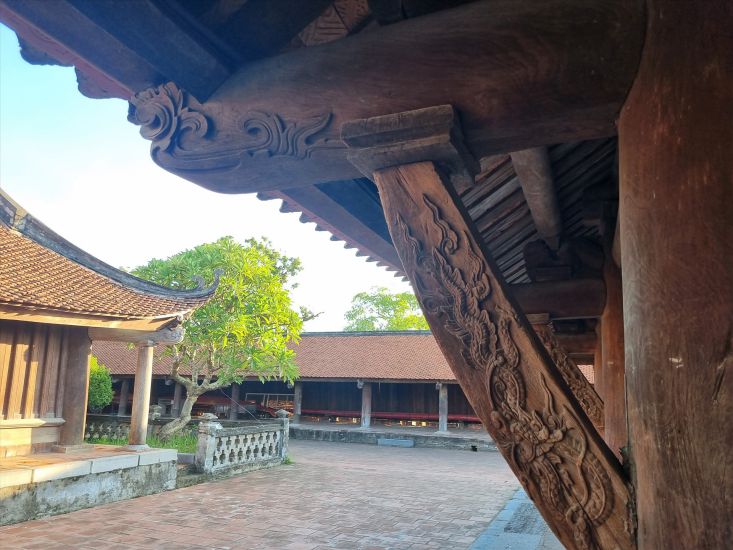
To this day, Keo Pagoda still retains almost its original appearance from the 17th century. The complex consists of 17 buildings with 128 compartments, built in the "Nội công ngoại quốc" style with the characteristic "Tiền Phật, hậu Thánh" layout. The entire structure uses precious ironwood, linked by sophisticated wooden veneer techniques without needing rivets, showing the skillful craftsmanship of ancient artisans.
Along the main axis of the pagoda are Tam Quan Ngoai, the lake and then Tam Quan Noi. Prominent among them is the 17th-century wood carved door set that was once recognized as a National Treasure. Although the original is currently kept at the Vietnam National Museum of Fine Arts, the restored version at the pagoda still clearly shows the sophistication of ancient sculpture art.
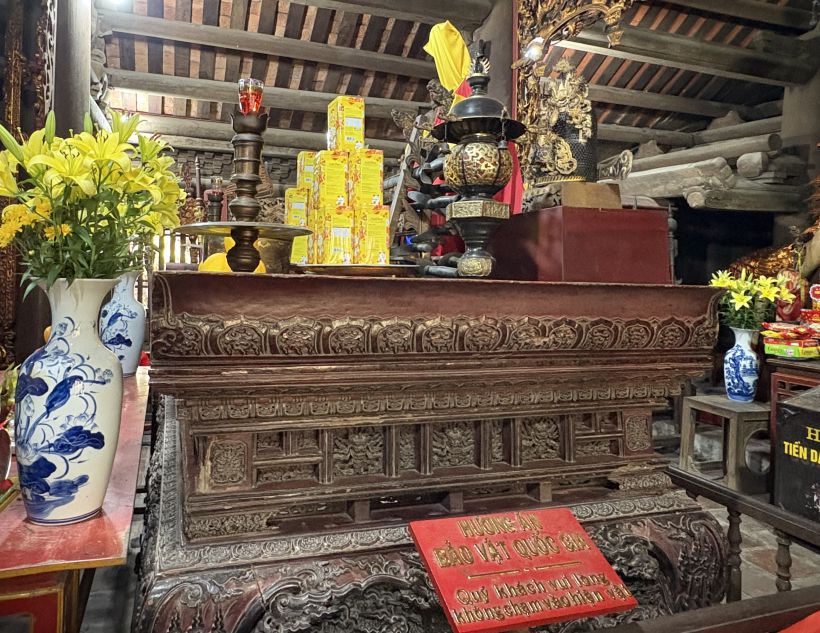
Another treasure of the pagoda is the incense table placed at Tong Muong Palace. The work is elaborately crafted with a dense and sophisticated pattern system, showing the high level of wood carving of artisans during the Le Trung Hung period.
The most prominent highlight of the complex is the wooden bell tower over 11m high with a 3-layer match-stayed roof architecture. The project is considered a symbol of traditional Vietnamese construction techniques, both elegant and sustainable, and creating a characteristic contemplative look for the sacred space of Keo Pagoda.


