
An unscheduled trip
In the last days of July, I packed my backpack and left Can Tho, starting the journey to Ho Chi Minh City to visit a close friend I had not seen for a long time. The trip was originally planned to be quite simple: Meeting friends, chatting, resting and then returning. But the stories about Vung Tau made us decide to spend more time for the coastal city.
From Ho Chi Minh City, we spent about 2.5 hours by car to get to Vung Tau. The closer to the sea, the different the atmosphere. Crowded roads gradually give way to more airy spaces, and sea breezes begin to creep through the car doors.
Arriving in Vung Tau, we visited some familiar landmarks of the city such as: Bai Sau, Christ the Redeemer statue on Small Mountain, Bach Dinh and then moved to the coastal area.
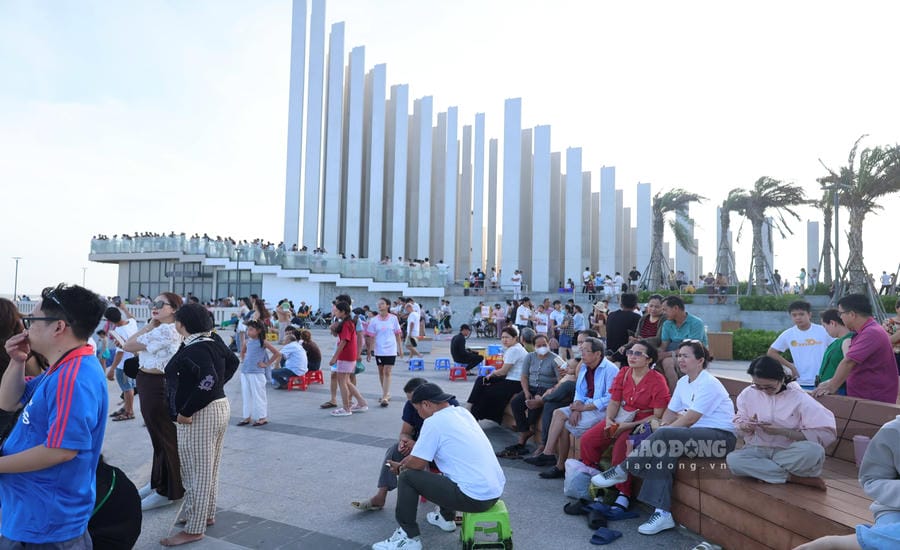
A notable destination is Tam Thang Tower with 143 towers ranging from 4.55m to over 34.25m high, arranged according to the altitude reaching out to the sea. The work evokes the image of 3 bow of boats facing the sea, inspired by the history of 3 villages Thang Nhat, Thang Nhi and Thang Tam. The surface of the towers is tiled with mosaic tiles, creating different lighting and shadow effects depending on the time. This is also a location chosen by many tourists, especially young people, to take photos and videos.
Nghinh Phong welcomes the footsteps of travelers
Each place has its own beauty, but the most noticeable thing in Vung Tau is the sea present in the city's rhythm of life. After a tour, instead of returning to the resting place, we decided to drive a little further according to the introduction of a local friend: Nghinh Phong Cape.
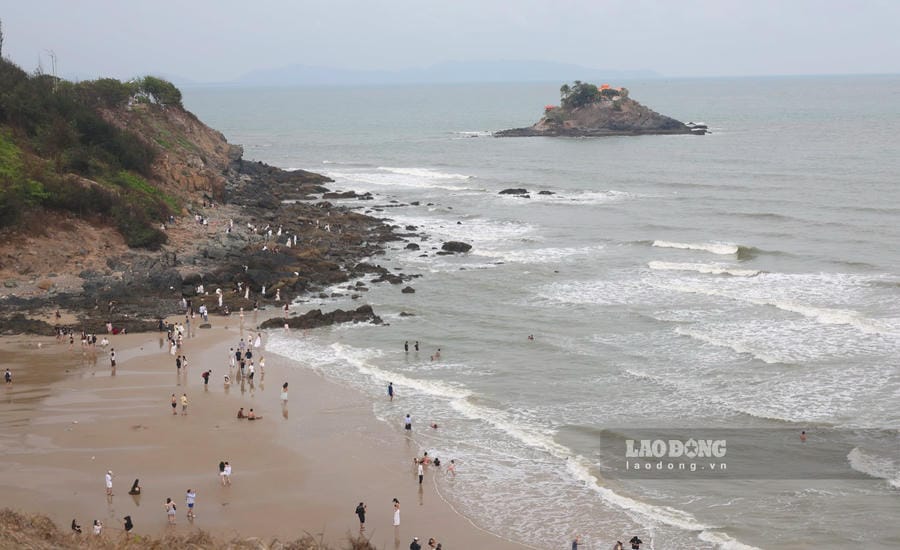
Nghinh Phong Cape is a point of land protruding into the sea, located in the South of Vung Tau ward. This place forms 2 small beaches, Vong Nguyet beach and Huong Phong beach, and also has a heaven gate - a check-in point that many tourists come to.
We arrived in Nghinh Phong at the end of the afternoon. The sunlight was no longer too harsh, the wind blowing from the sea brought a characteristic salty taste. Looking down from above, the sea stretched out in front of our eyes, waves continuously crashed into the rocky shore.
What I like about Nghinh Phong is not necessarily the works or photo angles, but the feeling of standing in a large space, with the sea ahead and the city behind. After the journey from Can Tho, then Ho Chi Minh City to Vung Tau, that moment makes the trip more memorable.
At the sky gate area, many tourists took the opportunity to take photos. Some stood for quite a long time just to admire the sea, some chose a high corner, quietly recording the sunset moment. Ms. Nguyen Thuy Linh, a tourist from Ho Chi Minh City, said that this is the second time she has come to Mui Nghinh Phong. "The previous time I came in the morning, this time I chose late afternoon, so the feeling is very different. Cool wind, wide sea and gentler sunshine. I like the space here quite open, standing for a while you can forget the noise and crowds of the city," Ms. Linh shared.
And Mr. Nguyen Hoang Chien - a tourist from Ban Co ward, Ho Chi Minh City said that he knew about Nghinh Phong Cape through images shared on social networks. "What makes me want to come here is the sea scenery. But when standing directly in Nghinh Phong, I can feel the strong sea breeze and the wide space. If I have time, I think I should come in the late afternoon to both admire the scenery and catch the wind," Mr. Quan said.
We also chose a location overlooking the sea to sit and rest. The unfinished stories from Ho Chi Minh City continued to be extended amidst the sound of waves and wind. The sunset gradually set, the sun gradually disappeared to the horizon, leaving behind late mornings on the sea surface. A trip that was not scheduled too elaborately unexpectedly had another stop that I had long remembered.
Harmony between development and conservation
Leaving Nghinh Phong Cape when it was dark, we returned to the center of Vung Tau. After a day of moving and visiting, the group decided to find a small restaurant to enjoy the dish that many people have mentioned - stingray hotpot.
The heat from the hotpot simmering in the middle of the evening is somewhat cool. The sour taste of the broth, fresh stingray pieces with vegetables and side dishes make the dinner more complete after a long day. But what I remember most in that evening is not only the typical dish of the coastal city.
On the way back, we met Ms. Phan Thi Cung and her daughter making a living on the sidewalk. Under the street lights, Ms. Cung was busy with a small load of goods, while her daughter was by her side helping her mother arrange things and pick up customers. Amidst the flow of people passing by, the two mothers and daughters still patiently waited for each customer to visit and buy.
Ms. Cung said that small business is the family's source of income. "On weekends or holidays, the coastal area is more crowded, and sales are also busier. On days when there are many customers, I work until late to pack up to return home" - Ms. Cung said.
The meeting only lasted for a moment, but the image of the two mothers and children carrying a small load of goods made me remember forever. In a vibrant coastal city, where the coastal roads are bright and tourists follow each other, there are still simple livelihood stories happening every day.
Vung Tau not only has beaches, mountainside roads or familiar destinations. Behind the development of tourism is the life of local people, who are looking for livelihoods from the vibrant pace of life in the city.
After a stingray hotpot meal and a short conversation with Ms. Phan Thi Cung and her children, we started our journey back to Can Tho along the route connecting through Ho Chi Minh City. The bus trip lasted about 8 hours. In the backpack there were still some small gifts bought in Vung Tau, and in the phone were photos that we had not had time to review.
Recently, Chairman of Ho Chi Minh City People's Committee - Nguyen Van Duoc and a working delegation conducted field inspections and surveys of a number of important locations and projects that have been, are being and are about to be implemented in the eastern area of the city. According to Mr. Duoc, Vung Tau area in general and Nghinh Phong Cape in particular are areas with special locations, beautiful landscapes, attracting many tourists.
Therefore, with large-scale projects and attracting tourists, it is necessary to calculate appropriate transport infrastructure, smooth connection to avoid affecting operations as well as people's lives. The research and investment of the project also needs to be comprehensively researched, harmonizing between the requirements of economic and tourism development with the preservation of landscape, sea space and local characteristic values.


