
For young tourist Bui Diep Thao Van (Da Nang), Japan is not only a destination, but also a place for her to step into the traditional cultural space - where each ritual, each activity carries long-standing meanings.
During her recent trip to Japan, Thao Van tried many activities imbued with her identity such as transforming into a samurai, learning mochi, or participating in traditional festivals. The most impressive experience for her was the moment she stepped onto the sumo ring.
The young girl participated in a sumo experience program in Osaka prefecture introduced by a local friend. This is a form of performance combined with exchange for tourists, not a professional competition, so the atmosphere is quite open. Participants almost do not need to prepare in advance, because all stages from costumes, props to guidance are taken care of by the martial artists.
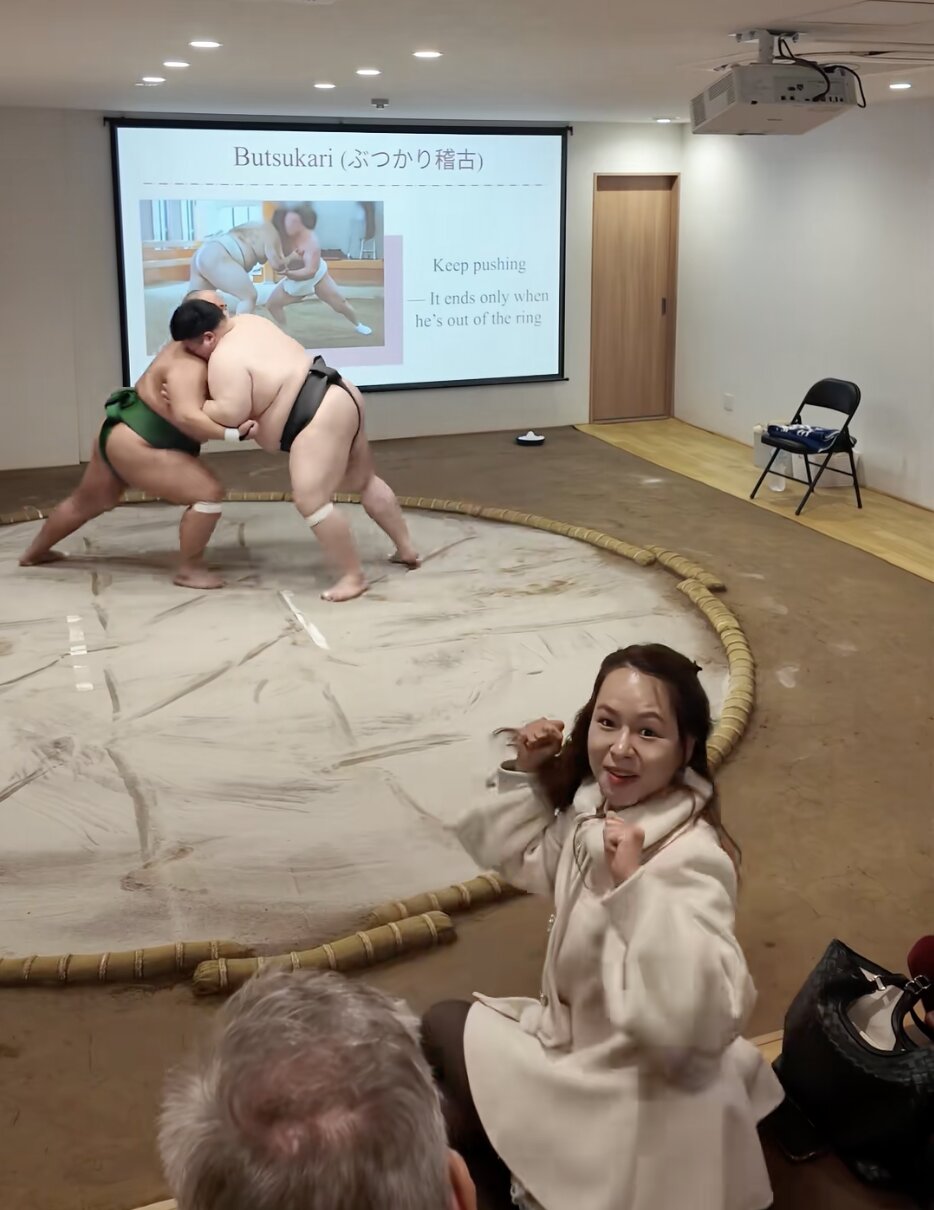
In about 3 hours, the program takes participants from basic knowledge to practical experience. After a realistic match simulation, the martial artists introduce traditional rituals, explaining the meaning of each movement.
The martial artist introduces to visitors basic techniques such as how to maintain center of gravity, posture for punches, how to push opponents, and also introduces strict rules in official competition such as ban on kicking, ban on slapping or snatching hair...
For Thao Van, the moment of barefoot touching the arena brings a very special feeling, both solemn and suspenseful. After the salt-spreading ritual of purification, she officially entered her "match". However, reality quickly showed that this was not a simple challenge.
“The thing that shocked me the most was the strength of a real sumo athlete. My opponent almost did not need to use much strength, while I put all my strength into pushing, but they still stood firm like a wall. I breathed heavily, my hands and feet were exhausted, and they were still calm as if they had never started. Although before that I tried to learn techniques very hard, when faced with reality, everything became small,” Thao Van recalled.
The female tourist added: "After this experience, I feel more clearly the discipline, respect for tradition and perseverance, which are very characteristic of Japan. Even during the exchange for tourists, the martial artists still maintained an extremely serious attitude.
Thao Van believes that the most important thing when participating in local cultural activities is attitude. For tourists, it may just be a new experience on the journey. But for locals, it is a part of heritage that has existed for centuries, carrying values that are not easy to replace. When tourists approach with respect, those experiences truly become complete.
Sumo was originally thought to have emerged as a ritual dance to entertain Shinto gods at temple festivals. The original forms of the newly formed sport were adapted and the goal was for wrestlers to throw their opponents. The rules were established during the Edo period (1603-1867).
Professional Sumo has six levels, not weight-defined, meaning a fight is usually between an extremely large and powerful wrestler and a slender but faster opponent. Wrestlers will be promoted or relegated depending on their results in the tournaments.
According to the Japan Tourism Organization (JNTO), there are now six tournaments - also known as basho - held annually in Japan, with events taking place in Osaka in March, Nagoya in July and Fukuoka in November alternating with three tournaments in Tokyo.
The Japanese Sumo Association has an English website providing details about the upcoming basho and information on how to buy tickets. Visitors can buy tickets at the ticket office on the day of the tournament, but there are many days when tickets are usually sold out, so you should buy beforehand.


