
Not only creating healthy playgrounds, these activities also contribute to preserving cultural identity, attracting tourists and promoting the development of highland tourism.
Bustling village yard, lively folk games of traditional festivals
In the first months of the year, when the weather gradually warms up, the festival atmosphere in many communes and wards in Son La becomes bustling and lively. From urban areas to highlands and border areas such as Thuan Chau, Yen Chau, Sop Cop or Moc Chau, everywhere you can see crowded folk game playgrounds, filled with laughter.
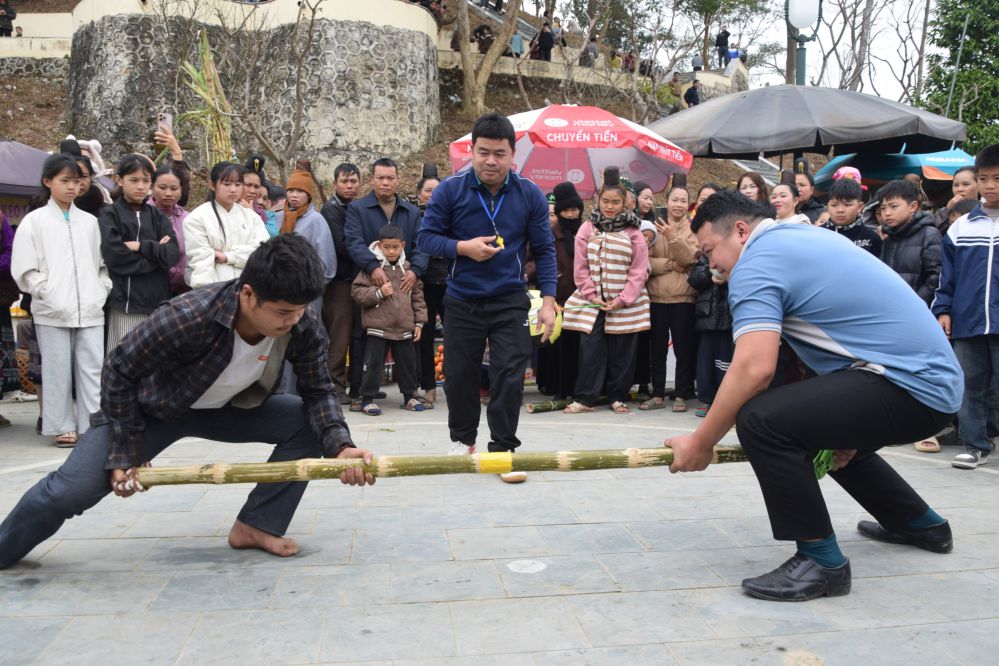
In each ethnic community, folk games have their own characteristics. The Thai people maintain familiar folk games such as tó mák lẹ,ném còn, đi cà kheo - both entertaining and showing dexterity and flexibility. Meanwhile, the Mong people stand out with folk games such as tu lu, bắn nỏ, đẩy gậy, ném pao - showing strength, skills and martial spirit.
Every evening at the cultural houses of the villages in To Hieu, Chieng An, Chieng Sinh, Chieng Coi wards, laughter is bustling. In Heo village, To Hieu ward, more than 30 members of the Thai ethnic cultural club still maintain regular activities, organize folk games, in which tó mák lẹ always attracts a large number of participants and cheers, regardless of age or gender.
Mr. Lo Van Hoa - Head of the Heo village Thai cultural club, shared: "We regularly maintain folk games to create a healthy playground in the early morning or evening, especially on weekends. Through this, everyone in the village becomes more attached, and young people also understand more about Thai ethnic culture.
Not only urban areas, but also in highland communes, the folk game tu lu of the Mong people also takes place sôi nổi every holiday and Tet. Wooden wheels spinning fiercely, cheers echoing throughout the village, creating a joyful and united atmosphere.
Speaking about the tu lu game, Mr. Khang A Say - Secretary of the Party Cell, Head of Nam Nghep village, said: "Tu lu is associated with the childhood of the H'Mong people, not only is it a folk game, but tu lu is also an opportunity for young men to show their bravery, many couples have become destined from watching and cheering together.
Preserving the soul of folk games through generations
In the treasure of culture of Son La ethnic groups, each folk game is a "piece" that creates its own identity. For the Thai people, tó mák lẹ is not only a folk game but also childhood memories, a community-connected activity.
Tó mák lẹ has a simple gameplay but requires high accuracy. Players use "mák lẹ" beads to compete through many positions such as standing, kneeling, running, lying down to shoot. Each turn is a challenge in skills and concentration.
Ms. Lo Thi Truc, Quynh Nhai commune, shared: "I was taught to play from a young age. This folk game becomes more and more captivating as you play it, not only fun but also helps people get closer to each other.
In addition, folk games such as throwing con and stilt walking of the Thai people also contribute to enriching cultural life. The image of con flying high in the spring sky or walking on stilts has become a familiar beauty in festivals.
For the H'Mong people, the folk game tu lu is an indispensable activity every beginning of the year. Wooden spinning tops are elaborately carved, combined with sturdy spinning strings, creating strong spinning rounds. Players must have good techniques to both keep spinning for a long time and hit the target.
Mr. Hang A Cho, a long-time tu lu player in Moc Chau ward, said: "Playing this folk game not only requires strength but also technique. Everyone wants to compete to show their bravery.
In addition, crossbow shooting, pao throwing, and stick pushing also attract a large number of young people to participate, both training physical strength and contributing to preserving traditional cultural values.
Games such as throwing balls and crossbows always create a lively competition atmosphere, attracting a large number of people to participate, contributing to strengthening community solidarity.
Spreading folk games, creating tourism attraction
In recent years, Son La has focused on developing folk games associated with physical training movements and building a cultural life at the grassroots level. Competitions from commune to provincial levels are organized regularly, attracting a large number of athletes to participate.
Mr. Do The Cong - Deputy Director of the Department of Culture, Sports and Tourism of Son La province, said: "Folk games have the advantage of being easy to organize and suitable for many ages. Maintaining and developing folk games not only helps improve health but also contributes to preserving and promoting cultural identity.
Notably, many schools have incorporated folk games into extracurricular activities. Through this, students experience reality, understand more about traditions and form a sense of preserving national culture.
Not only culturally meaningful, folk games also become a typical tourism product. At festivals and cultural festivals, tourists not only watch but also directly participate and experience folk games such as throwing con, tug-of-war, tó mák lẹ or tu lu.
Traveling to Nam Nghep with her family, Ms. Phuong Nhu Quynh (Hanoi) shared: "The first time experiencing tu lu, throwing pao, I had to try many times to do it, but it was very interesting and attractive.
Ms. Quynh also hopes that many community tourism villages in Son La will develop more folk games so that tourists have the opportunity to experience and understand more about local culture.
In the modern flow, maintaining folk games is not only about preserving tradition but also connecting the community, spreading cultural values, contributing to creating attraction for Son La tourism.


