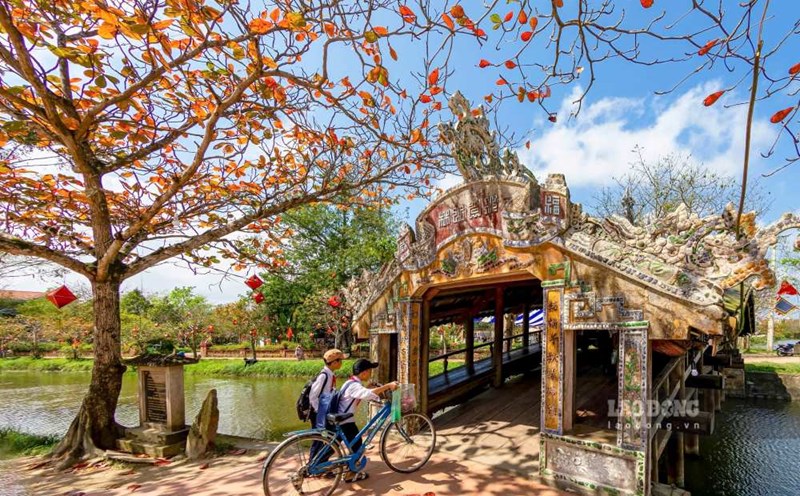
The most famous tiled roof bridge in Vietnam is probably the Covered Bridge in Hoi An ancient town and next is the Thanh Toan tiled bridge in Hue. But people know little about the Cho Luong tiled bridge in Hai Hau, which is both ancient and has a rare architectural beauty.
Located on the Trung Giang River with year-round clear blue water, Cho Luong tiled bridge is an ancient bridge built in 1511 at the end of the Later Le Dynasty. The bridge carries the beauty of unique architecture, along with great cultural and historical significance. The bridge was ranked as a National Historical and Cultural Relic by the State in 1990.
According to the instructions attached to the bridge roof, the Luong market tiled bridge was built in 1511, during the reign of King Le Hong Thuan. Through more than 500 years of history, with many restorations, the tiled bridge still retains its ancient and rustic beauty. The beauty of the bridge lies in the "thượng gia hạ kiều" architecture, i.e., the upper part is the house, the lower part is the bridge.
Initially, Ngoi Bridge was tiled with boi leaves. After many restorations, the bridge was tiled. Cho Luong Tiled Bridge underwent 2 of the largest restorations in 1922 and 2011. Although restored many times, the bridge still retains its original architectural style.
The upper part of the bridge is roofed with dragon scale tiles, with a structure similar to the design of a 3-compartment house in the North. The lower part is the bridge railing and bridge deck. Both parts are connected by a system of round columns erected along both sides of the bridge railing and gates built at both ends.
The bridge consists of 9 curved sections, like the body of a dragon. Raising the bridge roof are 40 round pillars made of solid ironwood. The bridge is built on 18 large and beautiful square stone pillars, divided into 6 rows, each row with 3 pillars. On each stone pillar is a system of large ironwood beams to support beams and floors.
The floor of the bridge is 2m wide, consisting of 66 ironwood bars assembled on a row of curved beams, and at the same time there are many shorter wooden bars swirling the edges to form many raised bars for pedestrians to climb and fall to avoid slipping. On both sides of the bridge are 2 rows of corridors curved along the bridge railing.
The inside corridor is joined with planks. Outside the corridor is a railing with upper and lower levels and 162 horizontal lacquered boards. To create 9 bridge house compartments, the ancient craftsman designed 10 beams and a system of beams for raising. The southern tiled roof is also skillfully tiled by talented craftsmen in a half-roof, half-construction style.
Therefore, the roof is not pushed or exposed, curved extremely softly, delicately, resembling the shape of a flying dragon... On both sides of the bridgehead, the ancients also designed 4 nghê standing in adoration. The trusses, 36 vertical bars, upper and upper bars, horizontal bars, upper and lower bars, horizontal bar system are all meticulously crafted, making the bridge frame both curved and curved, close to the dream bar.
On the main row of pillars in the middle of the bridge, the book carves 4 Chinese characters "Quan Phuong commune Kieu", meaning the bridge of Quan Phuong commune (old). On both sides of the bridgehead are carved 4 pairs of ancient parallel sentences in Chinese characters, including a large parallel sentence at the north gate:
Le Hong Thuan's four natures, the water's plan, the price of the oak, separated into the upper river.
Nguyen Khai Dinh thất niên trùng tập dư lương y cựu kính trung thề
Thus, Ngoi Bridge was built during the reign of King Le Hong Thuan, because the first 4 clans migrated and reclaimed the ancient land of Quan Anh. By the 7th year of Khai Dinh (1922), the bridge was restored, still retaining the original architectural features. The remaining parallel sentences are all imbued with the spirit of the Northern people of the past, typically the small parallel sentence at the southern end of the bridge:
“Giáp ngạn mã đề nhân thượng hạ
Hoanh Giang Hong Anh Nhat Dong Tay"
Provisional translation:
Horse hooves, people's feet going up and down, both banks crowded with paths
Rainbow reflects east and west, hot sunlight crosses the river
A few dozen meters from Ngoi Bridge are Luong market and Luong Pagoda, which are of the same construction age as Luong Pagoda. This is a very common structure in the Son Nam Ha region, first as a market meeting place, then a pagoda, creating a point of exchange and meeting of people in the region and from all directions, and also a connecting point both spiritually and materially.
The four families that reclaimed land and established hamlets have been very elaborate in building Ngoi Cho Luong bridge, creating the bridge with the most unique architecture of Son Nam Ha town, which has been mentioned in the song: "Nam bridge, Bac pagoda, Doai communal house". Along with Luong Pagoda and Phong Lac communal house, Ngoi Cho Luong bridge was once given 4 words by King Le: "Beautiful customs are perfect".
On a late spring day, but the unusually hot and sultry atmosphere, our discomfort immediately disappeared when we sat to catch the breeze on the railing inside the bridge. The water vapor of the Red River rising with the wind made the air suddenly cool, making us just want to lie here forever to enjoy the scene of "minh nguyet phong quang" and ponder King Le's praise.
The talent of tile workers and wood workers seems to have turned a traffic project into a unique architectural and cultural symbol. Therefore, Ngoi - Cho Luong bridge has a special beauty, unlike any other tile bridge, worthy of being the pride of the people of Quan Phuong in the past, and Hai Anh, Hai Hau today.