
The people of Bo Tram hamlet still say, if you want to understand Shan Tuyet tea, don't just drink a cup of tea. Follow them up the mountain, touch the mossy tea stem, smell the scent of freshly picked young leaves and listen to the stories of those who have dedicated their whole lives to the tea tree. Then you will understand why the tea flavor here has a unique flavor that cannot be mixed.
Tea trees preserving memories of the highlands
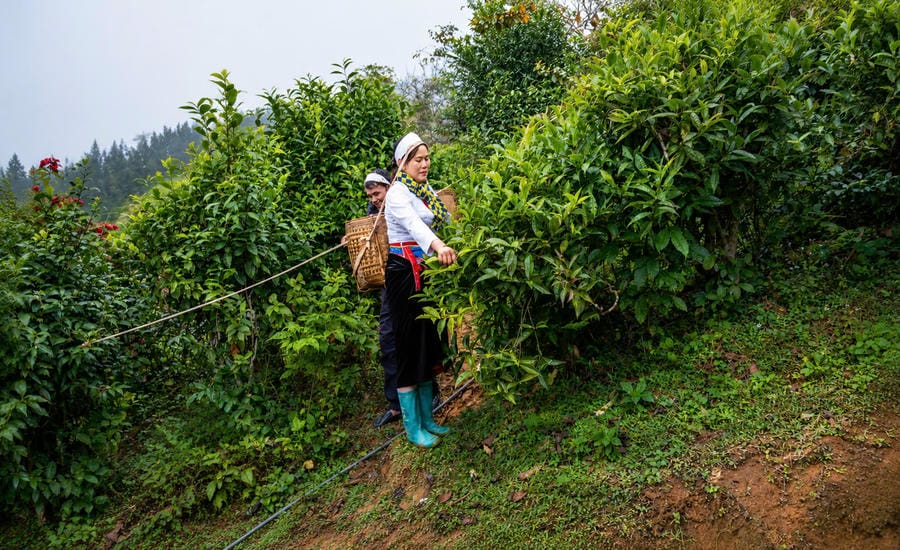
In Van Son, Shan Tuyet tea tree is not just a crop. It is part of the landscape, livelihood and memories of many generations. Unlike the straight tea hills in the midlands, Ngo Luong Shan Tuyet tea grows naturally at an altitude of about 1,200m. The tea plants grow interspersed in the old forest, rooting in rocks, catching sunlight, receiving rain and absorbing thin mist.
Some trees are taller than people, with rough trunks, covered with green moss. To pick young buds, people must stand on their knees or build ladders. Each harvest season is a journey along the mountainside, between clouds and wind. The special thing is that the tea region almost develops according to natural laws. People do not chase yields with fertilizers or stimulants. They believe that trees are grown by soil, by climate and by time. That creates a rich, sweet tea flavor and a very unique aroma.
But there was a time when the ancient tea trees were facing the risk of disappearing. Mr. Bui Van Bo - Director of Van Bo Agricultural Cooperative (HTX), still remembers the years when tea prices fell low and output was unstable. Many households successively cut down tea trees to plant crops that brought faster income.
Going through the tea trees that have just been cut down, I regret not only one tree. I regret a part of the soul of Ngo Luong," Mr. Bo shared. From that regret, he and many people in the village began the journey to keep the tea area. They found seedlings, mobilized people to restore the area, linked households to produce together and gradually changed the way of doing things. The goal is not simply to sell more tea, but to help people see that tea trees can still bring stable income if invested methodically.
Keeping tea trees is also synonymous with keeping livelihoods for people and preserving a cultural feature of the highlands.
Tea making profession preserves the scent of the mountain
After picking, the tea buds do not stay long in the mountains. Fresh leaves are immediately brought to the workshop to preserve the original flavor. The processing space always faintly smells of young tea mixed with the heat from the stir-fried pans.
Here, machinery only partially supports. Most stages still rely on the experience of people in the profession. From wilting, taming, roasting to drying, each step requires meticulousness. Just need too high heat or roasting time extended for a few more minutes, the tea batch will lose its inherent flavor. Tea makers often compare tea plants to having "personality". To have good tea, you must understand each batch of leaves, each time and even the change of weather.
Therefore, the quality of the teacup not only depends on the ancient tea roots but also lies in the hands of the maker. When the water just boils, the tea petals gradually bloom. The tea water is golden and clear. Taking a sip of slightly bitter tea at the tip of the tongue. But just a few minutes later, the gentle sweetness spreads deep in the throat, staying for a long time. That is the sweetness of the soil, of the mountain mist and of the years of persistently preserving the tea profession.
Taking the tea scent far
Previously, Ngo Luong Shan Tuyet tea was mainly consumed in the region. Familiar people buy it, tourists visit and bring a few packages as gifts. Few people know that in the mountainous region of Van Son, there is a Shan Tuyet tea region with such a characteristic flavor.
In recent years, the journey of tea has begun to expand. The cooperative has invested in perfecting the production process, improving packaging, building brands and gradually bringing products to more markets. In 2023, the product was recognized as OCOP 3-star. That is an important milestone, but for tea makers, certification is not the final destination.
What they want is for consumers to remember Ngo Luong with the flavor of a cup of tea. That path still has many challenges. The output today still depends quite heavily on regular customers, tourists and introduction orders. For products to have a sustainable foothold, more stable distribution channels and stronger connections with the market are needed.
According to Secretary of the Party Committee of Van Son commune - Nguyen Duy Tu, the locality is accompanying the Cooperative in perfecting designs, promoting products on digital platforms and expanding the consumption system. The goal is not only to improve the economic value of OCOP products but also to create motivation for people to continue to preserve the Shan Tuyet tea raw material area.
Because each tea tree preserved also means preserving an additional patch of forest, preserving more livelihoods for people and preserving a part of the identity of the mountainous region.
Each new bud season, Van Son tea hills are covered with a green color amidst white clouds. Tea pickers still quietly go up the mountain from early morning. Tea-making hands still patiently by the fire to preserve the full flavor of each batch of tea. And from those small cups of tea, the story of a land that is preserving indigenous resources, preserving traditional crafts and preserving the flavor of mountains and forests continues to be told.
In the midst of modern life, as many traditional values gradually fade, Shan Tuyet tea roots in Van Son still quietly take root on the mountainside. They not only create a specialty product, but also are proof of the persistence of the people of the highlands in the journey to preserve the land, preserve the craft and preserve the tea flavor for the future.


