
Doctors of Department of Gastrointestinal Surgery 2, K Hospital have just successfully performed laparoscopic surgery using robots to cut the esophagus and create aplasty for patient N.H. B, 66 years old, residing in Thuan Trung commune, Nghe An province. This is a complex case of esophageal cancer, requiring very high accuracy due to severe fibrosis of the tissues around the esophagus after chemotherapy and radiation therapy.
The patient was admitted to the hospital in a state of prolonged suffocation. Through medical history, doctors recorded that the patient had a history of smoking and using alcohol for many years - risk factors that have been proven to be closely related to esophageal cancer as well as many other digestive and respiratory diseases.
According to Dr. Doan Trong Tu, Head of Department of Gastrointestinal Surgery 2, K Hospital, the endoscopic results showed that the patient had an infiltrated ulcerated tumor occupying about half of the esophageal circumference, located 30-34cm from the upper palate. This is the mid-totooth esophageal region, located close to many important structures such as the trachea, bronchi and large blood vessels.
The patient was diagnosed with locally advanced esophageal cancer, the tumor had invaded through the esophageal wall muscle layer and metastasized to adjacent lymph nodes but no distant metastases had occurred. Doctors prescribed multimodal treatment with chemoradiotherapy at the same time to shrink the tumor before surgery.
After completing chemotherapy and radiation therapy, the patient achieved partial response, meeting the conditions to undergo esophagealectomy and reconstructive surgery.
Dr. Doan Trong Tu said that the first challenge comes from the phenomenon of fibrosis and adhesion of tissues around the esophagus after chemo-radiotherapy. In particular, the area adjacent to the thoracic aorta and the mediastinal lymph nodes is severely fibroized, making dissection difficult and posing a potential risk of large bleeding or damage to important structures.
In addition, the dissection of the upper mediastinum lymph nodes after radiation therapy also poses a risk of damaging the laryngeal inverted nerve. If this happens, patients may experience hoarseness, vocal cord paralysis, increased risk of choking and pneumonia after surgery.
In addition, a long history of smoking and drinking alcohol makes patients at high risk of respiratory and cardiovascular complications in the postoperative stage, including respiratory failure, pneumonia, alcohol withdrawal syndrome, or underlying cardiovascular diseases.
However, after careful consultation, doctors determined that robotic laparoscopic surgery is the optimal option, both ensuring thoroughness in cancer treatment and minimizing the risk of complications for patients.
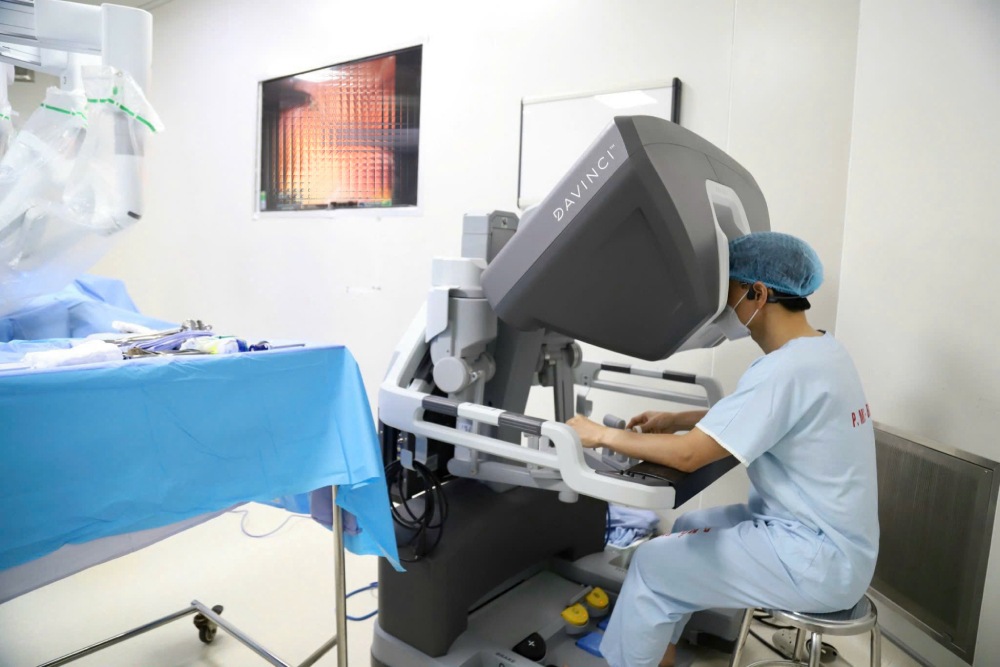
To perform the surgery, the team used the Da Vinci Xi Robot system - one of the modern surgical technologies today.
Thanks to the high-resolution 3D camera system and flexible robot arms, surgeons can clearly observe anatomical structures in the narrow space of the chest, while performing dissection operations with high accuracy.
Robot technology is particularly effective in dredging lymph nodes in difficult-to-reach areas such as the area next to the laryngeal inverted nerve or near the thoracic aorta, helping to reduce the risk of missed metastatic lymph nodes remaining after chemotherapy and radiation therapy.
In addition, the stability and flexibility of the robot arms helps the removal of tumors from the thoracic aorta and adjacent structures to take place more safely, minimizing the risk of major blood vessel damage.
For elderly patients with a long history of smoking and drinking alcohol, robot surgery also brings many benefits such as reduced postoperative pain, reduced chest damage, reduced blood loss, helping patients recover respiratory functions early, shortening resuscitation time and inpatient treatment time compared to traditional open surgery.
Robot-assisted laparoscopic esophageal surgery and plastic surgery were successful, ensuring the goal of radical cancer treatment while optimizing safety for patients.
Early-stage esophageal cancer usually has no specific symptoms. Most patients only come for examination when signs such as swallowing difficulty, painful swallowing, chest pain or difficulty eating appear. At that time, the disease often progresses to a later stage, making treatment more complicated and affecting the prognosis.
People should quit smoking, limit alcohol, maintain a healthy lifestyle, build a reasonable diet and proactively have periodic screenings for people with high risk factors. Early detection plays an important role in improving treatment effectiveness and improving the quality of life for esophageal cancer patients.


