
In the latest guidance on chickenpox vaccination from the World Health Organization (WHO) published in November 2025, a 2-dose vaccination schedule has been recommended to achieve optimal protection for chickenpox.
Results from studies cited as evidence for this recommendation have shown a clear increase in the 2-dose vaccination schedule compared to just 1 vaccine.
If with just one injection, the effectiveness of the chickpea vaccine reaches 95% [1], while with the 2-dose vaccination schedule, the effectiveness of the chickpea vaccine reaches 100% [2].
In this document, WHO also stated that countries are currently using a one-dose chickenpox vaccination schedule, so it should be noted that this vaccination program is only enough to reduce the mortality rate and severity of chickenpox.
The single-dose vaccination schedule is less effective in preventing circulating viruses and the possibility of causing chickenpox epidemics. The second dose should be injected at least 4 weeks after the first dose. Adults and children should be given this second dose to get optimal immunity.
The updated guidance on this chickenpox vaccine by WHO has also confirmed the results of the safety and immunity of the MAV/06 chickenpox vaccine - the Barycela vaccine is equivalent to the Oka chickenpox vaccines commonly used in current commercial vaccines [3.4].
The Barycela vaccine has been used for many years in the National Immunization Program of Korea and many other countries and has also shown its effectiveness in significantly reducing the incidence of chickenpox and even Zone disease ( Herpes zoster) in children vaccinated with [5] vaccination.
The WHO announcement also clearly states that the conversion of the doc away chickpea vaccine between the Oka and MAV/06 strains is safe, with no adverse reactions in healthy children vaccinated with the [6].
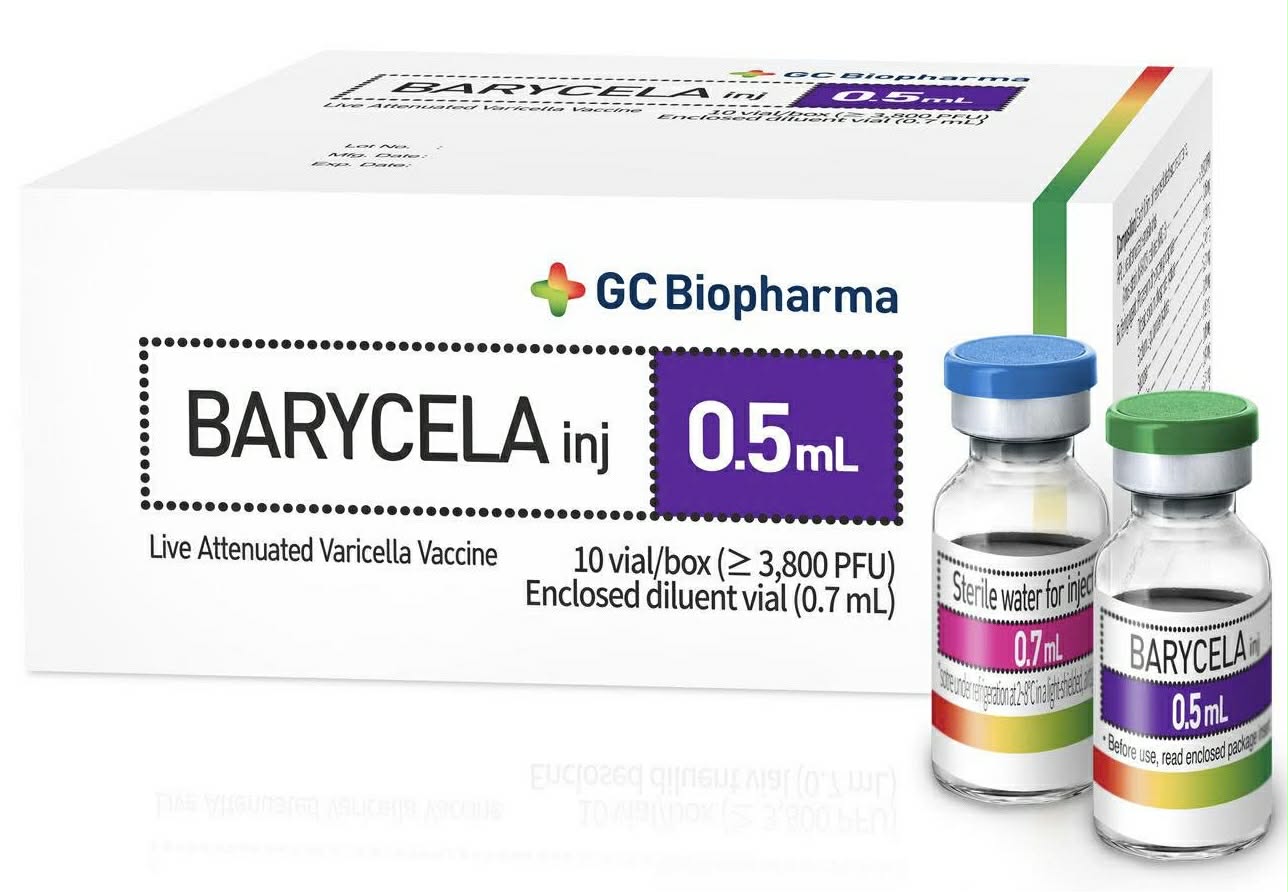
The above recommendations show that the use of the MAV/06 chickenpox vaccine - Barycela vaccine in the schedule of 1 or 2 doses for children is completely suitable.
The Barycela chicken vaccine contains the MAV/06 strain produced by GC Biopharma and is currently being distributed by NAV VAT GROUP in Vietnam.
1. Bayer O et al. Metaanalysis of vaccine effectiveness in varicella outbreaks. Vaccine. 2007;25(3738):665560.
2. Hong K et al. Effectiveness of two-dose varicella vaccination: Bayesian network meta-analysis. Patredi Infect Vaccine. 2024;31(1):5563.
3. Kim SH et al. Seroprevalence rate after 1 dose of varicella vaccine in infants. J Infect. 2010;61(1):6672.
4. Choi UY et al. Immunogenicity and Safety profiles of a new MAV/06 strain varicella vaccine in healthy children: a multinational, multicenter, randomized, double blinded, active-controlled phase III study. Vaccine. 2021;39(12):175864
5. Choi J-K et al. Trends in varicella and herpes zoster epidemiology before and after the implementation of universal one-dose varicella vaccination over a decade in South Korea, 20032015. Hum Vaccin Immunother. 2019;15(11):255460.
6. Kang HM et al. Safety of interchanging the live attenuated MAV/06 strain and OKA strain varicella vaccines in children. Vacines (Basel). 2023;11(9):1442.
WHO's updated guidance on chickenpox vaccine clearly states:
- It is necessary to vaccinate chickpeas according to the vaccination schedule with 2 doses of vaccine at least 4 weeks apart to achieve optimal protection.
- MAV/06 chickenpox vaccine - Barycela vaccine has the same safety and immunity as Oka chickenpox vaccines commonly used in commercial vaccines today.
- The exchange of the docententent raw chickpea vaccine between the Oka strain and the MAV/06 strain is safe, there are no adverse reactions in healthy children vaccinated.


