
Cyber security threats in Vietnam are increasing
In recent years, the cybersecurity context in Vietnam has witnessed a significant increase in both complexity and number of threats. According to the latest data from cybersecurity company Kaspersky, there have been 23,839,322 online attacks and 109,418,783 threats targeting local devices detected and prevented in Vietnam in the past year.
In addition, this global cybersecurity and digital privacy security company also revealed that 34% of Vietnamese businesses have become targets and faced supply chain attacks in the same period.
In this context, a shift from passive security methods to proactive strategies, based on surveillance data, such as building cybersecurity operations centers (SOCs) is required.
The SOC model is a centralized coordinating center specializing in continuously monitoring and protecting the information technology (IT) infrastructure of enterprises. The focus of operation of the SOC model is to proactively detect, analyze and respond to security incidents in the network and system of enterprises.
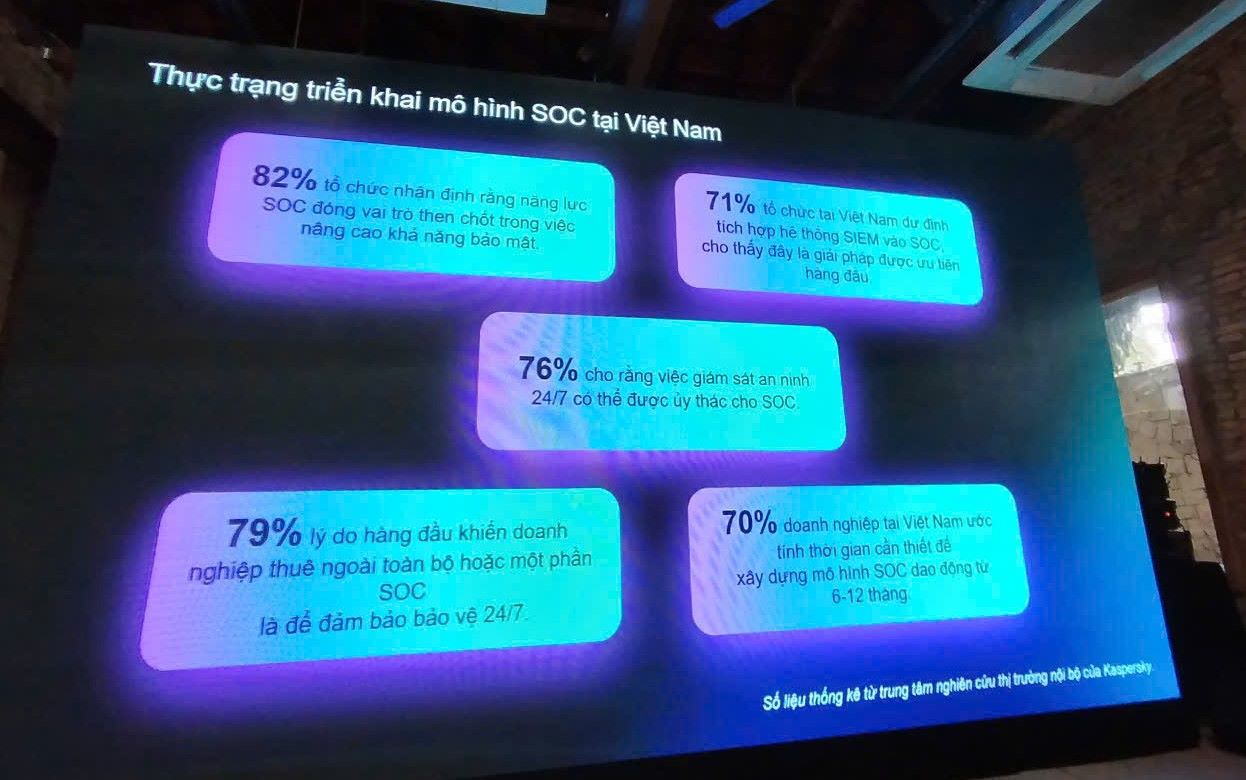
According to a recent study by Kaspersky, increasing investment in SOCs is becoming a priority for businesses in Vietnam, with 82% believing that this capacity plays an essential role in improving security capabilities.
At the same time, 74% of businesses are planning to integrate AI into the SOC model, which stems from the need to process large volumes of data (82%) and the implementation of forecasting analysis processes to prevent potential threats (85%).
Challenges and solutions
Although the integration of AI into the SOC model is increasing, businesses in Vietnam still face many challenges.
According to Kaspersky's records, 69% of businesses face difficulties in integrating and managing AI tools, while issues such as lack of high-quality training data (63%) and shortage of highly specialized AI personnel (57%) are still the main barriers.
Mr. Ngo Tan Vu Khanh, Kaspersky Country Director in Vietnam, commented: "As cyber threats in Vietnam become increasingly complex and persistent, Vietnamese businesses are under great pressure to strengthen their security capabilities instead of just relying on traditional methods.
According to Mr. Khanh, an optimally integrated SOC model will play a key role in a business's security strategy, allowing businesses to improve their comprehensive observation capabilities, respond to threats more effectively and maintain adaptability to constantly increasing network risks.
Mr. Khanh added that the implementation of the Law on Protection of Personal Data in Vietnam marks an important step forward in completing the legal framework on data privacy. As organizations accelerate to meet new requirements, data management is increasingly becoming a strategic priority.
In that context, advanced SOC operating capabilities play a key role in improving monitoring capabilities, supporting compliance and protecting sensitive data.
Faced with the above challenges, new generation SOCs have been developed by Kaspersky's cybersecurity experts with the ability to integrate AI, in order to improve detection, response and automation capabilities.
To further enhance deployment efficiency, SOC is also integrated with Security Information and Event Management (SIEM) systems and uses Real-Time Threat Intelligence, allowing enhanced data correlation from multiple sources and more accurate threat detection.
