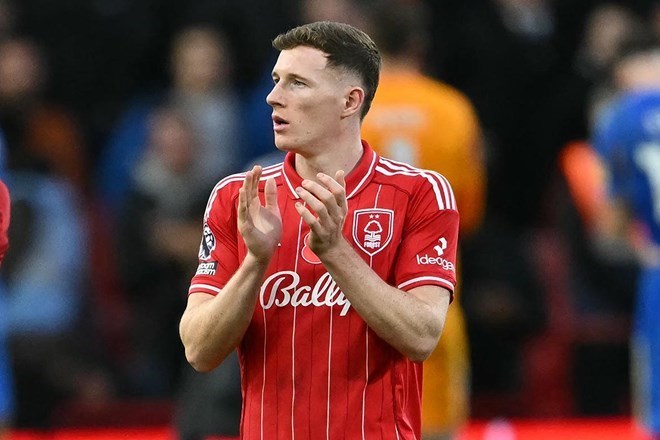
Elliot Anderson once made Manchester City suffer just a few months before this team decided to turn him into the most expensive English player in history.
In his last trip to the Etihad Stadium in March, the midfielder of Nottingham Forest launched a long-range shot from about 25m, defeating the home team's defense and bringing a surprising draw. That result may not change the course of the Premier League championship race, but dropping 2 points makes Man City's chances of winning the championship even slimmer in the final sprint.
Now, the £116 million deal for Anderson is not only a blockbuster contract, but also an affirmation for Man City's ambition to return to the top under the Enzo Maresca era.
Anderson's performance at the 2026 World Cup further strengthens the determination of the Etihad home team. They not only want to defeat Manchester United in the transfer market, but also possess a midfielder who fully converges the qualities of modern football. From diverse passing ability in both short and long distances, abundant energy to cover the midfield to versatility. In a tournament where besides Harry Kane and Jude Bellingham, very few English players left their mark, Anderson emerged as a bright spot.
Although reflecting the true price level of the current midfield market, the figure of 116 million pounds is still enough to shock many people. Man City is not a team that often breaks the bank for a player.
Jack Grealish with a price of £100 million is still an exception rather than a standard, especially when he has never met expectations. In fact, most of the most successful deals under Pep Guardiola only fluctuate in the range of £30-65 million.
Rayan Cherki belongs to the lower price group, and even Erling Haaland is not the most expensive contract. More notably, Rodri and Bernardo Silva - the midfielder pair that made the foundation for Guardiola's success - combined have a lower fee than Anderson, even though Rodri once held the club's transfer record when he first joined.
The common argument for expensive midfield deals is that midfielders can impact all aspects of the match, helping the whole system operate smoother. However, reality does not always prove that.
Mateus Fernandes is a typical example. Tottenham spent £85 million to recruit the Portuguese midfielder, even though he had just gone through two consecutive relegation seasons. Fernandes did not play poorly in Southampton and West Ham colors, but both teams had poor performances. After 72 matches in the Premier League, he has only scored 5 goals and had 8 assists.
That is also the common point of the current generation of midfielders. Transfer value continuously sets records, while statistics on goals are not really commensurate.
Even Anderson, after the super product against Man City, was once commented by a former Nottingham Forest player that he needed to improve his scoring ability if he wanted to reach the highest level.
That makes many people question, if Steven Gerrard or Frank Lampard play at the present time, how much will they be valued? Modern football values midfielders who have the ability to resist pressing, control space and adhere to tactics. In return, the box-to-box midfielder model scoring many goals is becoming increasingly rare. The responsibility of scoring goals is now more transferred to strikers, wingers or number 10s.
However, that does not prevent the value of the midfielders from continuing to increase faster than any other position. Sandro Tonali's transfer to Tottenham is clear evidence. Many Serie A teams want to bring the Italian international back to his hometown, but cannot compete with the financial strength of Spurs, the team that just finished the season in 17th place.