
For generations, brocade handcrafted by Gie - Trieng women has been closely associated with life, from production labor to festivals and weddings. At the beginning of 2026, the weaving profession of the Gie - Trieng people was included in the National List of Intangible Cultural Heritage. However, preserving the profession is still a major concern.
According to VNA, in Ri Met village, Dak Mon commune, Quang Ngai province, traditional brocade was once made from Kpay fruit fibers, through many stages such as drying, soaking, threading, and dyeing. The main products are black, dotted with yellow, white, and green patterns, shaping rice grains for women and corn grains for men. However, Kpay plants gradually disappeared, and people had to switch to using industrial fibers, making the material no longer as soft and cool as before.
According to Ms. Y Thuong (born in 1972), who started learning to weave at the age of 14, the most difficult thing is making yarn and creating patterns. "There is no formula, only based on the memory and skill of the artisan," she said. Brocade weaved mainly serves family life, or is sold at a low price. Previously, 10 pieces (1m x 2.5m) could be exchanged for a cow, now it is only about 600,000 VND/piece; large types with complex patterns cost about 1 million VND. Each piece takes 3-4 days of continuous weaving, or 2 weeks if taking advantage of the night.
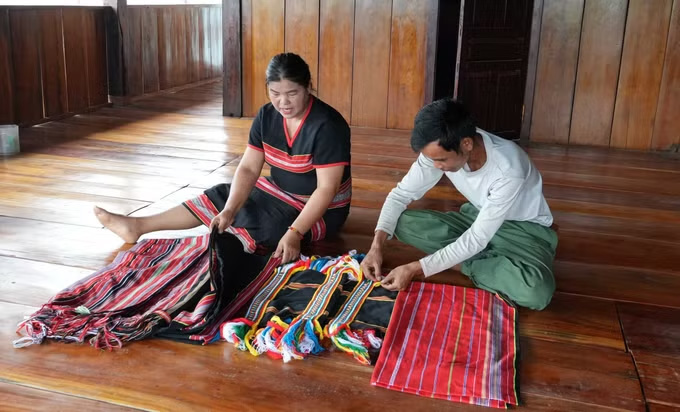
Ms. Thuong once opened a teaching class with nearly 20 people attending, but gradually only a few people left because of low income and patience-requiring work. "I am happy that the profession is recognized, but worried it will fade away," she shared.
In Dak Rang village, Duc Nong commune - which was recognized as a community tourist village at the end of 2023 - weaving is still maintained, associated with tourism experiences. Tourists can buy brocade, musical instruments, and can wine made by locals. However, according to Ms. Y Loan, although she knew how to weave from the age of 13, she now only does it when there are orders because the price is low and labor-intensive. "Brocade is still needed in festivals and weddings, but young people are no longer interested," she said.
Faced with this situation, the local government has issued many conservation orientations. Mr. Huynh Ngoc Ly - Vice Chairman of Dak Mon Commune People's Committee - said that the whole commune has 18 villages, of which 16 villages are Gie - Trieng people. Currently, there are 3 weaving models in Ri Met, Prong Met, Dak Po with about 50 participants. Although not yet producing on a large scale, groups are being oriented to link up for development.
The commune also promotes product promotion through social networks, fairs, and exhibitions to expand output and increase income during the off-season. At the same time, it will take advantage of capital from national target programs to invest and teach vocational skills to the younger generation.
According to Mr. U Chi Nam - Head of the Culture and Social Department of Duc Nong commune, in the coming time, there needs to be coordination between cooperatives, businesses and weaving groups to consume products, ensure output, create stable income for artisans, thereby preserving the traditional craft of the Gie - Trieng people.


