
Bringing rubber to sloping land in Gia Hoi, Son Luong, and Lien Son communes in Lao Cai province not only greens vacant land but also contributes to solving employment and increasing income for local people, according to the Lao Cai Provincial Electronic Information Portal.
On previously ineffective cultivated land areas, the green color of rubber forests is gradually being replaced. Through the linkage between the government, businesses and people, the rubber area of the whole region reached about 2,300ha, of which more than 2,200ha has been used for latex exploitation. This is an important shift in the direction of agricultural economic development in highland communes.
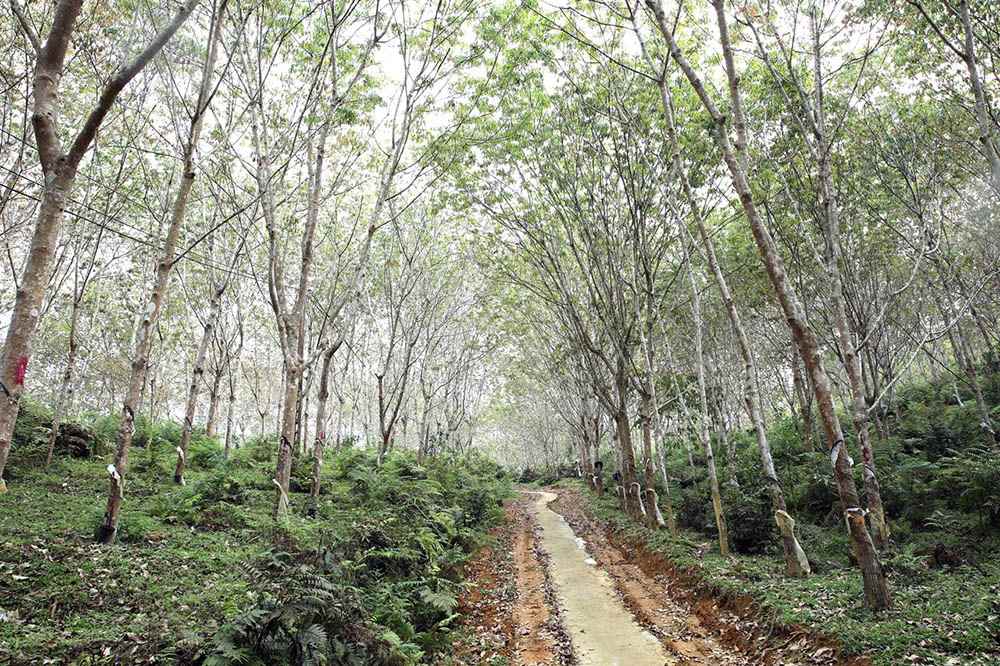
For sustainable development, Yen Bai Rubber Joint Stock Company implements many synchronous solutions. In the basic construction phase, businesses intercrop medicinal plants to take advantage of land and increase economic efficiency.
At the same time, the company focuses on pest and disease prevention, especially white pollen disease, to protect the leaf set and not affect the yield and quality of the garden. The latex shaving process is strictly implemented, ensuring long-term effective exploitation.
On average, each year, Yen Bai Rubber Joint Stock Company exploits nearly 1,800 tons of fresh latex, equivalent to about 920 tons of dry latex, achieving revenue of over 40 billion VND and contributing 1.5 billion VND to the state budget. All fresh latex products are consumed by Vietnam Rubber Group, contributing to stabilizing output for businesses.
Right from the beginning of the year, the company assigned specific tasks to each production team, focusing on caring for, weeding, and fertilizing to help plants grow well. Technical training on latex tapping is organized before each harvest season. In parallel, technical inspection is maintained regularly to ensure that the harvest process meets standards.
Mr. Diep Trung Tin - Head of Technical Planning Department, Yen Bai Rubber Joint Stock Company - said that the unit regularly inspects the shaving shell and shaving mouth at teams to maintain long-term exploitation capacity. Along with that, the company focuses on repairing the logging road system, creating favorable conditions for travel, exploitation and latex harvesting.
Not only bringing economic efficiency, rubber trees also create stable jobs for about 300 local workers, with an average salary of over 5 million VND/person/month.
According to Mr. Lo Van Doi - a company worker, latex mining is relatively light, does not require high technology, and workers can still take advantage of time to do other jobs such as caring for and harvesting tea.
Attached to the profession for more than 10 years, Mr. Doi and many workers in Gia Hoi commune have stable incomes, gradually improving their lives. People expect the company to continue to expand the rubber planting area to create more long-term jobs.
In 2026, Yen Bai Rubber Joint Stock Company sets a production target of 920 tons, with a yield of 0.41 tons/ha. To complete the plan, the company conducts a review of each batch of trees, classifies them according to exploitation capacity, and assigns specific targets to each team, group and worker. The output is monitored weekly and monthly for timely adjustment. At the same time, the enterprise develops a harvest schedule suitable for the season, strengthens technical inspection and proactively prevents and controls diseases.
Reality shows that rubber trees on sloping land are opening up new directions in sustainable agricultural development in highland communes. This model not only effectively exploits land potential but also contributes to improving people's lives and ensuring social security in the area.


