
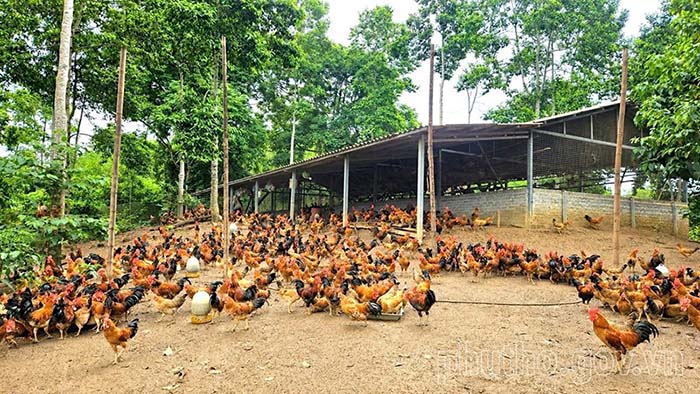
From 3 hectares of barren rocky hills, after more than 5 years of renovation, the land of Mr. Bui Van Lanh's family (in group 8, Thong Nhat ward, Phu Tho province) has gradually become an effective production model. Grapefruit, cypress, and gourd are intercropped; under the canopy are chicken and pig farming areas; water surface raises fish and stuffed snails. Elephant grass, bananas, and cassava are planted to proactively provide some food for livestock.
Livestock waste is collected, treated, and composted into fertilizer; crop by-products are used as animal feed. The components support each other, creating a relatively closed production cycle.
Practice in Phu Tho shows that the room for development of circular agriculture is still large. Cultivation alone generates about 2-3 million tons of by-products each year; about 25-30% of livestock waste has not been thoroughly treated. Production is still fragmented, making it difficult to collect, classify, recycle and reuse by-products.
A survey at 68 commune-level administrative units shows that about 48.53% do not have an official circular agriculture model. The rate of reusing crop by-products as organic fertilizer on the spot only reaches 26.17%. The link between circular economy, OCOP and tourism is still weak; the application of science, technology, digital transformation, logistics and preservation is still limited.
To promote this field, Phu Tho has issued the Project "Developing circular agriculture, integrating multi-value for key agricultural products and specialties of the province associated with building OCOP products and agricultural and rural tourism in Phu Tho province in the period 2026 - 2030".
In early July 2026, the Provincial People's Committee issued plan No. 258/KH-UBND to concretize the project. The total estimated cost needs are about 1,060 billion VND, of which the State budget supports 410 billion VND, and socialization sources are about 650 billion VND.
According to Mr. Nguyen Huy Nhuan - Director of the Department of Agriculture and Environment of Phu Tho province, switching to circular agriculture, integrating multi-value is an inevitable trend, aiming to shift from output thinking to agricultural economic thinking.
By 2030, the province aims for at least 70% of key crop by-products to be collected and reused; 60% of households and 100% of livestock farms to treat and reuse waste; 50% of forestry and aquatic by-products to be reused; the rate of organic fertilizer use to reach at least 30%.
Vice Chairman of Phu Tho Provincial People's Committee Dinh Cong Su emphasized that circular agriculture, integrated multi-value, associated with tourism and OCOP is an urgent requirement, contributing to restructuring the economic space, optimizing resources and developing ecological, modern, and sustainable agriculture.


