
With prices always at a high level, durian is a crop that brings economic value to many localities, causing many people to change jobs to "eat along". Pointing out early signs of 7 important pests and diseases on trees helps new gardeners join the game, promptly handle, limit damage, and increase profits.
Root rot - a major danger to durian gardens
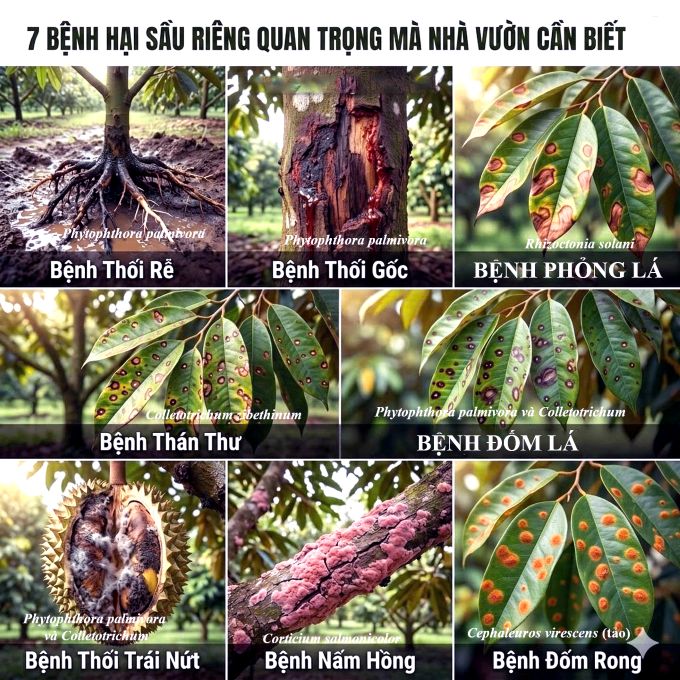
The disease is usually caused by Phytophthora palmivora fungus and is considered one of the dangerous diseases for durian. It often appears in gardens with low soil, poor drainage or after prolonged rains. When infected, the roots turn dark brown, soft and gradually rotten. The plant cannot absorb nutrients, so it grows slowly, leaves turn yellow and fall off a lot. If the disease is severe, the plant may die in a short time. To limit diseases of durian trees, gardeners need to pay attention to designing a good drainage system, and at the same time improve the soil with organic fertilizers and biological preparations to enhance beneficial microorganisms.
Root rot – signs of sap flowing on the body
The disease is caused by Phytophthora palmivora fungus, the disease usually appears in the trunk near the ground surface. The easily recognizable sign is that the trunk skin is dark black, cracked and oozing reddish-brown resin. The disease causes the internal wood tissue to gradually rot, causing the plant to weaken and develop poorly. If not treated promptly, the disease can spread around the trunk, causing the plant to die dry. An effective preventive measure is to keep the base of the plant always ventilated, avoid leaving mud clinging to the trunk, and regularly check the garden to detect early abnormal signs.
Leaf burns and anthrax – common diseases on leaves
The disease is caused by Rhizoctonia solani fungus, often appearing in humid garden conditions, dense canopy or lack of light. Light brown spots appear on the leaves, then spread to dry burn patches, reducing the photosynthetic area of the plant. Anthrax is caused by Colletotrichum zibethinum fungus. Round or oval dark brown spots appear on the leaves, the middle part may be dry and torn. When the disease is severe, the leaves turn yellow and fall off early.
Both of these diseases develop strongly in high humidity conditions, so pruning branches to create a ventilated canopy and regular garden cleaning are very necessary.
Leaf spots – easily confused signs
The disease is often caused by many agents, commonly a combination of Phytophthora palmivora and Colletotrichum fungus. The spots are brown or dark brown, round or uneven, appearing scattered on the leaf surface. When the disease develops strongly, the spots fold together into large patches, causing the leaves to dry and fall off. Careful observation of the shape and spread of the spots will help gardeners accurately identify them to have appropriate treatment directions.
Fruit rot – direct damage to yield
The disease is caused by Phytophthora palmivora and Colletotrichum fungi. When infected, the fruit appears with soft, dark brown rotten areas. In humid conditions, the surface of the fruit may appear with a white-gray fungus layer. The infected fruit is prone to cracking, premature shedding or complete rot, causing significant damage to gardeners. Keeping the garden ventilated, monitoring regularly and treating the diseased fruit early will help limit the risk of spread.
Pink fungus and seaweed spots – diseases that arise during the rainy season
The disease is caused by Corticium salmonicolor fungus, which usually appears on branches and stems. Initially, the fungus layer is white, then turns characteristic pink. The diseased branch can gradually dry out and die if not treated promptly. Meanwhile, seaweed spots are caused by Cephaleuros virescens algae, forming orange or brick red round spots on the leaves. The disease is common in gardens with high humidity and thick canopies.
According to MSc Nguyen Phuoc Tuyen, former Director of the Dong Thap Provincial Agricultural Extension Center, agricultural experts have concluded that most pests and diseases on durian develop strongly in damp and unventilated garden conditions. Therefore, in the context of many unseasonal rains such as today, gardeners need to pay attention to drainage systems, pruning branches to create reasonable canopies, applying balanced fertilizers and regularly checking gardens to detect early signs of disease, thereby effectively protecting the yield and lifespan of garden trees.

