
In Hai Hau land (Ninh Binh province), an ancient structure with a rare beauty is preserved, namely the Cho Luong tiled bridge. The bridge has a soft appearance like a carrying pole, curved like a dragon's body.
The bridge spans the Trung Giang River with year-round blue water, built in 1511 during the Later Le Dynasty. After more than 5 centuries and many restorations, the project still retains its inherent ancient and rustic beauty. In 1990, the bridge was recognized as a National Historical and Cultural Relic.
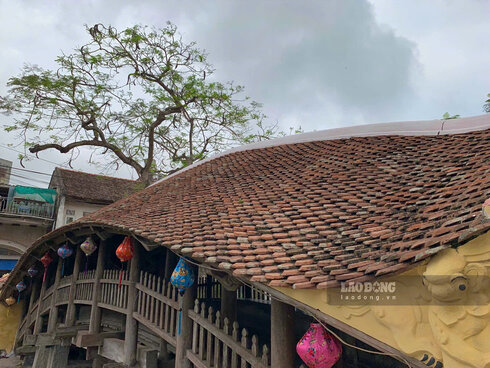
According to documents recorded on the bridge deck, the structure was built during the reign of King Le Hong Thuan. The special feature lies in the "thượng gia hạ kiều" architecture - above is the house, below is the bridge, a rare structure.
Initially, the bridge was roofed with paving leaves, later replaced by tiles through major repairs in 1922 and 2011. Despite many upheavals, the original architectural form is still preserved almost intact.
The bridge roof is tiled with dragon scales, designed in the traditional 3-compartment house style of the Northern region. The frame below includes ironwood columns tightly connected to the bridge body and 2 gates at both ends.
The bridge has a total of 9 sections curved like a dragon's body, supported by 40 solid ironwood pillars. Below are 18 large square stone pillars, divided into 6 rows, each row with 3 pillars. Above the stone pillars is a system of wooden beams supporting the entire floor and roof.
The bridge deck is about 2m wide, assembled from 66 ironwood bars placed on a curved beam system. Small wood bars are rounded to create raised curves, helping passersby avoid slipping. On both sides are curved corridors along the bridge body, inside paved with planks, and outside are elaborately carved railings with 162 horizontal lacquered boards.
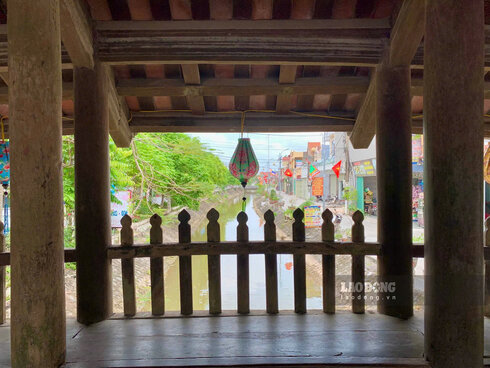
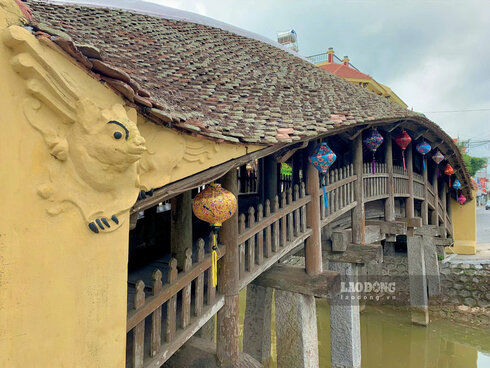
To create 9 bridge compartments, the ancients built 10 because of beams and a solid beam system. The tiled roof is roofed according to the half-roofing half-construction technique, creating tightness and soft curve, evoking the image of flying dragons.
At both ends of the bridge, there are also 4 nghê standing guard, along with a wooden structure system including beams, horizontal bars, longitudinal bars..., delicately crafted and articulated with traditional wooden tubes.
In the middle of the bridge is placed a letter engraved with 4 Han characters "Quan Phuong xa kieu", mentioning the ancient name of this land. At both ends of the bridge are still preserved many ancient parallel sentences, reflecting the life and spirit of Northern residents in the past.
Near the bridge are Luong market and Luong Pagoda, buildings of the same age, creating a unique cultural and religious living space of the Son Nam Ha region. This used to be a place for trade, meetings and community connection.
Cho Luong tiled bridge was built by 4 families reclaiming land in the ancient Quan Anh region. The project was once bestowed by King Le with 4 words "My tuc kha phong", recognizing the cultural value and good customs of the locality.
In the saying "South Bridge, North Pagoda, Doai Pagoda", Luong market tiled bridge is a typical symbol of the Southern region.
With the talent of carpenters and porters, the bridge is both a transportation project and a unique cultural symbol, and a source of pride for the people of ancient Quan Phuong and Hai Hau today.


