
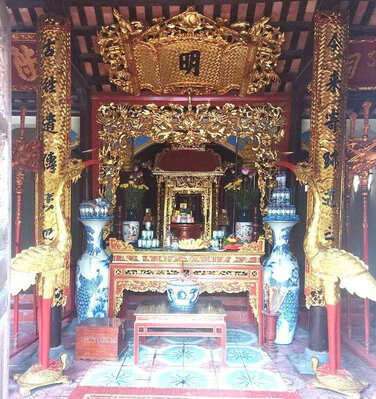
Quang Cu Temple is one of 2 relics in Le Ich Moc ward (Hai Phong city), built to commemorate Trang Nguyen Le Ich Moc - the first person to achieve the highest score in this land.
Le Ich Moc (1458 - 1538) was born in Rang village, Kinh Mon prefecture, former Hai Duong town, now Le Ich Moc ward (Hai Phong city). According to the History of the Party Committee of Hai Phong City, from a young age, he was famous for being intelligent, hardworking and studious.
In deprived conditions, he spread sand on a tray to practice writing, diligently studying scriptures day and night. In just 5 years, he mastered the teachings of Buddhist scriptures, and his reputation spread throughout the region.
In the spring of the year Nham Tuat (1502), under the reign of King Le Hien Tong, he took the imperial examination and passed the Trạng nguyên exam out of 61 successful candidates, then held the position of Ta Thi Lang.
When the Mac dynasty replaced the Le dynasty (1527), he resigned and returned to his hometown. Here, he renovated Rang Pagoda, named it Dien Phuc Tu (now Quang Cu Temple), and at the same time opened a school to teach, contributing to training talents for the locality. Since then, this place has become a center of education and learning for the whole region.
Not only focusing on education, Le Ich Moc also worked with the villagers to reclaim the swampy land along the river, planting forests, especially the green ironwood forest, and local people benefited from it from generation to generation.
He passed away on February 15th of the lunar calendar in 1538, at the age of 80. To commemorate his merits, people built a temple to worship him, preserving the image of a talented and exemplary person for posterity.
Although not large in scale and with simple architecture, Quang Cu Temple still carries many typical values, and is a valuable document for learning about Hai Phong's academic traditions. In 1992, the relic was ranked as a historical and cultural relic.
According to local documents, the temple is ancient, and was restored in 1991 and 2020 with traditional ironwood.
The project has an area of more than 3,200 m2, with a Dinh-shaped layout including 3 front hall compartments and 1 rear palace compartment, facing South. The ancient nose-shaped tiled roof creates a space that is both solemn and close to Vietnamese villages.
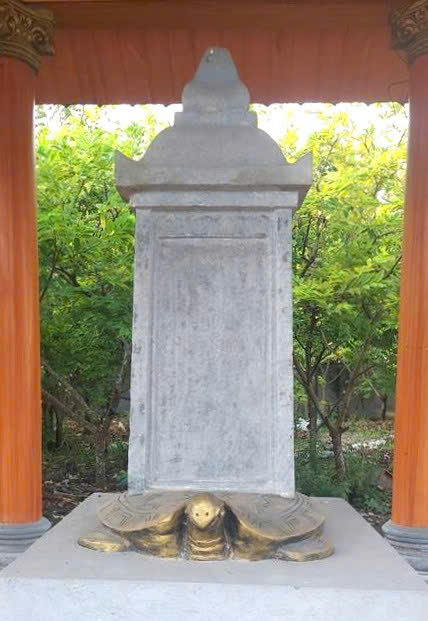
Currently, the temple still preserves some artifacts such as bronze bells, incense burners, wooden beds, bowls, altars and statues of Trang Nguyen Le Ich Moc. In particular, the ancient stele "Ho Than" erected in 1822 is still intact in the campus.
Every year, the Quang Cu Temple festival takes place on November 8th and January 9th of the lunar calendar, with many traditional activities such as procession of spirits, Chinese chess, cockfighting, volleyball, Cheo singing..., attracting a large number of people and tourists.
Along with the memorial area of Trang Nguyen Le Ich Moc, Quang Cu Temple is not only a spiritual living space but also contributes to preserving and spreading the spirit of studiousness and the will to rise up among the people.


