
Dong Quan Pagoda, with the character name Bao Quang Tu, located in Vinh Thuan commune, Hai Phong city, is one of the ancient pagodas with a long history in the coastal region of the North. According to documents, the pagoda was built before 1572, under the reign of King Mac Mau Hop, the 5th king of the Mac Dynasty.
Legend has it that this work was built by the two fathers and sons Thanh Hoang of Pham An Khe and Pham Viet Kinh village, with the contribution of the Mac royal family and local Buddhists.
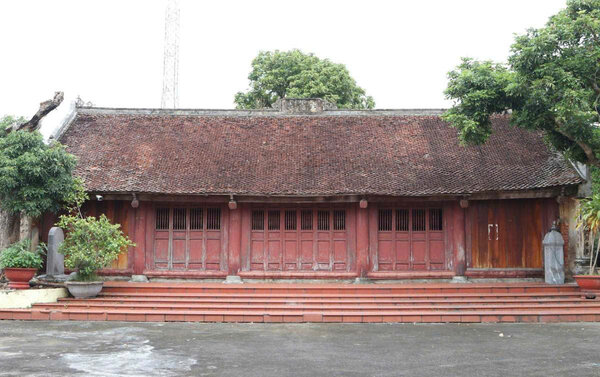
Materials such as wood and stone are transported from the capital Thang Long by river to gather in the Southeast area of Dong Quan village.
In the early days, the pagoda was large-scale with many items including 1 upper hall, 3 front halls, 3 incense burning halls, 7 rear halls. However, through historical changes, the structure no longer maintained its original state.
Currently, the pagoda still has the front hall, the Buddhist hall with the architecture of the Dinh character, along with the ancestral house and guest house that were restored later. However, this is still one of the few relics bearing the imprint of Mac dynasty religious architecture still existing in Hai Phong.
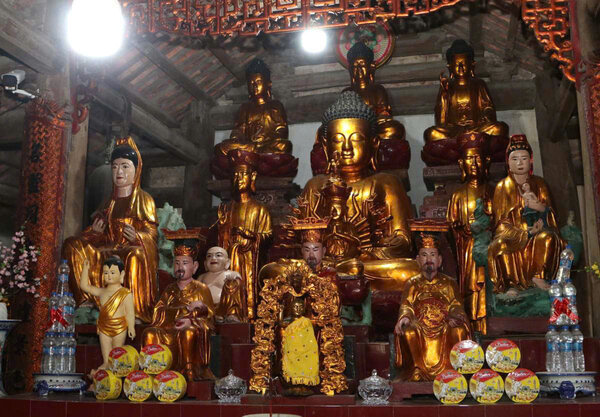
Inside the Buddha hall, the system of statues is arranged in tight layers with 4 main rows of statues. At the top is the set of Tam The statues, followed by the statues of Amitabha, Jade Emperor and Nam Tao - Bac Dau, and below is the Nine Dragons tower and the statue of Thich Ca the newborn.
On both sides of the Three Jewels are placed the Ten Palaces of Minh Vuong set of 10 earthen statues, more than 1 meter high, shaped in the position of setting up the court.
In addition to the main statues, the pagoda also preserves many unique sculptures such as the statue of the Three Ancestors Huyen Quang in the style of Bodhisattva Samantabhadra, clearly reflecting the art of Buddhist sculpture of the Mac dynasty in the 16th century.
Notably, in the two chambers, a pair of Ho Phap statues, the diamonds protecting the Dharma, are placed. Based on the shaping style and dragon motifs on the armor pillars, researchers believe that these two statues date back to the early 18th century, belonging to the group of earliest earthen Ho Phap statues still existing in Vietnam.
Not only has architectural value, Dong Quan Pagoda also preserves two ancient stone steles, both original steles. Among them, the "Bao Quang Tu Chung Bi Ky" stele is large in size, exquisitely decorated with the image of a dragon worshiping the moon on the stele's forehead, along with a system of vine patterns and soft lotus petals.
The content of the stele is engraved in Han characters, recording the list of people who contributed to building the pagoda.
The second stele named "Hau Phat Bia Ky" is larger in size, although many words are blurred, it is still a valuable source of documents. Behind the pagoda, there are currently two stupas Quang Minh and Hien Linh, where the remains of the ancestors are kept.
Today, Dong Quan Pagoda is still an important cultural and religious space for local people. Every year, on the 10th day of the first lunar month, the pagoda organizes a festival with the procession ritual from the communal house and temple to the pagoda, along with many folk activities such as Chinese chess, cockfighting, swinging.
In particular, the banh day making contest is maintained as a traditional beauty, expressing gratitude to Thanh Hoang and the desire for a prosperous harvest.
With outstanding historical, architectural and cultural values, Dong Quan Pagoda has been recognized as a National historical and cultural relic since 1992.


