
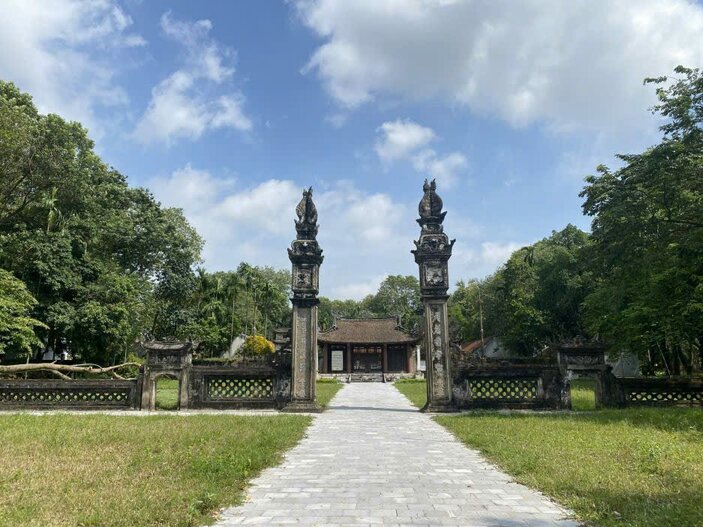
Quan Gia communal house is located in the green space of Gia forest, belonging to Duong Hoa commune (Hanoi). According to legend, this place has existed for more than a millennium and is associated with the homeland of General Ly Phuc Man - who made great contributions to helping King Ly Nam De build Van Xuan, the first independent state in the nation's history.
In the 542 uprising, Ly Phuc Man was one of the key generals who drove out the Luong army, contributing to bringing Ly Nam De to the throne. After that, he was assigned to guard the South, continuing to make many feats of arms, including defeating the Lam Ap invaders.
He was also married to a princess by the king and granted national status. In 544, in the battle to protect To Lich citadel, he bravely sacrificed himself.
To commemorate his merits, people buried him in the Holy Tomb area, near Ma Lake. After a long period of time, this area became a forbidden forest and a temple was built. Not only in Yen So, many villages along the Day River also worship Ly Phuc Man as Thanh Hoang, creating a large religious space in the ancient Doai region.
According to records in "Viet Dien U Linh", from 1016, King Ly Thai To ordered the construction of a temple here. By the Tran Dynasty and the following centuries, the communal house continued to be expanded with many items such as the front hall, corridor, three-entrance gate... Although it was destroyed in 1947, the work was restored and preserved by the people.
Currently, Quan Gia communal house has the shape of traditional architecture with the layout "Nội Công, ngoại Quốc". The main items include nghi môn, communal house yard, two rows of left and right palms, front hall, great shrine and rear palace. The main materials are bricks and wood, with many exquisite carved details such as dư head, vi kèo, dragon shapes in ancient style.
The relic still preserves many precious artifacts. Prominent are 43 terracotta panels on the inner three-entrance wall with living themes and mascots.
Besides, there is a system of steles from the 17th to the 19th centuries, recording the merits of Ly Phuc Man and the restorations of the communal house. In the rear palace, there are currently 3 ancient statues, along with many valuable worship items such as wooden palanquins, bronze horses, and Nguyen Dynasty incense altars.
Not only possessing historical and architectural value, Quan Gia communal house is also a community cultural activity center. Every year, from March 10 to 16 of the lunar calendar, the Gia festival is held with traditional procession and worship rituals, attracting a large number of people and tourists.
With typical values, Quan Gia communal house has been recognized as a National historical and cultural relic since 1994, becoming a unique destination in the heart of Hanoi.


