
According to information from Sciencealert, a mysterious architectural work has just been discovered under the ruins of the ancient city of Tell el-Fara'in, also known by ancient names such as Per-Wadjet or Buto, in the Nile Delta.
This city has a history of nearly 6,000 years, once an important religious center worshiping the snake goddess Wadjet. Throughout the ages, the area was continuously built, destroyed and rebuilt before being abandoned around the 7th century.
Due to the complex terrain with many layers of mud, groundwater and overlapping remnants, excavation using traditional methods faces many difficulties. The research group led by Mohamed Abouarab of Kafrelsheikh University used satellite radar technology and resistance measurement methods to survey deep underground.
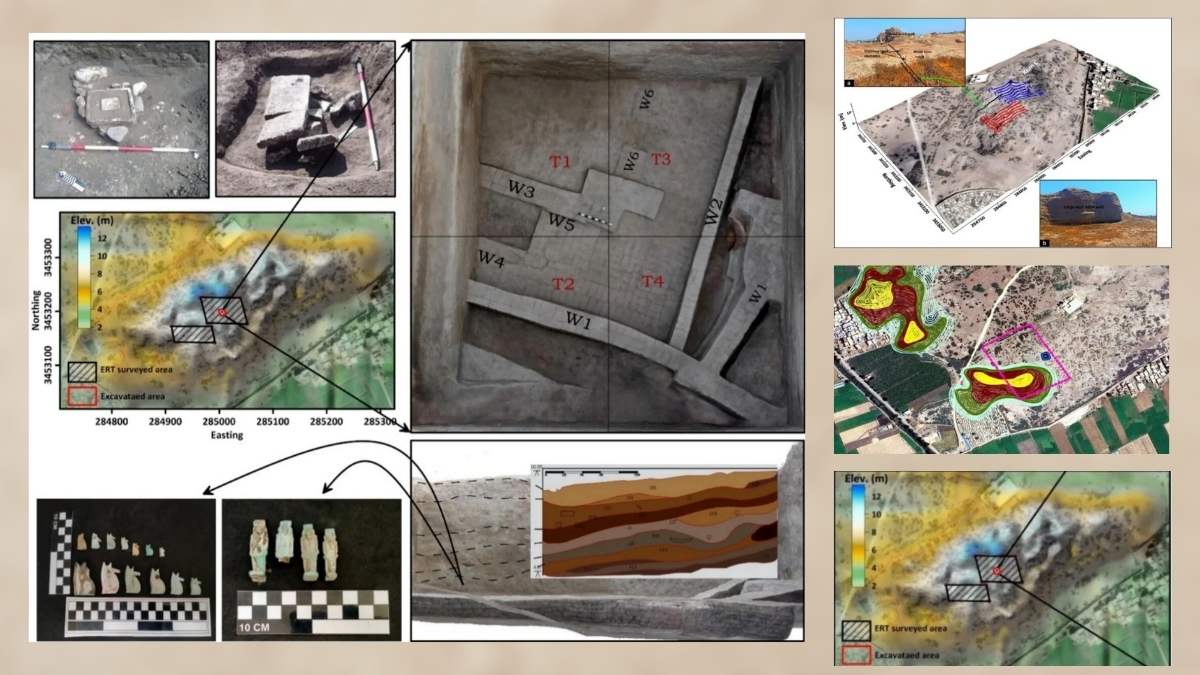
Data from the Sentinel-1 satellite helped identify major anomalies, then the team conducted detailed measurements in the Kom C area. More than 1,300 measurements revealed a mud brick structure, about 25 x 20 meters in size, located 3 to 6 meters deep underground.
Subsequent excavations confirmed that the structure dates back about 2,600 years, belonging to the Saite dynasty - the 26th dynasty of ancient Egypt, before being conquered by the Persian Empire.
At the scene, archaeologists found many mud brick walls and artifacts of spiritual significance such as amulets and small statues. Some artifacts depict famous gods such as Isis, Horus and Taweret.
Notably, the research team discovered a hybrid statue combining the characteristics of baboons, falcons and the dwarf god Patikos, showing the diversity in beliefs during this period.
Based on the artifacts, scientists believe that the structure may have been a temple, religious complex or the residence of priests. However, the exact function still needs more research time to determine.
This discovery also marks an important step forward in combining remote sensing technology and geophysics in archeology, helping to discover buried structures without large-scale excavation.
The research team hopes that in the next surveys, more ancient structures may be discovered, even a second temple still deep under the thick clay layer.


