
A national treasure, the statue of two people carrying each other to play the khen, discovered during an ancient tomb excavation in Thanh Hoa, is a typical artifact of Dong Son culture.
In the first National Treasure recognition in 2012, this work was placed along with many prominent artifacts such as Ngoc Lu bronze drum, Hoang Ha bronze drum or a kneeling-shaped lantern found in Lach Truong.
According to the National Museum of History, the statue was discovered by Swedish archaeologist Olov Janse in 1935 when excavating the Han tomb area in Lach Truong (Thanh Hoa). The artifact is dating back about 2,500 - 2,000 years, belonging to the Dong Son period.
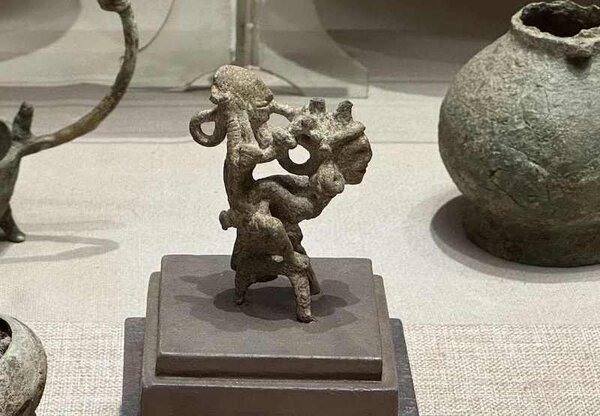
The statue is cast in brass, with a characteristic yellow color, compact size with a height of 8.5cm and a width of 9.5cm. However, the shape still clearly shows the two characters in a moving state of cohesion and vitality.
The special feature is that the statue is cast solidly in a clay mold, without any trace of joining. Artisan Dong Son has processed the structure according to the principle of 3 support points including 2 feet and the tail of the yoke touching the ground, creating a solid position without a support.
The image of the carrier is shown in a bouncing posture, two legs apart, two arms around the back to support the person above. The character sits on his back playing the khen, one hand holding the musical instrument, the other hand leaning on the carrier's shoulder.
Both are wearing scarves, large earrings and trousers, typical details of Dong Son residents.
Unlike many static Dong Son statues, this work stands out for the movement and interaction between the two characters, and is considered one of the most vivid statue blocks left of this culture.
The statue not only shows the sophisticated bronze casting skill but also reflects the complex mold manufacturing technique and the ability to control the temperature when pouring metal. The patterns engraved on hair and hands further show the harmonious combination between shaping and decoration.
In terms of content, the statue represents the real life of Dong Son residents, associated with festival activities and music, and does not contain mythology or religious elements.
The image of playing the khen also shows the important role of this musical instrument in community activities, having appeared on many artifacts such as bronze drums, axes or muôi handles.
To this day, khen is still widely used in the cultural life of many ethnic groups such as H'Mong, Muong or Central Highlands communities, showing the continuation of tradition over thousands of years.
Although many Dong Son relics have been excavated, the statue of two people carrying each other playing the khen is still a unique artifact, without a similar replica. The value of the statue lies in both technique, art and documents about the spiritual life of ancient Vietnamese residents.
On October 1, 2012, the artifact was recognized by the Prime Minister as a National Treasure under Decision No. 1426/QD-TTg.
Currently, the statue is kept and displayed at the National Museum of History (No. 1 Trang Tien, Hanoi), in a thematic space about Dong Son culture.


